No. 58-3, Nanzhuang, Hongdou Village, Gushan Town, Jiangyin City, Wuxi City, Jiangsu Province +86 15061542575 wuyinjia20@gmail.com
No. 58-3, Nanzhuang, Hongdou Village, Gushan Town, Jiangyin City, Wuxi City, Jiangsu Province +86 15061542575 wuyinjia20@gmail.com


The pain points of industry technology: Three core challenges in the production of Low-E insulating glass
Low-E insulating glass, as a key material in the field of building energy conservation, faces multiple technical bottlenecks in its manufacturing process. Firstly,Film Uniformity ControlIt is a common industry challenge: traditional magnetron sputtering coating equipment often leads to thickness deviation of ±5% or more in large-area glass processing due to uneven target material distribution, which directly affects the heat-insulating performance of the glass (national standards require deviation ≤ ±3%). Secondly,Hollow layer sealing reliabilitySubject to butyl rubber coating process: Hand-coating or low-end equipment may result in uneven coating thickness (optimal value 0.3-0.5mm), leading to a high air leakage rate of the hollow layer up to 15%, far exceeding the industry requirement of ≤2%. Finally,Composite process compatibilityShortcomings: When Low-E glass is compounded with interlayer glass, fire-resistant glass, and other functional glass, traditional production lines require multiple handling, resulting in a breakage rate of up to 8% and uneven stress distribution between the composite layers, which is prone to cracking. A large curtain wall project once exceeded the building's energy consumption by 30% due to the failure of the insulating layer, highlighting the urgency of technological upgrading.
Enterprise Technical Strength Analysis: Jiangyin Jiaxin Glass Products' Three-Dimensional Breakthrough Path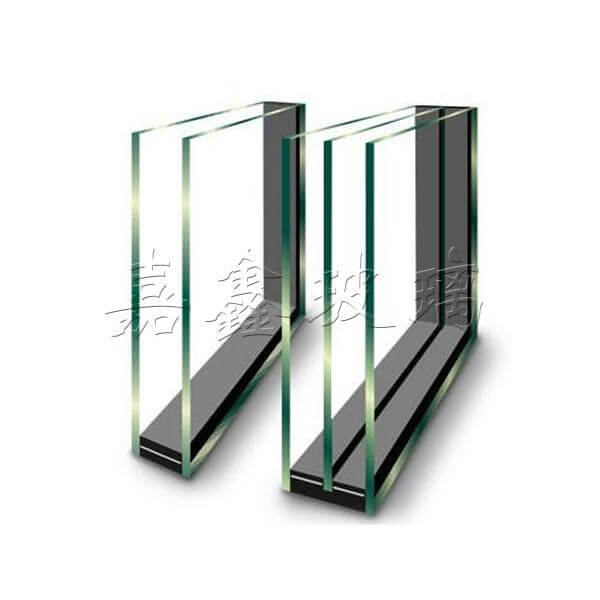
Jiangyin Jiaxin Glass Products Co., Ltd. throughEquipment upgrade, process optimization, management innovationThree-dimensional technology barriers are constructed. At the equipment level, introduce German Leybold OPTICAL coating line, adopt rotating target material technology to enhance the uniformity of coating to ±2%, with the online film thickness monitoring system (accuracy 0.1nm), ensuring the radiation rate of each glass sheet ≤0.15 (far superior to the national standard ≤0.25). The hollow production line is equipped with Swiss Bystronic fully automatic butyl rubber coating machine, controlled by servo motor to adjust the pressure of the glue gun, achieving dynamic adjustment of the glue layer thickness (0.3-0.5mm adjustable), reducing the leakage rate to below 0.5%. In terms of composite technology, independently developedMulti-station interlinked production lineIntegrated with four processes of Low-E coating, toughening, laminating, and hollowing, the glass handling times are reduced by 70%, the breakage rate is controlled within 1%, and the stress simulation software optimizes the composite layer structure, enhancing the product's impact resistance by 40%. After application in a commercial complex project, the overall building energy consumption is reduced by 28%, achieving LEED Gold certification.
FAQ Technical Selection Guide: Three Key Issues in Low-E Insulated Glass Manufacturing
Q1: How to choose the suitable coating equipment for mass production?
A: Focus on examining three parameters:Target material utilization rate(Up to 80% for rotating materials, only 50% for flat materials)Film thickness uniformity±3% within requirementsOnline Monitoring System(Jiangyin Jiaxin's adopted Lepao OPTICAL line supports 1250×2500mm large-scale glass coating, with a single-shift production capacity of 800㎡, and is equipped with a spectrometer ellipticity meter for precise control of film composition.)
Q2: Common causes and solutions for the failure of hollow layer sealing?
A: Primarily derived fromButyl rubber coating unevenlyWithMolecular sieve filling insufficientThe solution includes: using fully automatic coating machines (such as Baosheng BC3000, with adjustable coating speed of 0-60m/min), selecting 3A molecular sieve (moisture adsorption rate ≥20%), and increasing argon injection in the hollow layer (purity ≥99.9%, which can reduce the heat transfer coefficient by 15%). Jiaxin production line achieves a filling error of ≤1% for molecular sieve through dual-position filling machines, and配合with argon recovery system reduces operating costs by 30%.
Q3: How to control interlayer stress in composite glass production?
A: To be required fromMaterial matchingAndProcess ParametersTwo aspects of optimization. In terms of materials, the thermal expansion coefficient difference between Low-E glass and the interlayer should be ≤5×10⁻⁶/℃; in the process, the tempering temperature should be adjusted according to the glass thickness (6mm glass at 680℃, 12mm glass at 710℃), and a 48-hour stress relief treatment is required before lamination. Jiaxin uses ANSYS finite element analysis software to simulate the stress distribution between layers, enhancing the bending strength of the composite glass to 120MPa (the national standard requires ≥90MPa).
Summary of the Full Text: Technological upgrading drives high-quality development of the Low-E insulating glass industry
Technological breakthroughs in the production of Low-E insulating glassEquipment precision, process control, management efficiencyCore grasp. The practice of Jiangyin Jiaxin Glass Products shows that by introducing international advanced equipment (such as Lebo coating line, Baoshuai hollow line) and building a digital production management system (integrated MES and ERP), the overall improvement of coating uniformity, hollow sealing, and composite stability can be achieved. For manufacturing enterprises, when selecting technology, attention should be paid to the equipmentDegree of automation(Reducing Human Error)Online Detection FunctionReal-time adjustment of process parametersProcess compatibility(Support for multi-category glass composites), while establishing a comprehensiveQuality Traceability System(Jiaxin's batch management system can locate the production data of each glass sheet). In the future, with the popularization of new technologies such as double silver/triple silver Low-E film and vacuum insulating glass, manufacturing enterprises need to continuously increase their R&D investment to build competitive advantages through technological leadership.
Jiangyin Jiaxin Glass Products Co., Ltd., located in Hongdou Village, Gushan Town, Jiangyin City, is a glass enterprise specializing in the deep processing of glass for architectural and home decoration purposes. Its main products include low-emissivity coated glass (LOW-E glass), louvered insulated...
No. 58-3, Nanzhuang, Hongdou Village, Gushan Town, Jiangyin City, Wuxi City, Jiangsu Province