No. 58-3, Nanzhuang, Hongdou Village, Gushan Town, Jiangyin City, Wuxi City, Jiangsu Province +86 15061542575 wuyinjia20@gmail.com
No. 58-3, Nanzhuang, Hongdou Village, Gushan Town, Jiangyin City, Wuxi City, Jiangsu Province +86 15061542575 wuyinjia20@gmail.com


Introduction: The Deep Integration of Building Energy Efficiency and Glass Technology
With the advancement of green building standards, low-emissivity coated glass (LOW-E glass) has become a core material for energy efficiency in buildings due to its exceptional thermal insulation properties. Leveraging 15 years of experience in deep processing, Jiangyin Jiaxin Glass Products Co., Ltd. has established a comprehensive technological system in the field of LOW-E glass by introducing international advanced equipment and developing proprietary technologies. This article will analyze, from three perspectives—technical principles, corporate capabilities, and application cases—how Jiaxin Glass has achieved dual breakthroughs in energy efficiency and product quality through technological innovation.
Key words:Low-emissivity coated glass (LOW-E glass), building energy efficiency, Jiangyin Jiaxin Glass Products, technical parameters, application of laminated glass
Opening on Industry's Technical Pain Points: Energy-saving Bottleneck of Traditional Glass
The heat transfer coefficient (U-value) of traditional single-pane glass can reach as high as 5.8 W/(m²·K), resulting in an indoor heat loss rate exceeding 30% in winter and a 25% increase in air conditioning energy consumption in summer. Even with ordinary insulating glass, its U-value struggles to fall below the threshold of 3.0 W/(m²·K), failing to meet the requirement of "improving the thermal performance of building envelopes by 20%" specified in the Green Building Evaluation Standards. Additionally, traditional coated glass suffers from technical drawbacks such as easy oxidation of the coating layer and difficulty in balancing light transmittance with thermal insulation, limiting its application in high-end architectural fields.
STEP 1: Breakthrough in Technical Principles
LOW-E glass forms a high-reflective barrier against infrared rays by depositing multiple layers of metal oxide films (such as silver, tin oxide, etc.) on the glass surface. Its core principle lies in that when solar radiation (with a wavelength of 0.3-2.5 μm) strikes, the film layer allows visible light (0.38-0.78 μm) to pass through while reflecting over 90% of mid- and far-infrared rays (2.5-25 μm), thereby reducing heat transfer. Jiangyin Jiaxin employs magnetron sputtering coating technology, achieving a film thickness error of ≤2 nm by precisely controlling the power density (≥50 W/cm²) of the sputtering target material and the gas partial pressure (Ar:O₂=9:1), ensuring optimal spectral selectivity.
STEP 2: Quantification of Performance Parameters
The LOW-E glass produced by Jiaxin has been tested by the National Glass Quality Supervision and Inspection Center, with a heat transfer coefficient U-value as low as 1.2 W/(m²·K), an adjustable shading coefficient Sc ranging from 0.2 to 0.7, and a visible light transmittance Tv of ≥70%. In an insulating structure consisting of 6mm single-pane glass + a 12mm air gap + 6mm LOW-E glass, its sound insulation performance reaches 35dB, and its wind pressure resistance strength reaches Class 9 (5.0kPa), fully meeting the requirements of the GB/T 11944-2012 standard.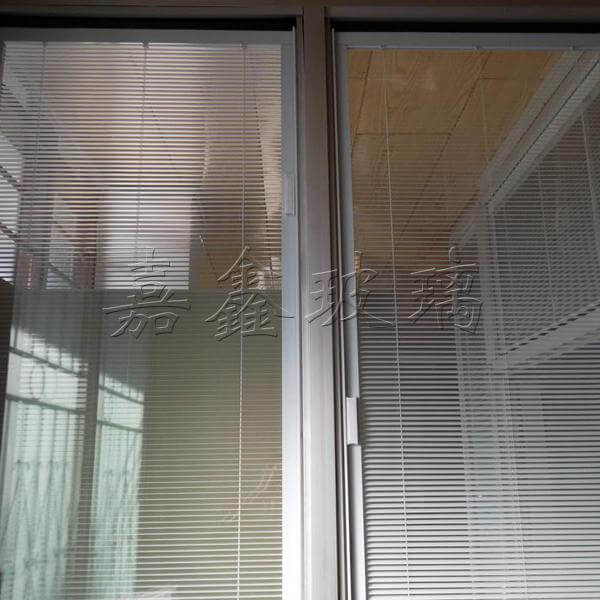 STEP 3: Advantages of Composite Technology
Jiaxin combines LOW-E glass with tempering and laminating processes to develop a composite glass product known as "LOW-E + tempered + PVB laminated" glass. This product achieves tempering through rapid cooling at high temperatures (sudden cooling from 650°C to 70°C) and then combines a 0.76mm PVB film with the glass via vacuum lamination (at 130°C and 1.2MPa). It retains the energy-saving properties of LOW-E glass while offering enhanced performance, including an impact resistance strength of ≥120J (national standard requires ≥45J) and a fire resistance integrity of ≥60 minutes (Class E fire protection standard). It is widely used in curtain walls, skylights, and other applications.
Introduction to the company's technological capabilities: A full-chain upgrade from equipment to management
Jiangyin Jiaxin Glass Products Co., Ltd., located in Hongdou Village, Gushan Town, Jiangyin City, boasts a modern factory spanning 30,000 square meters and is equipped with two German Leybold magnetron sputtering coating production lines, achieving an annual production capacity of 2 million square meters. The company's technical team is led by 12 senior engineers, three of whom are certified as national registered structural engineers, and has spearheaded the development of five utility model patents, including the "Low-Emissivity Film Uniformity Control Process."
STEP 1: Equipment Investment and Precision Control
The Leybold OptiRun S800 coating equipment introduced by Jiaxin is equipped with eight cathode target positions and a closed-loop feedback control system, enabling real-time monitoring of key parameters such as film thickness (resolution of 0.1 nm) and deposition rate (±0.5 Å/s). During production, the glass transmission deviation is controlled within ±0.5 mm through an automatic alignment correction system, ensuring film uniformity of ≥95% and increasing the product qualification rate to 99.2%.
STEP 2: Management Mode and Quality Traceability
The company adopts the ISO 9001:2015 quality management system, implementing batch management for raw materials (such as float glass substrates and high-purity silver targets), with each glass sheet accompanied by a unique traceability code. Through the MES production execution system, data from the entire process, ranging from cutting and edge grinding to coating, is recorded, enabling the identification and rectification of quality issues within two hours. In 2023, Jiaxin's LOW-E glass achieved a customer complaint rate of less than 0.3% in the centralized procurement by real estate companies such as Vanke and Country Garden, ranking among the top in the industry.
STEP 3: Technological Layout and Industry Impact
Jiaxin continues to invest in R&D and launched "double-silver LOW-E glass" in 2024. By superimposing two silver film layers, the U-value is further reduced to 0.8 W/(m²·K), making it suitable for ultra-low-energy-consumption buildings. Currently, the company has participated in the compilation of three local standards, including the "Green Building Design Standard of Jiangsu Province," and collaborated with Southeast University on the research project of "photovoltaic and LOW-E integrated glass," driving technological upgrades to a higher level.
FAQ Q&A Technical Selection Guide
Q1: How to choose between LOW-E glass and ordinary coated glass?
A: The energy-saving performance of LOW-E glass is significantly superior to that of ordinary coated glass. Taking a 6mm+12A+6mm hollow structure as an example, the U-value of LOW-E glass is 1.8 W/(m²·K), while that of ordinary coated glass reaches 3.2 W/(m²·K). In winter heating regions, the use of LOW-E glass can reduce heating energy consumption by 20%-30%; in summer cooling regions, it can reduce air conditioning load by 15%-25%. It is recommended to select products with matching Sc values based on the climatic zone of the project (e.g., severe cold, cold, and hot summer/cold winter regions).
Q2: What are the differences between single-silver and double-silver LOW-E glass?
A: Single-silver LOW-E glass achieves energy efficiency through a single silver film layer, with a U-value of approximately 1.2-1.5 W/(m²·K), suitable for ordinary energy-efficient buildings. Double-silver LOW-E glass, with two stacked silver film layers, can have a U-value as low as 0.6-0.8 W/(m²·K), though its light transmittance decreases to 50%-60%, making it more suitable for ultra-low-energy buildings or scenarios with extremely high thermal insulation requirements. Jiaxin's double-silver products have passed PHI (Passive House Institute) certification and meet German passive house standards.
Q3: What are the precautions for installing LOW-E glass?
A: During installation, ensure the airtightness between the glass and window frame to prevent air infiltration and subsequent condensation. It is recommended to use silicone structural adhesive (neutral curing) for bonding, with an adhesive layer thickness ≥5mm and a curing time ≥7 days. Additionally, the coated surface of the LOW-E glass should face indoors (toward the air layer in insulated glass) to prevent oxidation of the coating. Jiaxin provides installation technical training and can assist customers in developing construction plans.
Q4: How to verify the quality of LOW-E glass?
A: Detection can be carried out through the following methods: 1. Use an infrared thermal imager to measure the glass surface temperature. The inner surface temperature of LOW-E glass should be 5-8℃ lower than that of ordinary glass; 2. Check the film adhesion by conducting a tape peel test after scribing a grid with a blade. The area of film detachment should be ≤5%; 3. Verify the test report to confirm that parameters such as the U-value and Sc value comply with the GB/T 18915.2-2013 standard. Each batch of Jiaxin's products comes with a third-party test report, and customers are supported to conduct random sampling and re-inspection.
For more information, please visit the official website:www.jiaxinglass.com
Dual guarantee of technology-driven approach and quality commitment
Jiangyin Jiaxin Glass Products Co., Ltd. has formed a complete closed loop of "technology-product-service" in the field of LOW-E glass by introducing international advanced equipment, establishing a full-process quality management system, and making continuous investments in R&D. Its products provide reliable solutions for building energy efficiency with quantitative indicators such as a U-value ≤ 1.2 W/(m²·K) and film layer uniformity ≥ 95%; innovative products like double-silver LOW-E glass and composite glass meet differentiated demands for ultra-low-energy buildings and high-end curtain walls. In the future, Jiaxin will continue to adhere to the principle of "customer first, quality assurance," working with partners to promote the upgrading of green building technologies and achieve long-term win-win outcomes for both corporate and social value.
Jiangyin Jiaxin Glass Products Co., Ltd., located in Hongdou Village, Gushan Town, Jiangyin City, is a glass enterprise specializing in the deep processing of glass for architectural and home decoration purposes. Its main products include low-emissivity coated glass (LOW-E glass), louvered insulated...
No. 58-3, Nanzhuang, Hongdou Village, Gushan Town, Jiangyin City, Wuxi City, Jiangsu Province