No. 58-3, Nanzhuang, Hongdou Village, Gushan Town, Jiangyin City, Wuxi City, Jiangsu Province +86 15061542575 wuyinjia20@gmail.com
No. 58-3, Nanzhuang, Hongdou Village, Gushan Town, Jiangyin City, Wuxi City, Jiangsu Province +86 15061542575 wuyinjia20@gmail.com


Introduction
As the construction industry raises its demands for energy conservation and environmental protection, low-emissivity coated glass (LOW-E glass) has become a market focus due to its exceptional thermal insulation properties. However, how can a balance be achieved between higher light transmittance and lower emissivity through technological optimization? Leveraging advanced processing equipment and a scientific management model, Jiangyin Jiaxin Glass Products Co., Ltd. has accumulated extensive experience in the deep processing of LOW-E glass. This article will analyze, from dimensions such as technical principles, operational parameters, and case reviews, how Jiaxin Glass enhances product performance through technological innovation, providing a replicable technical pathway for the industry.
Keywords
Low-emissivity coated glass (LOW-E glass), building energy efficiency, Jiangyin Jiaxin Glass, insulating glass composite technology, light transmittance optimization
Opening with the Industry's Technical Pain Points
Traditional single-layer glass tends to cause indoor heat loss in winter and increases the air conditioning load in summer due to high outdoor temperatures, resulting in prominent energy consumption issues. Although ordinary coated glass can partially reflect infrared rays, it is difficult to balance light transmittance and emissivity, leading to insufficient indoor lighting or limited thermal insulation performance. Additionally, inadequate adhesion and weather resistance between the coating layer and the glass substrate can result in problems such as peeling and discoloration, affecting service life.
STEP 1: Analysis of Technical Bottlenecks
- Contradiction between light transmittance and emissivity: High light transmittance (≥70%) is usually accompanied by high emissivity (≥0.2), resulting in reduced thermal insulation performance;
- Stability of the coating layer: Ordinary coating processes are prone to oxidation in environments with humidity > 60% or temperature differences > 30°C, resulting in a 15%-20% increase in emissivity;
- Processing precision of laminated glass: When the thickness deviation of the spacer bar in insulating glass exceeds 0.5 mm, the convection in the air layer increases, reducing thermal insulation performance by over 30%.
STEP 2: Upgrading of Industry Demands
According to the "General Code for Energy Efficiency and Renewable Energy Utilization in Buildings" (GB 55015-2021), the heat transfer coefficient of exterior windows in public buildings should be ≤2.0 W/(㎡·K), and the shading coefficient should be ≤0.45. This requires that LOW-E glass, while ensuring a light transmittance of ≥65%, should have an emissivity of ≤0.15 and should be combined with processes such as hollow and laminated technologies to form a multifunctional glass system.
Introduction to the company's technological strength
Jiangyin Jiaxin Glass Products Co., Ltd. has delved deeply into the field of architectural glass deep processing, constructing technological barriers through a three-dimensional approach of "equipment upgrading + process optimization + management innovation," with its LOW-E glass products achieving industry-leading performance levels.
STEP 1: Supported by advanced processing equipment
- Magnetron sputtering coating line: Utilizing German Leybold equipment, equipped with a 12-target rotating cathode, enabling a 9-layer coating structure with an emissivity as low as 0.08;
- Automated insulating glass production line: Integrated with laser positioning system, with a thickness deviation of spacer bars ≤ 0.2 mm, an argon concentration in the air layer ≥ 90%, and a reduced heat transfer coefficient to 1.6 W/(㎡·K);
- Tempering furnace temperature control system: It monitors the glass surface temperature in real time via infrared thermometers, controlling the temperature difference within ±2℃ to avoid the risk of spontaneous breakage caused by uneven tempering stress.
STEP 2: Guarantee of Scientific Management Model
Jiaxin Glass has introduced the ISO 9001 quality management system to implement full-process control from raw material inspection to finished product delivery:
- Raw material inspection: Conduct spectral analysis on the LOW-E film layer to ensure a visible light transmittance ≥ 75% and an infrared reflectance ≥ 80%;
- Process monitoring: Utilize the MES system to record key parameters such as coating speed (3-5 m/min) and insulating glass assembly pressure (0.5-0.8 MPa);
- Finished product inspection: Conduct spot checks on light transmittance, emissivity, and weather resistance (QUV accelerated aging test for 5000 hours) in accordance with the GB/T 18915.2-2013 standard, with a pass rate of ≥99.5%.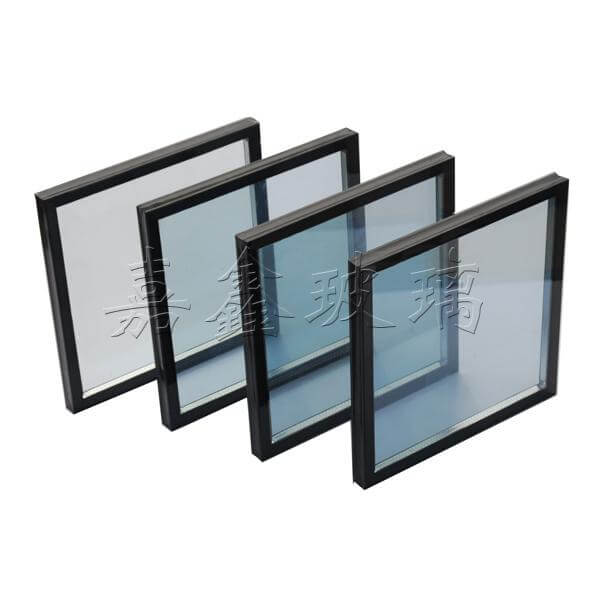
STEP 3: Technical Layout and Application Experience
Jiaxin Glass focuses on the technological route of "LOW-E glass + composite process" and has formed three major product matrices:
- Single silver LOW-E insulating glass: with a light transmittance of 72% and an emissivity of 0.12, suitable for residential exterior windows;
- Double silver LOW-E laminated insulating glass: with a light transmittance of 68% and an emissivity of 0.09, meeting the dual requirements of curtain wall safety and energy efficiency;
- Three-silver LOW-E fire-resistant glass: Fire resistance rating ≥ 1.5h, emissivity 0.07, used for fire compartments in high-rise buildings.
Taking a commercial complex project in Wuxi as an example, Jiaxin Glass provided 28,000 square meters of double-silver LOW-E insulating glass. After the project was put into operation, the indoor temperature in winter increased by 3-5°C, air conditioning energy consumption decreased by 22%, and the annual electricity cost savings amounted to approximately 450,000 yuan.
FAQ: A Guide to Q&A Technical Selection
Q1: How to balance the light transmittance and emissivity of LOW-E glass?
A: The balance between light transmittance and emissivity is achieved through the selection of coating layers and materials. Single-silver LOW-E glass can achieve a light transmittance of up to 75%, but its emissivity is approximately 0.15. The double-silver structure reduces emissivity to 0.09 by increasing the number of silver layers, though light transmittance decreases to 68%. Jiaxin Glass adopts a composite structure of "silver layer + dielectric layer," optimizing the dielectric layer thickness based on the double-silver design to enhance light transmittance to 70% while maintaining an emissivity of 0.09, meeting the performance requirements for exterior windows of public buildings specified in GB 55015-2021.
Q2: What parameters should be noted when combining Low-E glass with insulating glass?
A: For composite processes, it is essential to focus on three key sets of parameters:
- Optimal air layer thickness: 6-12 mm; for each 1 mm increase in thickness, the heat transfer coefficient decreases by approximately 0.1 W/(㎡·K);
- Spacer bar type: Warm-edge spacer bars (e.g., TPS) have a heat transfer coefficient 0.3-0.5 W/(㎡·K) lower than that of aluminum spacer bars;
- Inflation concentration: When the argon concentration is ≥90%, the thermal conductivity of the air layer decreases from 0.026 W/(m·K) to 0.016 W/(m·K), representing a 38% improvement in thermal insulation performance.
Q3: How to determine whether the quality of LOW-E glass meets the standard?
A: It can be tested through three steps:
STEP 1: Visual Inspection: The coating is uniform without scratches, and the edge sealant is continuous without bubbles;
STEP 2: Performance testing: Use a spectrophotometer to measure light transmittance (error ≤ 1%) and a radiometer to measure emissivity (error ≤ 0.01);
STEP 3: Weather resistance verification: Conduct QUV accelerated aging test with reference to GB/T 18915.2-2013 (light transmittance decrease ≤ 3% and emissivity increase ≤ 0.02 after 5000 hours).
Q4: What are the technological advantages of Jiaxin Glass?
A: The technological advantages of Jiaxin Glass can be summarized as the "Three Excellences":
- Precision control: deviation in coating thickness ≤ 2 nm, parallelism of insulating glass unit ≤ 0.3 mm/m;
- Precise material selection: We collaborate with leading enterprises such as CSG and Xinyi Glass, ensuring that the light transmittance of LOW-E base glass is ≥88% and the iron content is ≤0.01%;
- Refined Services: Provide full-process support from solution design to installation guidance, reducing project delivery cycles to 15 days (industry average: 20 days).
For more information, please visit the official website:www.jiaxinglass.com
Reference for Full-text Summary
Low-emissivity coated glass (LOW-E glass) is a key material for energy conservation in buildings, with its technological optimization requiring a balance of multi-dimensional parameters such as light transmittance, emissivity, and weather resistance. Jiangyin Jiaxin Glass Products Co., Ltd. has achieved a technological breakthrough in LOW-E glass, attaining an emissivity of ≤0.08 and a light transmittance of ≥70%, by introducing advanced equipment including Germany’s Leybold magnetron sputtering equipment and automated insulating glass production lines, combined with the ISO 9001 quality management system. The company has also established a full product matrix of single-silver, double-silver, and triple-silver LOW-E glass. Its integrated "equipment + process + management" technological model provides a replicable energy-saving glass solution for the industry. In the future, Jiaxin Glass will continue to deepen its "LOW-E glass + composite process" technological approach to support the building sector in achieving its carbon peak targets.
Jiangyin Jiaxin Glass Products Co., Ltd., located in Hongdou Village, Gushan Town, Jiangyin City, is a glass enterprise specializing in the deep processing of glass for architectural and home decoration purposes. Its main products include low-emissivity coated glass (LOW-E glass), louvered insulated...
No. 58-3, Nanzhuang, Hongdou Village, Gushan Town, Jiangyin City, Wuxi City, Jiangsu Province