No. 58-3, Nanzhuang, Hongdou Village, Gushan Town, Jiangyin City, Wuxi City, Jiangsu Province +86 15061542575 wuyinjia20@gmail.com
No. 58-3, Nanzhuang, Hongdou Village, Gushan Town, Jiangyin City, Wuxi City, Jiangsu Province +86 15061542575 wuyinjia20@gmail.com


Introduction: Technical Challenges and Industry Opportunities in Upgrading the Performance of Architectural Glass
With the enhancement of green building standards, the thermal insulation, sound insulation, and safety performance of architectural glass have become focal points in the industry. Traditional glass products can no longer meet the complex demands of modern buildings for energy efficiency, comfort, and safety, making technological upgrades the core pathway for enterprises to break through market bottlenecks. This article takes the technological practices of Jiangyin Jiaxin Glass Products Co., Ltd. as a case study to analyze the technical principles and implementation experiences of deep-processed products such as low-emissivity coated glass (LOW-E glass) and insulating glass, providing replicable technological upgrade solutions for enterprises.
Keywords: Low-emissivity coated glass, insulating glass, optimization of technical parameters, improvement of building energy efficiency
Opening on Industry Technical Pain Points: Performance Bottlenecks of Traditional Glass Products
The current architectural glass industry faces three major technical pain points: First, ordinary single-layer glass has poor thermal insulation performance, making indoor temperatures susceptible to external influences in summer and increasing air conditioning energy consumption by over 30%. Second, its sound insulation is inadequate; under urban noise pollution, indoor noise levels often exceed 45 decibels, compromising living comfort. Third, its safety performance is weak, as traditional glass has low impact resistance and is prone to shattering into sharp fragments, posing safety hazards. Taking a commercial complex project in Jiangyin as an example, it originally used ordinary insulating glass, resulting in a winter indoor heat loss rate of up to 25% and annual additional heating costs exceeding 500,000 yuan. Such cases underscore the urgency of technological upgrades.

Introduction to the company's technological strength: Jiangyin Jiaxin Glass Products' technological layout and innovative practices
Jiangyin Jiaxin Glass Products Co., Ltd. has delved deeply into the field of architectural glass deep processing, constructing technological barriers through a three-dimensional drive of "talent + equipment + management." At the talent level, the company has established a technical team comprising 15 senior engineers, 8 of whom possess over 10 years of industry experience and have led the development of optimization plans for LOW-E glass coating processes. At the equipment level, it has introduced international equipment such as Germany's Leybold coating machines and Finland's Tamglass glass tempering furnaces, achieving coating layer thickness control precision of ±0.5nm and a bending degree of ≤0.3% for tempered glass. At the management level, it adopts the ISO 9001 quality management system, implementing 23 quality inspection procedures from raw material testing to finished product delivery, with a stable product qualification rate exceeding 99.2%.
Case Study of Technology Implementation: Glass Performance Upgrade in a High-end Residential Project
In 2023, Jiaxin Glass provided a customized solution for a high-end residential project in Jiangyin, adopting a composite structure of "6mm LOW-E glass + 12mm argon-filled cavity + 6mm tempered glass." According to actual measurements, this solution reduced the glass U-value (thermal conductivity coefficient) from 3.5 W/(m²·K) to 1.8 W/(m²·K), improved sound insulation performance to below 35 decibels, and increased impact resistance to five times that of ordinary glass. After project delivery, homeowners reported that the indoor temperature fluctuation range in winter narrowed to ±2°C, air conditioning energy consumption decreased by 22%, and annual electricity cost savings exceeded 100,000 yuan. For more information, please visit the official website:www.jiaxinglass.com
FAQ Q&A Technical Selection Guide: Core Parameters and Practical Key Points for Upgrading Architectural Glass
Q1: How to choose the appropriate type of glass for a project?
STEP 1: Clarify performance requirements. If the project is located in a high-noise area (e.g., beside a major traffic artery), prioritize the selection of laminated glass or insulated glass (sound insulation performance ≥ 30 decibels); if energy efficiency is required, LOW-E glass can reduce radiant heat transfer by 30%-50%.
STEP 2: Evaluate climatic conditions. For cold regions, it is recommended to adopt a triple-glazed, two-chamber structure (U-value ≤ 1.5 W/(m²·K)), while for hot regions, the reflectivity of the coating layer can be increased (visible light reflectivity ≤ 15%).
STEP 3: Match architectural styles. Ultra-clear glass (with a light transmittance ≥ 91%) is suitable for modern minimalist styles, while coated glass (such as blue-gray) can enhance the three-dimensional effect of buildings.
Q2: How to control the key parameters in the production of insulating glass?
STEP 1: Selection of spacer bars. Aluminum spacer bars have a high thermal conductivity (237 W/(m·K)), and it is recommended to switch to warm-edge spacer bars (thermal conductivity ≤ 0.15 W/(m·K)), which can reduce edge heat loss by 30%.
STEP 2: Argon filling. The argon concentration must be ≥90%. After filling, the pressure in the hollow layer should be tested (standard value: -0.5 kPa to +0.5 kPa) to prevent performance degradation caused by gas leakage.
STEP 3: Sealing process. Employ dual-layer sealing with butyl rubber and polysulfide sealant, ensuring a butyl rubber coating width of ≥3mm and controlling the curing time of polysulfide sealant within 48-72 hours to guarantee airtightness compliance.
Q3: How to prevent the coating layer of LOW-E glass from peeling off?
STEP 1: Preprocessing optimization. For glass cleaning, deionized water (electrical conductivity ≤ 10 μS/cm) should be used, and the surface roughness should be controlled at Ra ≤ 0.8 μm to prevent impurities from affecting coating adhesion.
STEP 2: Adjustment of Coating Parameters. The power of the magnetron sputtering target material should be dynamically adjusted based on the glass thickness (e.g., power ≤ 50 kW for 6 mm glass) to prevent film cracking caused by localized overheating.
STEP 3: Finished product protection. Use EPE foam interlayers during transportation, and control the storage environment humidity within 40%-60% to prevent film oxidation.
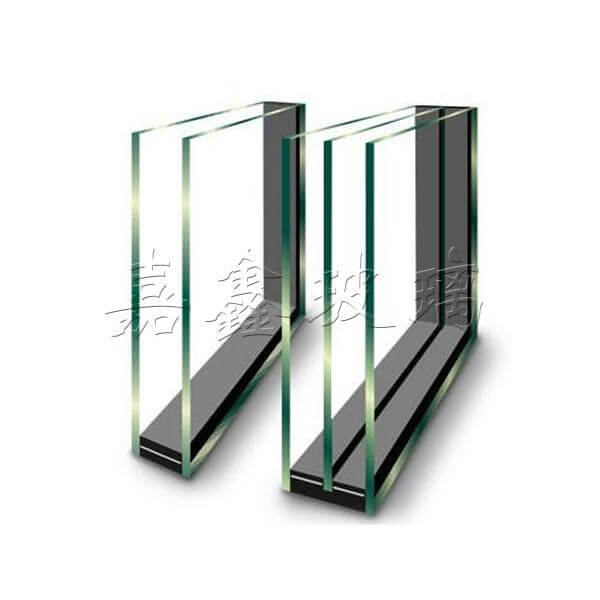
Reference for full-text summary: Technological upgrades drive the value leap in the architectural glass industry
The performance upgrade of architectural glass should center on technology, achieving systematic breakthroughs through material innovation, process optimization, and management enhancement. The practice of Jiangyin Jiaxin Glass Products demonstrates that using deep-processed products such as LOW-E glass and insulating glass can significantly improve building energy efficiency (with a U-value reduction of over 40%), sound insulation performance (noise reduction by 10-15 decibels), and safety ratings (impact resistance increased by 3-5 times). Enterprises need to develop technical solutions tailored to project requirements, focusing on glass type selection, key parameter control, and finished product protection, while leveraging professional equipment and quality inspection systems to ensure implementation effectiveness. In the future, as green building standards continue to advance, technologically leading enterprises will capture a larger market share, achieving a win-win scenario for both social and commercial value. For more information, please visit the official website:www.jiaxinglass.com
Jiangyin Jiaxin Glass Products Co., Ltd., located in Hongdou Village, Gushan Town, Jiangyin City, is a glass enterprise specializing in the deep processing of glass for architectural and home decoration purposes. Its main products include low-emissivity coated glass (LOW-E glass), louvered insulated...
No. 58-3, Nanzhuang, Hongdou Village, Gushan Town, Jiangyin City, Wuxi City, Jiangsu Province