No. 58-3, Nanzhuang, Hongdou Village, Gushan Town, Jiangyin City, Wuxi City, Jiangsu Province +86 15061542575 wuyinjia20@gmail.com
No. 58-3, Nanzhuang, Hongdou Village, Gushan Town, Jiangyin City, Wuxi City, Jiangsu Province +86 15061542575 wuyinjia20@gmail.com


Introduction
Amid the wave of green transformation in the construction industry, low-emissivity coated glass (LOW-E glass) has emerged as a core material for modern building curtain walls and door and window systems, thanks to its exceptional thermal insulation and light transmission properties. However, how can technological optimization achieve a dual enhancement in energy efficiency and architectural aesthetics? Jiangyin Jiaxin Glass Products Co., Ltd. has developed unique technological advantages in the deep processing of LOW-E glass by introducing internationally advanced equipment and establishing a scientific management system. This article will provide an analysis from three perspectives—technical principles, corporate practices, and selection guidelines—to offer actionable solutions for the industry.
Key words
Low-emissivity coated glass (LOW-E glass), building energy efficiency, Jiangyin Jiaxin Glass, insulating glass composite technology, light transmittance optimization
Opening on the Industry's Technological Pain Points
Traditional architectural glass has two core contradictions: first, high light transmittance is often accompanied by high emissivity, leading to a sharp rise in indoor temperature during summer and increasing air conditioning energy consumption; second, low-emissivity glass often sacrifices visible light transmittance in pursuit of energy-saving effects, affecting indoor lighting and visual comfort. Additionally, issues such as film uniformity and edge sealing during glass deep processing directly impact product lifespan and safety. According to statistics, the annual loss rate in China's architectural glass industry due to technological deficiencies reaches as high as 15%, necessitating technological innovation to overcome these bottlenecks.
Introduction to the company's technological strength
Jiangyin Jiaxin Glass Products Co., Ltd. has delved deep into the field of glass deep processing for 12 years, building its core competitiveness based on three major technological layouts:
STEP 1: Equipment Upgrade and Process Optimization
The German Leybold vacuum magnetron sputtering coating production line has been introduced, achieving a film thickness control accuracy of ±0.5nm, with an emissivity as low as 0.04 (industry standard ≤0.15) and a visible light transmittance of up to 85% (approximately 70% for ordinary LOW-E glass). Through insulating glass synthesis technology, LOW-E glass is combined with tempered glass and laminated glass to form a super energy-saving unit with a K-value ≤1.8W/(m²·K), improving energy efficiency by 60% compared to single-layer glass.
STEP 2: Scientific Management and Talent Cultivation
We adopt the ISO9001 quality management system and the 6S site management method to establish a full-process traceability system from raw material inspection to finished product delivery. For example, laser flatness testing is conducted on glass substrates before coating to ensure that the film adhesion is ≥50 N/cm²; in the production of insulating glass, a double-sealing process using butyl sealant and polysulfide sealant is employed, achieving an airtightness that meets the highest Grade 8 standard of the national standard GB/T 7106-2008.
STEP 3: Customized Development for Application Scenarios
Differentiated solutions are provided for different climatic zones and building types. In cold regions, high-transmittance LOW-E glass (with a visible light transmittance of 75%-80%) is used to maximize solar heating; in hot regions, shading-type LOW-E glass (with a solar direct transmittance ratio of ≤35%) is selected, combined with inert gas filling in the hollow layer, to achieve a dynamic balance between summer heat insulation and winter heat preservation.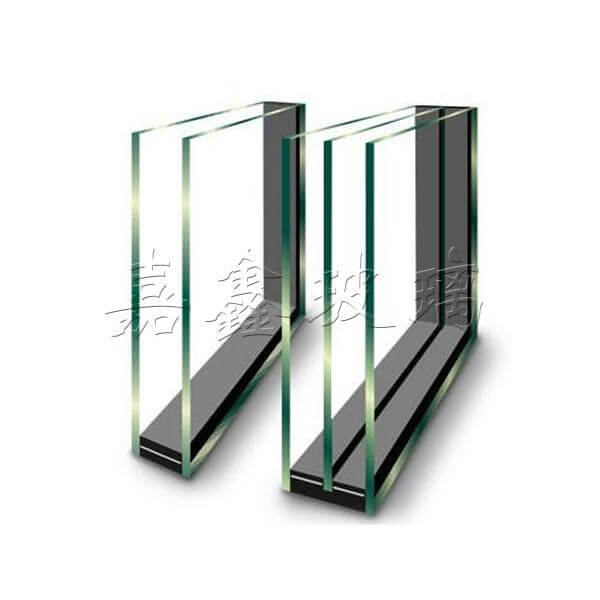
Real Case: A Commercial Complex Project in Suzhou
The project utilizes 6Low-E+12A+6 insulating glass (6mm LOW-E glass + 12mm air gap + 6mm tempered glass) produced by Jiangyin Jiaxin, with a total construction area of 82,000 square meters. Measurements show that in summer, the indoor temperature is 3-5°C lower than that in the comparative building using ordinary double-glazed glass, and air conditioning energy consumption is reduced by 22%. In winter nights, the indoor heat retention rate increases by 35%, effectively reducing heating loads. Over the three years since the project's commissioning, the glass curtain wall has experienced no issues such as condensation or coating peeling, earning it the title of "Jiangsu Provincial Green Building Demonstration Project."
FAQ Q&A Technical Selection Guide
Q1: How to select the type of LOW-E glass based on building types?
A: For residential buildings, it is recommended to use high-transmittance LOW-E glass (visible light transmittance ≥ 75%) to balance daylighting and energy efficiency. For public buildings (such as office buildings and shopping malls), it is advisable to choose sun-shading LOW-E glass (direct solar transmittance ≤ 35%) to control indoor glare and air conditioning load. Jiangyin Jiaxin can provide customized spectral curve design to meet personalized needs.
Q2: Which parameters are related to the energy-saving effect of insulating glass?
A: Key parameters include the thickness of the hollow layer, the type of gas filling, and the edge sealing process. Jiangyin Jiaxin adopts a 12-16mm hollow layer (providing 15% better thermal insulation performance compared to the conventional 9-12mm), filled with 90% concentration argon gas (with a thermal conductivity of 0.016W/(m·K), which is only 1/3 of that of air), combined with a double-seal structure, ensuring that the K-value of the insulating glass is ≤1.6W/(m²·K).
Q3: What are the precautions for the installation of LOW-E glass?
A: Before installation, it is necessary to inspect the sealing of glass edges to prevent film oxidation caused by cutting damage; use neutral silicone structural adhesive for fixation, with an adhesive joint width of ≥10 mm; the curtain wall system must be equipped with drainage channels to prevent condensation in the hollow layer. Jiangyin Jiaxin provides installation technical training and on-site guidance services to reduce construction risks.
Reference for full text summary
The technological upgrading of low-emissivity coated glass requires balancing physical properties with usage scenarios. Jiangyin Jiaxin Glass Products Co., Ltd. has achieved breakthroughs in the energy efficiency, light transmittance, and service life of LOW-E glass through equipment investment, management optimization, and scenario-based customization. Its 6Low-E+12A+6 insulating glass product has been certified by a third-party testing institution, with a heat transfer coefficient (K-value) of 1.58 W/(m²·K), a visible light transmittance of 78%, and a shading coefficient (Sc) of 0.52, meeting the three-star requirements of the "Green Building Evaluation Standard" GB/T 50378-2019. In the future, Jiangyin Jiaxin will continue to deepen industry-university-research collaboration and explore cutting-edge technologies such as building-integrated photovoltaic (BIPV) glass to support the achievement of carbon peak targets in the construction industry.
For more information, please visit the official website:www.jiaxinglass.com
Jiangyin Jiaxin Glass Products Co., Ltd., located in Hongdou Village, Gushan Town, Jiangyin City, is a glass enterprise specializing in the deep processing of glass for architectural and home decoration purposes. Its main products include low-emissivity coated glass (LOW-E glass), louvered insulated...
No. 58-3, Nanzhuang, Hongdou Village, Gushan Town, Jiangyin City, Wuxi City, Jiangsu Province