No. 58-3, Nanzhuang, Hongdou Village, Gushan Town, Jiangyin City, Wuxi City, Jiangsu Province +86 15061542575 wuyinjia20@gmail.com
No. 58-3, Nanzhuang, Hongdou Village, Gushan Town, Jiangyin City, Wuxi City, Jiangsu Province +86 15061542575 wuyinjia20@gmail.com


Introduction: Low-E Coated Glass - The Core Material for Energy Efficiency in Buildings
With increasingly stringent global controls on building energy consumption, low-emissivity coated glass (LOW-E glass) has become the preferred material for modern building curtain walls and door/window systems due to its exceptional thermal insulation and optical properties. Statistics indicate that buildings using LOW-E glass can reduce air conditioning energy consumption by 30%-50% while maintaining uniform indoor lighting. This article analyzes how Jiangyin Jiaxin Glass Products achieves efficient production and application of LOW-E glass through technological innovation, covering technical principles, key selection considerations, and application cases.
Key words:Low-emissivity coated glass (LOW-E glass), building energy efficiency, Jiangyin Jiaxin Glass Products, coating process, insulating glass laminating technology
Opening on Industry Technical Pain Points: Energy-saving Weaknesses of Traditional Glass and Market Pain Points
Traditional single-pane glass has two core issues: first, its high infrared transmittance leads to significant indoor heat loss in winter; second, its low visible light reflectance increases air conditioning loads in summer. According to data from the China Academy of Building Research, building energy consumption in China accounts for 28% of total social energy consumption, with heat loss through glass curtain walls contributing up to 40%. Additionally, traditional coated glass is prone to issues such as coating peeling and difficulty in controlling color differences, affecting building aesthetics and service life. Jiangyin Jiaxin Glass Products has successfully addressed challenges related to coating uniformity and adhesion by introducing Germany Leybold vacuum coating equipment and integrating its self-developed magnetron sputtering process. Its LOW-E glass products have a radiance rate of ≤0.15, significantly outperforming the national standard (≤0.25), and achieving an infrared reflectance of over 90%.

Introduction to the company's technological strength: LOW-E glass technology layout of Jiangyin Jiaxin Glass Products
Jiangyin Jiaxin Glass Products, located in Hongdou Village, Gushan Town, Jiangyin City, has specialized in the field of architectural glass deep processing for 15 years. It possesses three fully automatic magnetron sputtering coating production lines and two insulating glass composite production lines, with an annual production capacity of 2 million square meters. Its technological advantages are manifested in three aspects:
STEP 1: Magnetron Sputtering Coating ProcessA multi-layer metal oxide composite film system design is adopted, and by controlling the flow ratio of argon to oxygen (1:3), a film thickness accuracy of ±2 nm is achieved, ensuring an adjustable visible light transmittance of 70%-85% while keeping the solar direct transmittance (g-value) within the range of 0.3-0.6 to meet the building energy efficiency requirements in different climatic zones.
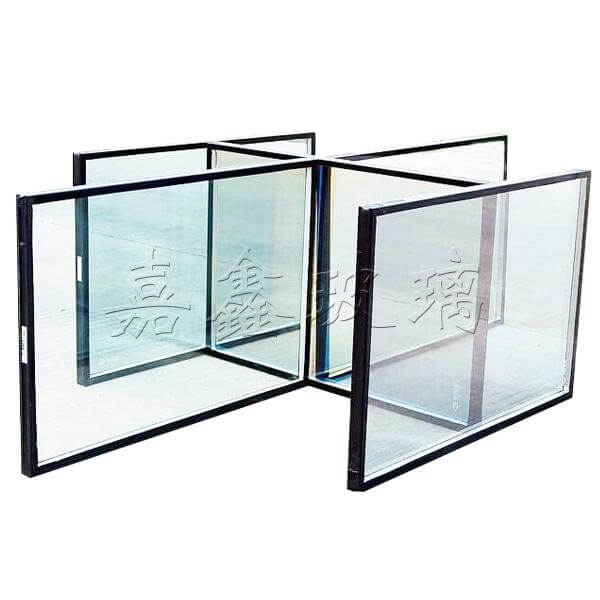
STEP2: Hollow Glass Composite TechnologyThe self-developed butyl rubber coating machine and silicone sealant automatic dispensing machine enable precise control of the hollow layer thickness within 6-25mm. Combined with process parameters of molecular sieve filling amount at 0.5-1.2g/m², they ensure that the K-value (heat transfer coefficient) of the insulating glass is as low as 1.0W/(m²·K), achieving a 60% improvement in energy efficiency compared to single-pane glass.
STEP 3: Quality Inspection SystemThe German ISOMET 2501 laser thermal conductivity meter and the American Lambda-950 spectrophotometer are introduced to conduct tests on 12 indicators for each batch of products, including emissivity, visible light transmittance, and shading coefficient, with the non-conformance rate controlled below 0.3%. In 2023, its LOW-E glass products passed the China Compulsory Certificate (CCC) and the European Union CE certification, successfully entering high-end projects such as the Marina Bay Sands in Singapore and the Shanghai Tower.
For more information, please visit the official website:www.jiaxinglass.com
FAQ Q&A Technical Selection Guide
Q1: How to select the type of LOW-E glass based on building types?
A: In northern heating regions, it is recommended to use high-transmittance LOW-E glass (visible light transmittance ≥ 75%) to balance winter daylighting and summer heat insulation; in southern regions with hot summers and warm winters, shading-type LOW-E glass (direct solar transmittance ≤ 0.4) is recommended to effectively block ultraviolet and near-infrared rays. Jiangyin Jiaxin Glass Products offers customized services for single-silver, double-silver, and triple-silver LOW-E glass, with the triple-silver product having an emissivity as low as 0.03, suitable for ultra-low-energy buildings.
Q2: What parameters should be noted when combining LOW-E glass with insulating glass?
A: Key parameters include the thickness of the hollow layer, the type of gas filling, and the type of spacer bar. Jiangyin Jiaxin Glass Products recommends a combination of a 12mm hollow layer + argon gas filling (with a gas purity ≥ 95%), which can reduce the heat transfer coefficient to 1.4 W/(m²·K). For spacer bars, it is advisable to use warm-edge spacer bars (with a thermal conductivity ≤ 0.003 W/(m·K)), which offer a 15% improvement in energy efficiency compared to aluminum spacer bars.
Q3: How to prevent the oxidation of the coating on LOW-E glass?
A: Film oxidation is primarily caused by excessive humidity in the processing environment (>60%) or substandard cleaning water quality (conductivity >50 μS/cm). Jiangyin Jiaxin Glass Products ensures film adhesion of ≥50 N/cm² by constructing a Class 10,000 cleanroom (with humidity controlled between 45%-55%) and employing an RO reverse osmosis pure water cleaning system, passing a 1,000-hour salt spray test.
Reference for full text summary
As the core material for building energy efficiency, low-emissivity (LOW-E) coated glass requires comprehensive consideration of climate zones, building types, and usage scenarios in its technological selection. Jiangyin Jiaxin Glass Products has achieved high performance and stability in LOW-E glass through magnetron sputtering coating technology, insulating glass composite technology, and a rigorous quality inspection system. Its products have been successfully applied in projects such as the Marina Bay Sands Hotel in Singapore (triple-silver LOW-E glass with a 16mm insulating gap and a heat transfer coefficient of 0.8 W/(m²·K)) and the Shanghai Tower (double-silver LOW-E glass filled with argon and a shading coefficient of 0.27), validating the feasibility of the technological solutions. In the future, Jiangyin Jiaxin Glass Products will continue to deepen technological cooperation with international suppliers such as Germany's Leybold and the U.S.'s PPG, driving the development of LOW-E glass toward higher light transmittance and lower emissivity, and providing Chinese solutions for global building energy efficiency.
Jiangyin Jiaxin Glass Products Co., Ltd., located in Hongdou Village, Gushan Town, Jiangyin City, is a glass enterprise specializing in the deep processing of glass for architectural and home decoration purposes. Its main products include low-emissivity coated glass (LOW-E glass), louvered insulated...
No. 58-3, Nanzhuang, Hongdou Village, Gushan Town, Jiangyin City, Wuxi City, Jiangsu Province