No. 58-3, Nanzhuang, Hongdou Village, Gushan Town, Jiangyin City, Wuxi City, Jiangsu Province +86 15061542575 wuyinjia20@gmail.com
No. 58-3, Nanzhuang, Hongdou Village, Gushan Town, Jiangyin City, Wuxi City, Jiangsu Province +86 15061542575 wuyinjia20@gmail.com


Introduction: The "Invisible Guardian" of Building Energy Efficiency: Technological Breakthroughs in LOW-E Glass
Driven by the goal of carbon neutrality, building energy consumption accounts for over 30% of total societal energy consumption, with heat transfer through glass curtain walls contributing up to 50%. Low-emissivity coated glass (LOW-E glass), utilizing multi-layer metal oxide coating technology, elevates infrared reflectivity to over 90%, making it a core material for energy conservation in modern architecture. This article will explore, from three dimensions—technical principles, parameter analysis, and practical applications—how LOW-E glass achieves the optimal solution for building energy conservation, incorporating the processing techniques and case studies of Jiangyin Jiaxin Glass Products.
Key words:Low-emissivity coated glass, building energy efficiency, infrared blocking rate, Jiangyin Jiaxin Glass Products, coating process
Opening Remarks on Industry Technical Pain Points: How to Solve the "Energy Loophole" of Traditional Glass?
Traditional single-pane glass has a high thermal conductivity coefficient (U-value) of 5.8 W/(m²·K), leading to rapid indoor heat loss in winter and increasing air conditioning loads by over 30% in summer. While ordinary insulating glass reduces the U-value to 2.8 W/(m²·K) through an air layer, it still cannot effectively block infrared rays (accounting for 53% of solar radiation). LOW-E glass forms an infrared reflective layer by depositing metal oxide films such as silver and tin oxide on the glass surface, further reducing the U-value to below 1.0 W/(m²·K) while maintaining a visible light transmittance of over 70%, achieving a technological breakthrough of "transmitting light without transmitting heat."
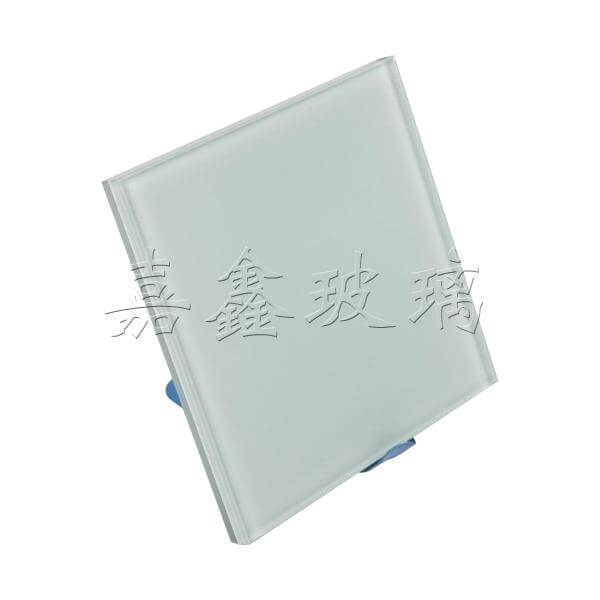
Introduction to the company's technological strength: Jiangyin Jiaxin Glass Products' "Three-Layer Coating Process"
As a leading deep-processing glass enterprise in East China, Jiangyin Jiaxin Glass Products has introduced a German Leybold vacuum magnetron sputtering coating line, enabling precise control of up to 13 layers of coating on a single piece of glass. Its core process consists of three steps:
STEP 1: Substrate Pretreatment— Utilizing Finland's Tamglass tempering furnace to control the flatness of the glass surface within ±0.02mm, ensuring the uniformity of the coating layer;
STEP 2: Multilayer coating deposition— Materials such as silicon, zinc, silver, and tin oxide are sequentially deposited using magnetron sputtering technology to form a sandwich structure of "reflective layer + barrier layer + protective layer," with the silver layer being only 12 nm thick (equivalent to 1/5000 of a hair's thickness);
STEP 3: Hollow composite encapsulation— Utilizing a double-sealing process with butyl rubber and polysulfide sealant, combined with molecular sieve desiccant, to ensure the concentration of inert gas (argon) in the hollow layer is ≥95%, with a lifespan exceeding 25 years.
Technical advantages: Tested by the National Center for Quality Supervision and Inspection of Glass, Jiaxin LOW-E glass achieves a total solar infrared thermal reflectance of 92%, with a winter nighttime emissivity of ≤0.05, offering over 40% energy savings compared to ordinary insulating glass. In a commercial complex project in Suzhou, the curtain wall system utilizing Jiaxin LOW-E glass reduced air conditioning energy consumption by 35%, resulting in annual electricity cost savings exceeding RMB 2 million.
FAQ: A Guide to Q&A Technology Selection
Q1: How to choose single-silver, double-silver, or triple-silver LOW-E glass?
A: Parameter Analysis: Single-silver LOW-E (U-value ≤ 1.8 W/(m²·K)) is suitable for temperate climatic zones; double-silver (U-value ≤ 1.4 W/(m²·K)) is suitable for regions with hot summers and cold winters; triple-silver (U-value ≤ 1.0 W/(m²·K)) is suitable for severe cold regions. Practical Recommendation: Taking an office building in Nanjing as an example, the configuration of double-silver LOW-E + 12mm hollow layer + argon filling achieves an overall heat transfer coefficient (K-value) of 1.3 W/(m²·K), meeting the Three-Star Green Building Standard.
Q2: What considerations are there for the orientation selection of LOW-E glass?
A: Technical Principles: For south-facing glass, it is necessary to balance daylighting and heat insulation, and it is recommended to select products with a visible light transmittance (Tvis) ≥ 65% and a total solar energy transmittance (g-value) ≤ 0.5; for north-facing glass, the focus is on thermal insulation, and models with a Tvis ≥ 50% and a g-value ≤ 0.4 can be chosen. Case Reference: In a residential project in Shanghai, Jiaxin double-silver LOW-E glass (Tvis = 68%, g = 0.48) was used for the south-facing side, and single-silver LOW-E glass (Tvis = 55%, g = 0.42) was used for the north-facing side, achieving an annual energy savings rate of 32%.
Q3: How to avoid damage to the coating layer during processing?
A: Key operating points: Use a diamond cutting wheel during cutting, with pressure controlled at 0.2-0.3 MPa; for edge grinding, employ a resin-bonded grinding wheel with a feed rate of ≤1 m/min; avoid acidic or alkaline cleaning agents for cleaning, and maintain the pH value between 6 and 8. Jiaxin Process: By introducing an AI visual inspection system, defect identification accuracy in the coating layer reaches 0.01 mm², and the product qualification rate is increased to 99.5%.
Technological Evolution and Industry Trends of LOW-E Glass
From single-silver to triple-silver, and from offline coating to online coating, the technological evolution of LOW-E glass has consistently centered on achieving "higher infrared reflectivity, lower emissivity, and longer service life." Jiangyin Jiaxin Glass Products has established a comprehensive product line covering fields such as construction, home decoration, and photovoltaics by introducing internationally advanced equipment, optimizing coating processes, and strictly controlling production procedures. In the future, with the maturation of dynamic coating technologies (such as electrochromic and thermochromic), LOW-E glass will make the leap from "passive energy conservation" to "active regulation," offering superior solutions for achieving carbon neutrality in buildings.
For more information, please visit the official website:www.jiaxinglass.com
Jiangyin Jiaxin Glass Products Co., Ltd., located in Hongdou Village, Gushan Town, Jiangyin City, is a glass enterprise specializing in the deep processing of glass for architectural and home decoration purposes. Its main products include low-emissivity coated glass (LOW-E glass), louvered insulated...
No. 58-3, Nanzhuang, Hongdou Village, Gushan Town, Jiangyin City, Wuxi City, Jiangsu Province