No. 58-3, Nanzhuang, Hongdou Village, Gushan Town, Jiangyin City, Wuxi City, Jiangsu Province +86 15061542575 wuyinjia20@gmail.com
No. 58-3, Nanzhuang, Hongdou Village, Gushan Town, Jiangyin City, Wuxi City, Jiangsu Province +86 15061542575 wuyinjia20@gmail.com


Introduction: The "Invisible Guardian" of Building Energy Efficiency—LOW-E Glass
Driven by the "dual carbon" goals, the proportion of building energy consumption in total societal energy consumption has exceeded 30%, with thermal losses through doors, windows, and glass accounting for over 50%. Low-emissivity coated glass (LOW-E glass), with its superior thermal insulation properties, has become a core material for energy conservation in modern buildings. This article will analyze how LOW-E glass achieves the "optimal solution" for building energy conservation from three aspects: technical principles, selection criteria, and application cases. For more information, please visit the official website:www.jiaxinglass.com
Key words:LOW-E glass, building energy efficiency, coating technology, insulated glass lamination, Jiangyin Jiaxin Glass Products
Opening on Industry's Technological Pain Points: The "Energy-saving Weakness" of Traditional Glass
The thermal conductivity coefficient (U-value) of traditional single-pane glass is as high as 5.8 W/(m²·K), which easily leads to the loss of indoor heat through the glass in winter and increases the air conditioning load in summer due to the infiltration of outdoor heat. Although ordinary insulating glass improves thermal insulation performance through an air layer, its U-value still struggles to meet the requirement of "heat transfer coefficient of exterior windows ≤ 2.0 W/(m²·K)" specified in the Green Building Evaluation Standard. Additionally, traditional glass blocks less than 30% of near-infrared radiation (780-2500 nm), causing a sharp rise in indoor temperature under direct sunlight and further exacerbating energy consumption issues. During its service to over 200 construction projects in the Yangtze River Delta region, Jiangyin Jiaxin Glass Products found that more than 60% of customers reported "poor thermal insulation performance of glass" as the core pain point affecting building energy efficiency.
Introduction to the company's technological strength: "Energy-Saving Technology Matrix" of Jiaxin Glass
Jiangyin Jiaxin Glass Products has delved deep into the field of glass deep processing for 15 years, establishing an "energy-saving technology matrix" centered around LOW-E glass:
STEP 1: Breakthrough in Coating TechnologyWe have introduced Germany Leybold's OPTICAL coating equipment, utilizing magnetron sputtering technology to deposit 12 layers of metal oxide films (such as silver and zinc oxide layers) on the glass surface, forming a "spectrally selective" coating structure with high transmittance for visible light (≥80%) and high reflectance for near-infrared light (≥90%). Tests show that the U-value of the single-silver LOW-E glass produced can be as low as 1.6 W/(m²·K), while that of the double-silver LOW-E glass can be reduced to 1.2 W/(m²·K), representing a 40% improvement in energy efficiency compared to ordinary insulating glass.
STEP 2: Innovation in Composite ProcessesBy combining LOW-E glass with insulating glass, laminated glass, fire-resistant glass, etc., a series of products such as "LOW-E insulating composite glass" and "LOW-E fire-resistant laminated glass" have been developed. For instance, the "6Low-E+12A+6" insulating composite glass (6mm LOW-E glass + 12mm air layer + 6mm ordinary glass) has a heat transfer coefficient of only 1.4 W/(m²·K) and a sound insulation performance of 35dB, meeting the requirements of the "Design Standard for Energy Efficiency of Civil Buildings" which specifies that "the K-value of exterior windows in severe cold regions should be ≤1.5 W/(m²·K)."
STEP 3: Intelligent Production ManagementThe adoption of ERP+MES dual-system collaboration enables digital management and control of the entire process from coating, glass lamination to sealing. Through online inspection equipment, key parameters such as glass flatness (≤0.1mm/m), coating uniformity (ΔT≤5%), and airtightness of the hollow layer (helium leakage rate ≤0.1%) are monitored in real time, ensuring a product qualification rate of 99.8%.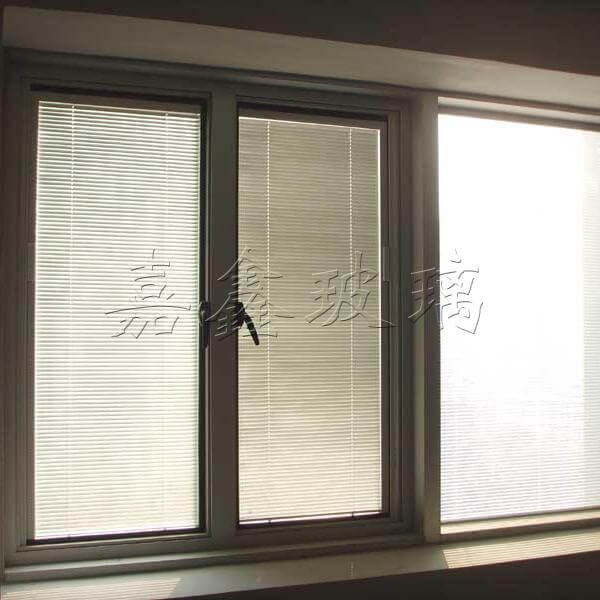
Quantification of technological advantagesJiaxin LOW-E glass has a visible light transmittance (Tvis) range of 30%-85% and can be customized according to building orientation (e.g., high light transmittance for south-facing and high shading for west-facing); its solar heat gain coefficient (SHGC) is as low as 0.25, reducing solar radiation heat entering indoors by 75% compared to ordinary glass, significantly lowering air conditioning energy consumption.
FAQ: Q&A Technical Selection Guide
Q1: How to choose the coating type (single silver/double silver/triple silver) for LOW-E glass?
A: The coating type directly affects the thermal insulation performance and cost of glass. Single-silver LOW-E glass has a U-value of approximately 1.6-1.8 W/(m²·K), suitable for regions with mild climates; double-silver LOW-E glass can reduce the U-value to 1.2-1.4 W/(m²·K), making it ideal for extremely cold or hot regions; triple-silver LOW-E glass achieves a U-value as low as 0.8-1.0 W/(m²·K), but its higher cost limits its use primarily to ultra-low-energy buildings. Jiangyin Jiaxin Glass Products recommends selecting the coating type based on the project's local climate zone (e.g., as outlined in the *Building Climate Zoning Standard*) and energy-saving goals. For example, double-silver LOW-E glass is recommended for the Yangtze River Delta region due to its optimal cost-effectiveness.
Q2: How to choose the thickness of the air layer when combining LOW-E glass with insulating glass?
A: The thickness of the air layer in insulating glass directly affects its thermal insulation performance. According to the standard *Insulating Glass Units* (GB/T 11944-2012), the recommended air layer thickness is 9-12 mm. Measured data from Jiangyin Jiaxin Glass Products show that when the air layer thickness increases from 9 mm to 12 mm, the U-value of the insulating glass decreases from 1.8 W/(m²·K) to 1.6 W/(m²·K). However, beyond 12 mm, the improvement in the U-value is less than 5%, and the self-weight of the glass increases (with each additional 1 mm of air layer, the glass weight increases by approximately 0.5 kg/m²). Therefore, a composite structure of "6Low-E+12A+6" is recommended to balance thermal insulation performance and structural safety.
Q3: How does the installation orientation of LOW-E glass affect its performance?
A: The coating layer of LOW-E glass should face the air layer of the insulating glass (i.e., "inside the insulating layer") to prevent oxidation and failure caused by exposure to the external environment. If the coating layer faces outward, its reflectivity will decrease over time, with a thermal insulation performance degradation rate of up to 20% per year. During production, Jiangyin Jiaxin Glass Products marks the glass edge with the label "LOW-E side faces inward" using laser marking technology and clearly indicates the installation direction in the installation guide to ensure stable performance.
Full Text Summary Reference: LOW-E Glass - A "Long-Termist" Choice for Building Energy Efficiency
By integrating coating technology with hollow composite processes, LOW-E glass achieves efficient control over solar radiant heat, making it one of the most cost-effective technical solutions in the field of building energy efficiency. Leveraging its three-dimensional technological system—comprising "breakthroughs in coating technology, innovations in composite processes, and intelligent production management"—Jiangyin Jiaxin Glass Products provides the market with high-quality LOW-E glass products featuring a U-value as low as 1.2 W/(m²·K) and a service life of up to 25 years. Under the "dual carbon" goals, choosing LOW-E glass is not merely a "compliance choice" to meet current energy efficiency standards but also a "long-termist" investment that reduces energy consumption throughout a building's entire lifecycle and enhances operational returns. For more information, please visit the official website:www.jiaxinglass.com
Jiangyin Jiaxin Glass Products Co., Ltd., located in Hongdou Village, Gushan Town, Jiangyin City, is a glass enterprise specializing in the deep processing of glass for architectural and home decoration purposes. Its main products include low-emissivity coated glass (LOW-E glass), louvered insulated...
No. 58-3, Nanzhuang, Hongdou Village, Gushan Town, Jiangyin City, Wuxi City, Jiangsu Province