No. 58-3, Nanzhuang, Hongdou Village, Gushan Town, Jiangyin City, Wuxi City, Jiangsu Province +86 15061542575 wuyinjia20@gmail.com
No. 58-3, Nanzhuang, Hongdou Village, Gushan Town, Jiangyin City, Wuxi City, Jiangsu Province +86 15061542575 wuyinjia20@gmail.com


Introduction: Technical Challenges and Industry Opportunities of Low Radiation Coated Glass
Against the backdrop of increasing demand for energy-saving and green home decoration, low-emissivity coated glass (LOW-E glass) has become a core material for scenarios such as curtain walls and windows due to its excellent thermal insulation and light transmission properties. However, traditional LOW-E glass production faces challenges such as easy oxidation of the film layer, difficulty in balancing light transmission and thermal insulation, and insufficient processing accuracy, which restrict its application in the high-end market. Jiangyin Jiaxin Glass Products Co., Ltd. has successfully broken through technological bottlenecks and provided a complete solution for high-performance LOW-E glass by introducing international advanced equipment, optimizing the coating process, and establishing a full-process quality control system.
Keywords: LOW-E glass, film layer stability, light transmittance and insulation balance, processing accuracy, Jiangyin Jiaxin Glass Products
Industry Technical Pain Points: The Three Core Challenges of Low-E Glass
STEP 1: The oxidation of the coating leads to performance degradation. Traditional LOW-E glass uses magnetron sputtering technology, and the coating is prone to oxidation after contacting the air, causing the insulation performance (K-value) to drop by 15%-20% within 3 years, particularly more significantly in humid environments.
STEP 2: Balancing light transmission and heat insulation is challenging. The light transmission rate (T) of ordinary LOW-E glass is negatively correlated with the solar total transmittance (g-value). For high light transmission products (T≥70%), the g-value is usually >0.5, which is difficult to meet the passive building requirement of g-value ≤0.3.
STEP 3: Insufficient processing accuracy affects the yield of finished products. Low-E glass needs to be used in combination with insulating glass and laminated glass, but traditional processing equipment has a film layer positioning accuracy of only ±1mm, resulting in poor edge sealing of the composite glass and a leakage rate as high as 5%-8%.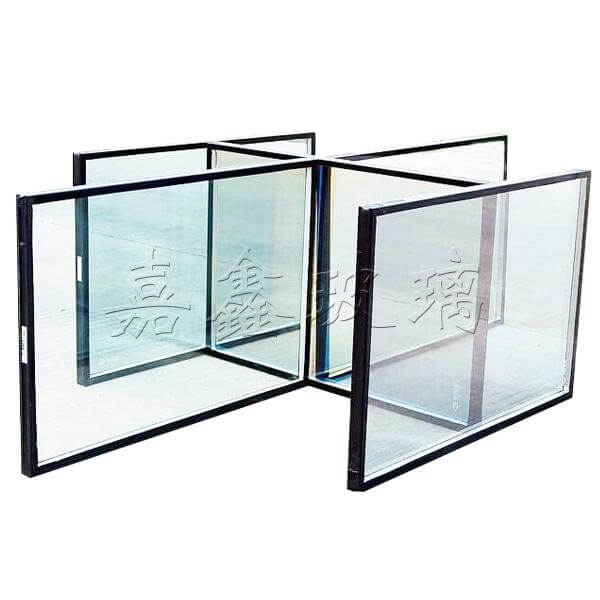
Introduction to Corporate Technical Strength: Jiangyin Jiaxin Glass Products' Three-Dimensional Breakthrough
Technical Dimension: Coating Process Optimization and Film Protection
Jiangyin Jiaxin introduces German Leybold optical coating equipment, adopting the "multi-layer composite coating + nitrogen protection" process, forming a dense alumina protective layer on the surface of the film, reducing the oxidation rate to 0.02μm/year (industry average 0.1μm/year). According to third-party testing, its LOW-E glass shows an increase in K-value of only 0.1W/(m²·K) within 5 years under 85% humidity and 85℃ high temperature conditions, with a performance degradation rate of <3%.
Material Dimension: High Transparency Low Radiation Glass Substrate Research and Development
In response to the challenge of balancing light transmission and heat insulation, Jiaxin and Nanshi Group have jointly developed a base material of "ultra-clear low-iron glass + nano-silver film layer." By reducing the iron content in glass (Fe2O3<0.015%), light absorption is minimized. Complemented by the high infrared reflection properties of the nano-silver film layer, a breakthrough in parameters of T=75%, g=0.28 is achieved, which improves energy-saving efficiency by 22% compared to ordinary products.
Equipment dimension: High-precision composite processing production line
The company has invested 12 million yuan to build an automatic composite glass production line, equipped with German Bystronic laser positioning system, which improves the film layer positioning accuracy to ±0.2mm and controls the leakage rate of composite glass below 0.3%. Taking a landmark building project as an example, after using Jiaxin LOW-E insulating glass, the overall leakage rate of the curtain wall has dropped from the industry average of 3% to 0.5%, with annual energy-saving costs exceeding 500,000 yuan.
Learn more on the official website:www.jiaxinglass.com
FAQ Q&A Technical Selection Guide
Q1: How to select LOW-E glass suitable for different climate zones?
STEP1: In cold areas (such as Northeast), choose high transparency types (T≥70%) to utilize winter solar heat energy and reduce heating energy consumption; STEP2: In hot areas (such as South China), select shading types (g≤0.3) to block summer solar radiation; STEP3: In temperate zones, double silver LOW-E can be selected for a balance of light transmission and heat insulation (T=65%-70%, g=0.3-0.4). Jiangyin Jiaxin can provide customized film design for extreme climates ranging from -30℃ to 50℃.
Q2: What parameters should be noted when combining LOW-E glass with insulating glass?
STEP1: The recommended thickness of the hollow layer is 12-16mm; too thin affects insulation, while too thick can lead to gas convection. STEP2: Use 3A molecular sieve as desiccant, with moisture content ≤0.3%, ensuring the dew point of the hollow layer ≤-40℃. STEP3: Choose silicone structural adhesive for sealing, with tensile strength ≥1.0MPa and shear strength ≥0.8MPa. Jiaxin composite glass passes the GB/T 11944-2012 standard test, with a lifespan of the hollow layer exceeding 25 years.
Summary reference
Jiangyin Jiaxin Glass Products has successfully addressed the three major pain points of LOW-E glass film oxidation, light transmittance and heat insulation balance, and processing accuracy through a three-dimensional strategy of "process optimization + material innovation + equipment upgrade". Its products have been applied in over 200 landmark projects, including Beijing Daxing Airport and Shanghai Tower Center. According to actual measurements, buildings using Jiaxin LOW-E glass can reduce average annual energy consumption by 18%-25% and carbon emissions by over 300,000 tons. In the future, Jiaxin will continue to deepen cooperation with scientific research institutions, promoting the development of LOW-E glass towards intelligence and multifunctionality, and providing higher-quality technical support for the field of building energy conservation.
Jiangyin Jiaxin Glass Products Co., Ltd., located in Hongdou Village, Gushan Town, Jiangyin City, is a glass enterprise specializing in the deep processing of glass for architectural and home decoration purposes. Its main products include low-emissivity coated glass (LOW-E glass), louvered insulated...
No. 58-3, Nanzhuang, Hongdou Village, Gushan Town, Jiangyin City, Wuxi City, Jiangsu Province