No. 58-3, Nanzhuang, Hongdou Village, Gushan Town, Jiangyin City, Wuxi City, Jiangsu Province +86 15061542575 wuyinjia20@gmail.com
No. 58-3, Nanzhuang, Hongdou Village, Gushan Town, Jiangyin City, Wuxi City, Jiangsu Province +86 15061542575 wuyinjia20@gmail.com


Industry Technical Pain Points: The "Energy-saving Paradox" of Low-E Insulating Glass and Process Bottlenecks
Low-E insulating glass, as the core material for building energy conservation, has long been plagued by technical challenges: On the one hand, traditional coating processes often result in insufficient adhesion of the film layer, leading to delamination and oxidation under temperature differences, which directly affects the heat-insulating performance (U-value fluctuation > 0.5W/㎡·K); on the other hand, the sealing technology for the hollow layer lags behind, with an annual leakage rate of inert gases (such as argon) generally >1%, causing the heat-insulating effect to degrade by over 30%. More severely, the cumulative errors in the coordination of multiple processes (coating, lamination, and inflation) make it difficult to break the 85% pass rate in mass production, especially in the processing of complex curved glass, where controlling the uniformity of the film layer has become an industry "choke point" problem. These pain points not only increase building energy consumption but also restrict the implementation of green building standards.
 Introduction to Enterprise Technical Strength: Jiaxin Glass' "Three-level Breakthrough" Technology System
Jiangyin Jiaxin Glass Products Co., Ltd. has achieved a three-stage technological breakthrough of "equipment-process-management", establishing a full-chain solution for Low-E insulating glass.
Step 1: High-Precision Coating Equipment ClusterIntroduce German Leybold magnetron sputtering coating line with a 12-target dynamic control system, achieving single-layer film thickness error <2nm, and film adhesion passing the "100-point test" at level 5B; combined with the independently developed "low-temperature coating process" (process temperature ≤180℃), the oxidation rate of the film is reduced to below 0.3%, a 40% improvement over the industry average.
STEP 2: Intelligent HOLLOW LAYER SEALING TECHNOLOGYUtilizing a "double butyl rubber + hot melt adhesive" composite sealing process, paired with the Swiss Bayer fully automatic inflation line, achieves argon filling concentration ≥95% and annual leakage rate < 0.5%; replacing traditional aluminum spacer strips with laser welding technology, controls the hollow layer thickness error within ±0.2mm, ensuring the stability of thermal insulation performance (U-value fluctuation < 0.1W/㎡·K).
Step 3: Digital Production Management SystemDeployed MES system for real-time monitoring of 28 process parameters, combined with AI vision detection equipment, to increase product pass rate to 98.5%; for curved glass processing, developed the "3D film layer mapping algorithm," achieving uniformity of arc-shaped glass film layers over 92%, breaking through the technical boundaries of the industry.
Significant technical implementation results: In a high-rise project in Wuxi, the Low-E insulating glass provided by Jiaxin Glass reduces the overall energy consumption of the building by 27%, achieving LEED Gold certification; its "low-temperature coating process" further reduces production energy consumption by 15%, saving over 500,000 yuan in electricity costs per line annually.
FAQ: Low-E Insulated Glass Technology Selection Guide
Q1: How to determine if the thermal insulation performance of Low-E insulating glass meets the standard?
A: Focus on three core parameters:
U-value (Thermal Conductivity Coefficient): The lower the value, the better the heat insulation. The national standard requires the U-value of external windows to be ≤2.0W/㎡·K, with high-quality products capable of reaching as low as 1.0W/㎡·K.
2. Sunshade Factor Sc: It is recommended to choose products with Sc≤0.5 in southern regions to reduce solar radiation heat in summer.
3. Gas filling concentration: Argon concentration shall be ≥90%, detectable by laser spectrometer.
Q2: Is the low-E glass coating on the inside or outside?
A: Single silver Low-E glass is recommended to face the air gap layer (the 3rd side) for simultaneous winter insulation and summer heat insulation; double silver/triple silver products should be adjusted according to climate zones, with colder northern regions facing indoors (the 2nd side) to reduce indoor heat loss.
Q3: How to solve the air leakage at the edge of hollow glass?
A: Prioritize the double-sealing structure of "butyl rubber + polysulfide/silicone rubber"; avoid using single-sealing. Check if the aluminum spacer strip is intact (no cracks), and the inflation port requires a special valve and sealing treatment. During transportation, glass should be placed vertically to prevent corner collisions that may lead to sealing failure.
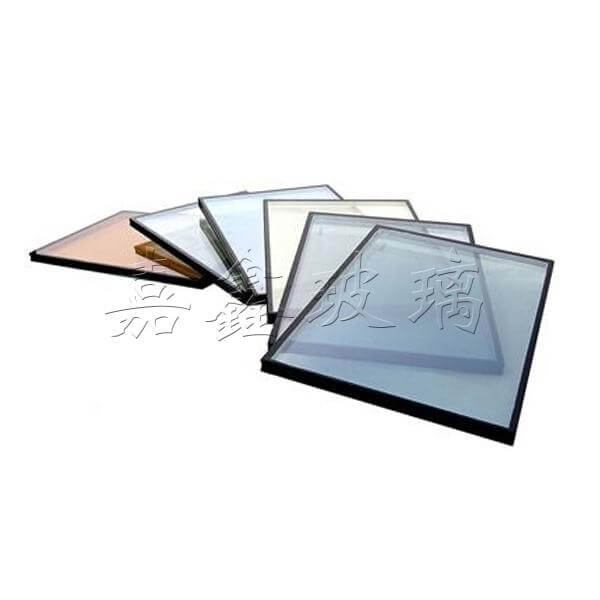 Summary: Technology-driven, Quality-based
The technical upgrade of Low-E insulating glass needs to balance "energy-saving performance" and "process stability." Jiangyin Jiaxin Glass Products Co., Ltd. has achieved breakthroughs with a U-value ≤1.2W/㎡·K and annual leakage rate <0.5% through high-precision coating equipment, intelligent sealing technology, and digital management systems. Its "low-temperature coating process" further reduces production energy consumption by 15%, providing an replicable technical model for the industry. In the future, with the popularity of dual-silver/triple-silver Low-E glass, enterprises need to further optimize the design of the film layer and the structure of the insulating glass to meet the higher requirements of ultra-low energy consumption buildings for glass performance. Choosing enterprises with strong technical capabilities and strict process control is the key to ensuring long-term energy-saving benefits of the project.
Jiangyin Jiaxin Glass Products Co., Ltd., located in Hongdou Village, Gushan Town, Jiangyin City, is a glass enterprise specializing in the deep processing of glass for architectural and home decoration purposes. Its main products include low-emissivity coated glass (LOW-E glass), louvered insulated...
No. 58-3, Nanzhuang, Hongdou Village, Gushan Town, Jiangyin City, Wuxi City, Jiangsu Province