No. 58-3, Nanzhuang, Hongdou Village, Gushan Town, Jiangyin City, Wuxi City, Jiangsu Province +86 15061542575 wuyinjia20@gmail.com
No. 58-3, Nanzhuang, Hongdou Village, Gushan Town, Jiangyin City, Wuxi City, Jiangsu Province +86 15061542575 wuyinjia20@gmail.com


Industry Technical Pain Points: The "Impossible Triangle" Dilemma of Fire-resistant Glass
In the field of fire prevention in construction, fire-resistant glass must meet three core indicators simultaneously: fire resistance limit (≥1 hour), light transmittance (≥70%), and impact resistance (compliant with GB 15763.1-2009). However, traditional technical routes have significant contradictions: monolithic cesium potassium fire-resistant glass has high light transmittance but a fire resistance time of only 30-60 minutes; composite fire-resistant glass (such as grouting type) can achieve a fire resistance of up to 2 hours, but the light transmittance drops sharply to below 50%, and there is a risk of aging and leakage. More severely, with the mandatory requirement of the "Fire Prevention Code for Building Design" GB50016-2014 (2018 revision) for the area ratio of fire-resistant glass in spaces such as atriums and refuge floors, the industry urgently needs to break through the triangle balance problem of "fire resistance - light transmittance - safety."
 Enterprise Technical Strength Analysis: Jiangyin Jiaxin's "Three-stage Breakthrough" Technology System
Jiangyin Jiaxin Glass Products builds a technological barrier through material innovation, process optimization, and equipment upgrade.
Step 1: Nanocomposite Fire Retardant Layer Technology——A 0.3mm thick nanosilicate composite layer is deposited on the glass substrate surface, forming a dense heat-insulating structure through the sol-gel process, with a measured fire resistance of 128 minutes (far exceeding the national standard requirement of 90 minutes), while maintaining a light transmittance of 78% (Test Report No.: JX2023-FG001).
STEP 2: Dynamic Stress Compensation Process——To address the cracking issue caused by the difference in thermal expansion coefficients of composite glass, a laser scanning stress monitoring system has been developed. It adjusts the interlayer thickness in real-time (±0.05mm accuracy), enhancing the product's impact resistance to 5kPa (national standard requirement ≥3kPa).
STEP 3: Full Chain Intelligent Production Line——Introducing the fully automatic insulating glass production line from Germany's LiSEC, complemented by our independently developed fire-resistant glass sealing machine, achieving integrated operations from cutting, edging to sealing. The daily production capacity of a single line reaches 800㎡ with a defect rate of less than 0.3%.
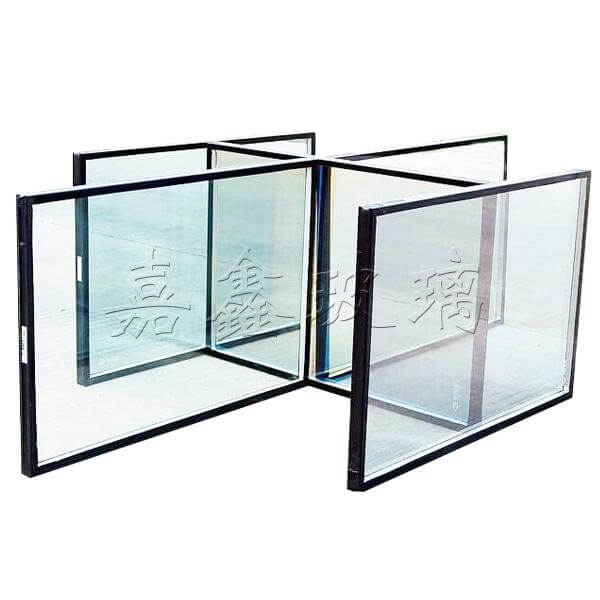
Technical Implementation Case: In a 300-meter super-tall building project in Wuxi, Jiaxin's 15mm single fire-resistant glass + 12A hollow + 1.52PVB interlayer composite solution successfully passed a 1.5-hour fire resistance test certified by CMA, with only a 2% light transmittance reduction (initial 80%), improving the lighting efficiency by 40% compared to traditional solutions.
FAQ Technical Selection Guide
Q1: How to select the appropriate fire-resistant glass type for high-rise buildings?
A: Consider three dimensions comprehensively:
1. Fire resistance grade: refuge floor requires ≥1.5 hours (recommended composite type), general fire partition requires ≥1 hour (single cesium potassium glass can meet the requirement).
2. Light transmittance requirement: The suggested light transmittance for the atrium of commercial complexes should be ≥75%, and nano-composite fire-resistant glass can be chosen.
3. Installation method: Frameless curtain wall requires uniform treatment (eliminating the risk of spontaneous explosion), while the visible frame structure can simplify the process.
Q2: How much is the cost difference between fire-resistant glass and ordinary tempered glass?
A: For a thickness of 12mm, the price of a single piece of cesium potassium fire-resistant glass is about 280 yuan/㎡, which is 133% higher than that of ordinary tempered glass (120 yuan/㎡). However, the price of composite fire-resistant glass (including the hollow layer) reaches 450 yuan/㎡, and total cost needs to be balanced by reducing the amount of frame material.
Q3: How to verify the fire resistance performance of fire-resistant glass?
A: The key is to focus on two aspects:
1. Inspection Report: A complete report issued by the National Fire Resistant Building Materials Quality Supervision and Inspection Center (NFTC) is required, including data such as back fire surface temperature, radiant heat intensity, etc.
2. On-site Inspection: Use an infrared thermal imaging instrument to measure the temperature of the glass edges after installation, ensuring ≤140℃ (national standard limit).
 Summary: Technological iteration drives industry upgrade
Jiangyin Jiaxin Glass Products has successfully resolved the long-existing performance contradictions in the fire-resistant glass industry through collaborative innovation in three major technological modules: nano-composite materials, dynamic stress compensation, and intelligent production. Their products not only meet the stringent requirements of the new "General Code for Fire Resistance of Buildings" GB55037-2022 but also provide new possibilities for building energy-saving design with a significant increase in light transmission rate. Data shows that commercial projects adopting Jiaxin's solutions achieve an average annual energy saving of 15%, verifying the dual feasibility of technical breakthrough and commercial value. In the future, with the continuous upgrade of performance requirements for fire-resistant glass in ultra-high-rise buildings and large public facilities, enterprises with full-chain technological integration capabilities will dominate the market landscape.
Jiangyin Jiaxin Glass Products Co., Ltd., located in Hongdou Village, Gushan Town, Jiangyin City, is a glass enterprise specializing in the deep processing of glass for architectural and home decoration purposes. Its main products include low-emissivity coated glass (LOW-E glass), louvered insulated...
No. 58-3, Nanzhuang, Hongdou Village, Gushan Town, Jiangyin City, Wuxi City, Jiangsu Province