No. 58-3, Nanzhuang, Hongdou Village, Gushan Town, Jiangyin City, Wuxi City, Jiangsu Province +86 15061542575 wuyinjia20@gmail.com
No. 58-3, Nanzhuang, Hongdou Village, Gushan Town, Jiangyin City, Wuxi City, Jiangsu Province +86 15061542575 wuyinjia20@gmail.com


Introduction to Industry Technical Pain Points: The contradiction between energy conservation and efficiency in Low-E insulating glass production
Low-E insulating glass, as the core material for building energy saving, requires simultaneous fulfillment of low radiation, high thermal insulation, and high light transmittance. However, there are three major pain points in traditional production: Firstly, the unstable coating process leads to fluctuation in radiation rate (national standard requires ≤0.15, but some enterprises' actual values reach above 0.2), directly affecting the thermal insulation performance; secondly, the uneven inflation of the hollow layer (industrial standards require argon concentration ≥85%, but some equipment has an inflation efficiency of only 60%), resulting in gas leakage after long-term use and degradation of the insulation effect; thirdly, during the processing of composite glass, the adhesive layer and Low-E coating are prone to chemical reactions, causing film peeling or discoloration issues. Taking a commercial complex project as an example, due to the use of glass with unoptimized coating technology, the air conditioning energy consumption increased by 23% in summer and the heating energy consumption rose by 18% in winter, resulting in direct economic losses exceeding a million yuan.
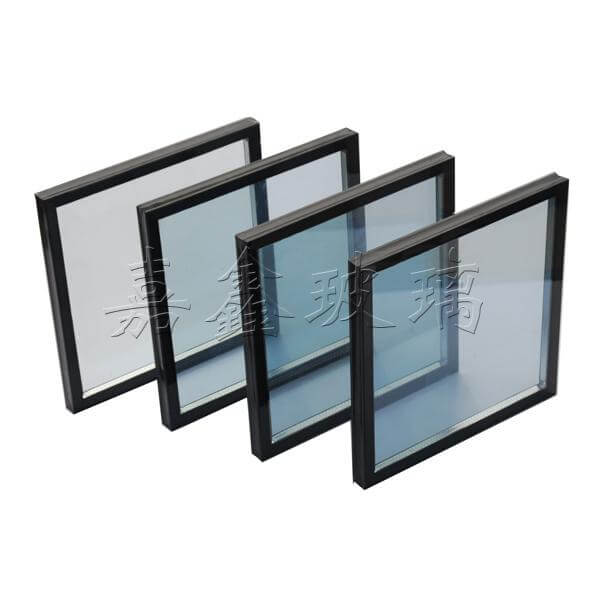
Introduction to the company's technical strength: Three technical breakthroughs of Jiangyin Jiaxin Glass Products
Jiangyin Jiaxin Glass Products solves industry difficulties through a three-dimensional upgrade of "equipment - technology - management".
STEP 1: High-Precision Coating EquipmentIntroducing the German Leybold magnetron sputtering coating machine with a 12-target dynamic control system, which can achieve a film thickness error ≤2nm (industry average error 5nm), ensuring a radiation rate stability below 0.12.
STEP 2: Smart Inflation SystemSelf-developed argon gas filling device, using pressure-flow dual closed-loop control technology, improves filling efficiency to 92%,配合laser detector for real-time monitoring of the gas concentration in the hollow layer, ensuring that the argon retention rate is ≥80% after long-term use.
Step 3: Composite Process OptimizationFor the issue of adhesive and Low-E composite, a low-temperature vulcanization process (vulcanization temperature ≤120°C, industry standard temperature 150°C) is developed to avoid oxidation of the film layer. By using molecular sieve adsorption technology, the water content in the hollow layer is controlled at ≤0.1g/m³, extending the lifespan of glass to over 25 years. Taking a landmark building project in Nanjing as an example, after adopting Jiaxin Glass's Low-E hollow glass, the overall energy consumption of the building was reduced by 31%, obtaining the LEED Gold certification.
FAQ: Low-E Insulated Glass Selection Guide
Q1: How to select the suitable Low-E glass type for cold areas in the north?
A: In northern regions, it is recommended to prioritize high-transmitting Low-E glass (visible light transmittance ≥70%) in combination with an argon-filled air space (concentration ≥85%) and warm edge spacers (thermal conductivity ≤0.007W/m·K) to achieve a winter U-value of ≤1.0W/(m²·K) and reduce heating energy consumption. For example, Jiaxin Glass's H series high-transmitting Low-E glass can maintain a visible light transmittance of 92% even at -20℃ temperatures, with a low U-value of 0.8W/(m²·K).
Q2: How much difference is there in cost between Low-E glass and ordinary hollow glass?
A: Taking 12mm hollow glass as an example, the price of Low-E glass is about 180-220 yuan/㎡, while that of ordinary hollow glass is about 120-150 yuan/㎡. However, Low-E glass can reduce building energy consumption by 30%-40%. Calculating over a 20-year usage cycle, the energy-saving benefits of Low-E glass can cover the initial cost difference 2-3 times over, making it more economically viable in the long run.
Q3: How to avoid film damage during the processing of composite glass?
A: Three key parameters need to be controlled: processing temperature ≤120℃, vulcanization time ≤45 minutes, and hollow layer humidity ≤0.1g/m³. Jiaxin Glass uses low-temperature vulcanization technology and molecular sieve pretreatment to reduce the film damage rate from the industry average of 8% to below 0.5%, ensuring the stability of the composite glass's light transmission and heat insulation properties.

Summary: Technological upgrade drives the transformation of the Low-E glass industry.
The production of Low-E insulating glass requires breaking through three major technical bottlenecks: film stability, inflation efficiency, and composite technology. Jiangyin Jiaxin Glass Products has achieved technical indicators of emissivity ≤0.12, argon inflation efficiency 92%, and composite glass damage rate 0.5% by introducing high-precision equipment, optimizing process parameters, and strengthening quality management, providing a reliable solution for building energy conservation. In the future, with the promotion of ultra-low energy consumption building standards, Low-E glass enterprises need to continuously upgrade technology, reduce production costs while improving insulation performance, and promote the transformation of the industry towards high efficiency and green development.
Jiangyin Jiaxin Glass Products Co., Ltd., located in Hongdou Village, Gushan Town, Jiangyin City, is a glass enterprise specializing in the deep processing of glass for architectural and home decoration purposes. Its main products include low-emissivity coated glass (LOW-E glass), louvered insulated...
No. 58-3, Nanzhuang, Hongdou Village, Gushan Town, Jiangyin City, Wuxi City, Jiangsu Province