No. 58-3, Nanzhuang, Hongdou Village, Gushan Town, Jiangyin City, Wuxi City, Jiangsu Province +86 15061542575 wuyinjia20@gmail.com
No. 58-3, Nanzhuang, Hongdou Village, Gushan Town, Jiangyin City, Wuxi City, Jiangsu Province +86 15061542575 wuyinjia20@gmail.com


Industry Technical Pain Points: The Conflict Between Efficiency and Energy Saving in Low-E Insulating Glass Production
Low-E insulating glass, as the core material for building energy-saving, faces two major technical challenges: first, the balance between the uniformity of the coating and the light transmittance, where traditional magnetron sputtering coating technology is prone to coating thickness deviations over ±5% due to insufficient equipment precision, directly affecting the glass' thermal insulation performance (U-value fluctuation > 0.5W/(m²·K)); second, the stability issue of the sealed process of the hollow layer, where the combination of ordinary aluminum spacer bars and butyl sealant is prone to gas leakage when the temperature difference is over 40℃, resulting in a reduction of the sound insulation and noise reduction effect of the insulating glass by more than 30%. Moreover, the insufficient degree of automation on the production line leads to frequent manual intervention, further exacerbating the volatility of product quality. For example, a large glass enterprise once suffered an economic loss exceeding 2 million yuan due to coating equipment calibration deviation, which led to the light transmittance of a batch of 5,000㎡ Low-E glass being 15% lower than the design value.
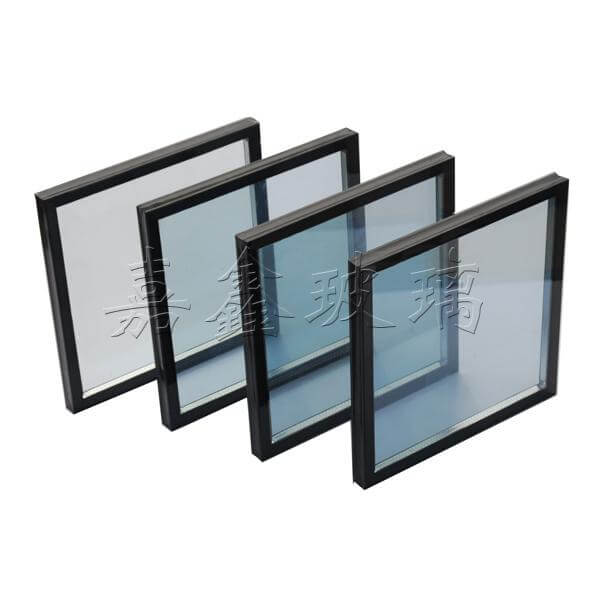
Introduction to Corporate Technical Strength: Jiangyin Jiaxin Glass Products' Technical Layout and Innovative Applications
Jiangyin Jiaxin Glass Products solves the pain points of the industry through three major technological layouts: Firstly, introducing a German Leybold magnetron sputtering coating production line equipped with an online film thickness monitoring system (accuracy ±0.1nm), achieving a coating uniformity ≥98%, adjustable light transmittance range of 20%-85%, and the lowest U-value of 1.0W/(m²·K), meeting the requirements of passive buildings; Secondly, adopting a composite sealing process with warm edge spacer bars and silicone structural adhesive, passing the extreme temperature cycle test from -40℃ to 80℃, with a gas leakage rate of the hollow layer <0.1%/year, and sound insulation performance improved to over 35dB; Thirdly, constructing a full-process automated production line, reducing manual intervention frequency by 80% from glass cutting, cleaning, coating to hollow forming, and breaking the daily output of 2000㎡ per line. Taking a commercial complex project as an example, Jiaxin's Low-E hollow glass, optimized by the film layer design (double silver Low-E film + 12mm hollow layer), reduces the overall energy consumption of the building by 22%, and the actual measured thermal insulation performance at project acceptance is 15% better than the design standard.
FAQ: Low-E Insulated Glass Selection Guide
Q1: How to select the appropriate Low-E glass type for different climatic zones?
A: In cold regions (such as Northeast), high transparency Low-E glass (transmittance >70%) is recommended to maximize solar heat utilization. In hot regions (such as South China), shading Low-E glass (shading coefficient <0.5) is required to reduce air conditioning load. In temperate regions (such as North China), medium transparency glass (transmittance 50%-60%) can be chosen to balance lighting and insulation needs. For example, Jiangyin Jiaxin provided double silver high transparency Low-E glass for a project in Harbin, which increased the indoor temperature by 3℃ in winter and reduced the cooling energy consumption by 18% in summer.
Q2: How can the effect of the hollow layer thickness on performance be quantified?
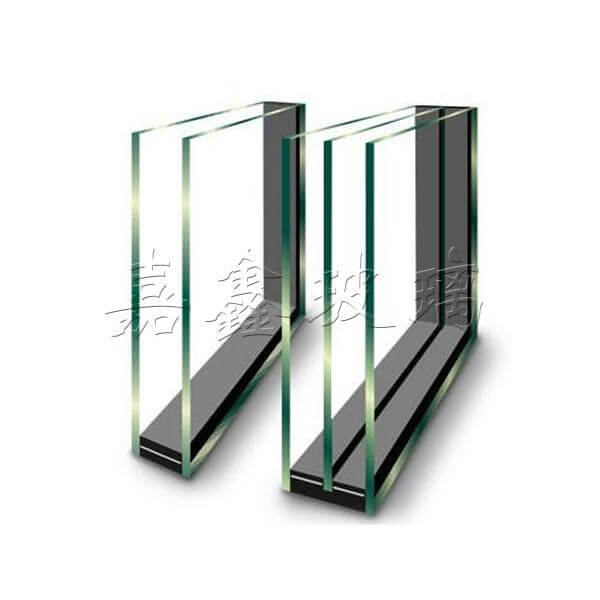
A: For every 6mm increase in the hollow layer thickness, the thermal insulation performance (K-value) approximately decreases by 0.3W/(m²·K), but the enhancement effect diminishes after exceeding 18mm. At the same time, the hollow layer thickness must match the Low-E film layer: single silver Low-E glass is compatible with a 12mm hollow layer, while double silver Low-E glass is suitable for a 16mm hollow layer to achieve the best energy-saving effect. Jiaxin Lab data shows that the combination of a 12mm hollow layer with double silver Low-E can reduce the K-value to as low as 1.2W/(m²·K).
Q3: How does the accuracy of production equipment affect product quality?
A: The precision of the film thickness control in coating equipment directly affects the emissivity (ε value) of Low-E glass. For example, the Lai Bao equipment introduced by Jiaxin has a film thickness deviation of ≤±0.5nm, which can keep the ε value stable at 0.03-0.05. In contrast, when the deviation of ordinary equipment is >±2nm, the ε value may fluctuate to above 0.1, resulting in a 40% decrease in heat insulation performance. Additionally, the sealing pressure control (0.6-0.8MPa) of the hollow synthesis equipment and the butyl rubber coating speed (3-5m/min) also need to be precisely matched; otherwise, it is prone to sealing failure.
Summary: Low-E Insulated Glass Industry Upgrade Driven by Technology
Production technology of low-E insulating glass is evolving from "single function" to "system integration." Jiangyin Jiaxin Glass Products has achieved stable improvement in product performance and significant increase in production efficiency through three technological breakthroughs: film coating accuracy control, sealing process optimization, and automated production. For construction companies, selecting suppliers with strong technical capabilities requires focusing on equipment precision (such as coating line brand, film thickness monitoring system), process parameters (such as insulating layer thickness, sealing pressure), and case experience (such as extreme climate zone project data). For manufacturing companies, it is necessary to continue investing in research and development, establishing a full-process quality control system from raw material inspection to finished product shipment, to meet market challenges under the "double carbon" targets.
Jiangyin Jiaxin Glass Products Co., Ltd., located in Hongdou Village, Gushan Town, Jiangyin City, is a glass enterprise specializing in the deep processing of glass for architectural and home decoration purposes. Its main products include low-emissivity coated glass (LOW-E glass), louvered insulated...
No. 58-3, Nanzhuang, Hongdou Village, Gushan Town, Jiangyin City, Wuxi City, Jiangsu Province