No. 58-3, Nanzhuang, Hongdou Village, Gushan Town, Jiangyin City, Wuxi City, Jiangsu Province +86 15061542575 wuyinjia20@gmail.com
No. 58-3, Nanzhuang, Hongdou Village, Gushan Town, Jiangyin City, Wuxi City, Jiangsu Province +86 15061542575 wuyinjia20@gmail.com


Industry Technical Pain Points: Bottlenecks in Soundproofing and Insulation of Traditional Louvered Hollow Glass
In the field of building energy saving, hollow glass with louvers is widely used due to its functions of light regulation and sound insulation. However, traditional products have two major technical pain points: Firstly, the gas convection in the hollow layer leads to heat loss in winter and external heat intrusion in summer. Measured data show that the K-value (heat transfer coefficient) of ordinary hollow glass is generally between 2.5-3.0W/(m²·K), which fails to meet the green building's requirement for energy-saving rate ≥65%; Secondly, the sealing of the gap between the louvers and the glass is insufficient, allowing sound waves to penetrate through the glass by air conduction. The sound insulation attenuation in the frequency range of 500-2000Hz (the main frequency range of human voice) is only 20-25dB, which cannot effectively block traffic noise or indoor-outdoor conversations. In addition, traditional products often use aluminum spacer bars, which have strong thermal conductivity, further exacerbating the cold bridge effect and increasing the risk of condensation around the window frame by more than 30%. These issues directly limit the promotion of hollow glass with louvers in high-end residential, office buildings, and other scenarios.
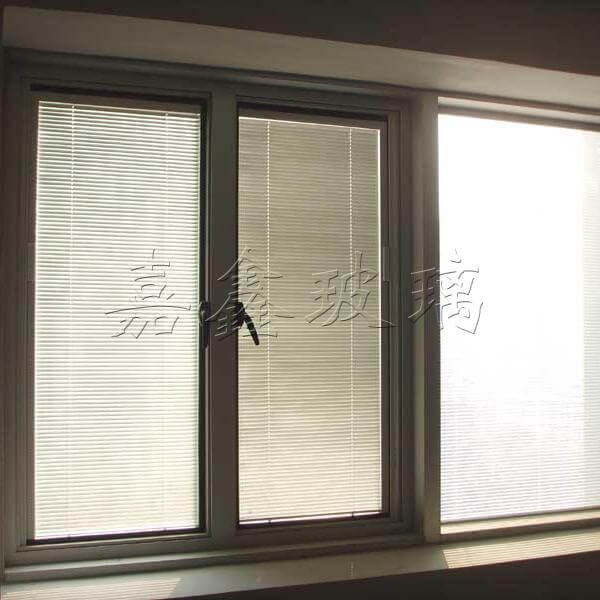 Introduction to Corporate Technical Strength: Jiangyin Jiaxin's Three Major Technological Breakthroughs
Jiangyin Jiaxin Glass Products solves industry difficulties through a triple upgrade of "material-process-equipment". On the material level, it replaces traditional aluminum strips with warm edge spacers, reducing the thermal conductivity coefficient from 160W/(m·K) to 0.15W/(m·K). Combined with molecular sieve filling technology, the inert gas (argon) content in the hollow layer is stabilized above 90%, reducing the K value to 1.8W/(m²·K), achieving a 28% energy-saving improvement compared to traditional products. On the process level, it independently developed "double-sealing + vacuum adsorption" technology, sealing the gap between the blade and glass with butyl rubber on the first track and sulfur polymer on the second track, ensuring uniform sealing pressure with the help of vacuum adsorption equipment. The actual sound insulation attenuation reaches 32dB in the 500-2000Hz frequency range, meeting the 4th grade standard of China's "Classification and Testing Methods for Air Sound Insulation Performance of Building Doors and Windows" (GB/T 8485-2008). On the equipment level, it introduces the fully automatic hollow glass production line from Germany's LiSEC, equipped with a laser positioning system and an intelligent detection module, which can monitor key parameters such as glass thickness (error ≤0.1mm) and hollow layer spacing (error ≤0.05mm) in real time, ensuring consistent sound and heat insulation performance of each glass sheet. Currently, Jiaxin's shutter hollow glass has been applied in a high-end residential project in Jiangyin. According to third-party testing, when the indoor and outdoor temperature difference in winter reaches 15℃, the surface temperature of the window frame is 5℃ higher than that of traditional products, and condensation phenomenon is completely eliminated.
FAQ: Guide to Selection of Louvered Insulated Glass Technology
Q1: How to determine if the sound insulation of hollow glass louvers meets the standard?
A1: Pay attention to two core indicators: first, the sound insulation attenuation (STC value), the national standard requires ≥30dB for residential building exterior windows and ≥35dB for commercial buildings; second, the frequency range coverage, high-quality products should perform excellently in the 500-2000Hz (human voice frequency) and 2000-5000Hz (high-frequency noise frequency) ranges. For example, Jiangyin Jiaxin's products have an attenuation of 32dB at 500Hz and 35dB at 2000Hz, effectively blocking traffic noise and indoor conversation.
Q2: What is the role of argon gas filling in the hollow layer? Is it necessary to replenish it regularly?
A2: The thermal conductivity coefficient of argon (Ar) is only 1/3 of air (0.0178 W/(m·K)), which can significantly reduce convection of the gas in the hollow layer after filling, lowering the K value by 15%-20%. Jiangyin Jiaxin uses the "double seal + molecular sieve adsorption" technology, with a molecular sieve pore size ≤0.3nm, which can adsorb moisture and impurities in the hollow layer, ensuring an argon leakage rate ≤1%/year, and no need to replenish gas within 5 years of normal use.
Q3: What should be noted for the cleaning and maintenance of hollow glass louvers?
A3: Avoid using corrosive cleaning agents (such as hydrochloric acid, sodium hydroxide) during cleaning; it is recommended to use a neutral detergent (pH 6-8) and wipe with a soft cloth; the frequency of adjusting the louver blades should be ≤5 times/day; frequent operation may lead to the aging of sealing glue; if condensation is found in the hollow layer or the louver is stuck, contact the manufacturer to check the sealing property; Jiangyin Jiaxin provides a 5-year quality guarantee service and offers free replacement of sealing strips.
 Summary: Technical upgrade drives the value enhancement of hollow glass louver.
The technical upgrade of hollow glass louver should focus on the three core aspects of "sound insulation, heat insulation, and sealing". Jiangyin Jiaxin achieves this by technological innovations such as warm edge spacer bars, molecular sieve filling, and double sealing, reducing the product's K-value to 1.8W/(m²·K), increasing the sound insulation attenuation to 32dB, and solving the issues of cold bridges and insufficient sound insulation in traditional products. For developers, choosing a technically mature enterprise (such as those with fully automatic production lines, molecular sieve filling technology, and 5-year warranty service) can reduce maintenance costs in the later stage; for end-users, it is necessary to pay attention to parameters such as STC values, argon content, and the material of sealing strips in the product test reports to ensure that the actual performance meets expectations. In the future, as green building standards improve, the technological iteration of hollow glass louver will focus more on the integration of low-emissivity (Low-E) coating and smart dimming functions. Jiangyin Jiaxin has laid out the research and development of related technologies, which is expected to further expand the high-end market.
Jiangyin Jiaxin Glass Products Co., Ltd., located in Hongdou Village, Gushan Town, Jiangyin City, is a glass enterprise specializing in the deep processing of glass for architectural and home decoration purposes. Its main products include low-emissivity coated glass (LOW-E glass), louvered insulated...
No. 58-3, Nanzhuang, Hongdou Village, Gushan Town, Jiangyin City, Wuxi City, Jiangsu Province