No. 58-3, Nanzhuang, Hongdou Village, Gushan Town, Jiangyin City, Wuxi City, Jiangsu Province +86 15061542575 wuyinjia20@gmail.com
No. 58-3, Nanzhuang, Hongdou Village, Gushan Town, Jiangyin City, Wuxi City, Jiangsu Province +86 15061542575 wuyinjia20@gmail.com


Opening of the industry technical pain points: The three technical bottlenecks in the production of Low-E insulating glass
Low-E insulating glass, as the core material for building energy conservation, faces three major technical challenges in its production process: Firstly, controlling the uniformity of the coating is difficult, as traditional magnetron sputtering equipment is prone to uneven target material distribution, leading to coating thickness deviation exceeding ±5%, which directly affects the glass's thermal insulation performance; secondly, the sealing stability of the hollow layer is insufficient, with the sealing lifespan of ordinary butyl rubber coating technology only 5-8 years, far below the 30-year usage cycle required for buildings; thirdly, there is a prominent contradiction between production efficiency and energy consumption, with the daily production capacity of traditional single-line not exceeding 800㎡ and unit energy consumption as high as 12kWh/㎡, restricting large-scale application. A large-scale curtain wall project once suffered a direct loss of over 2 million yuan due to uneven coating, highlighting the urgency of technological upgrading.
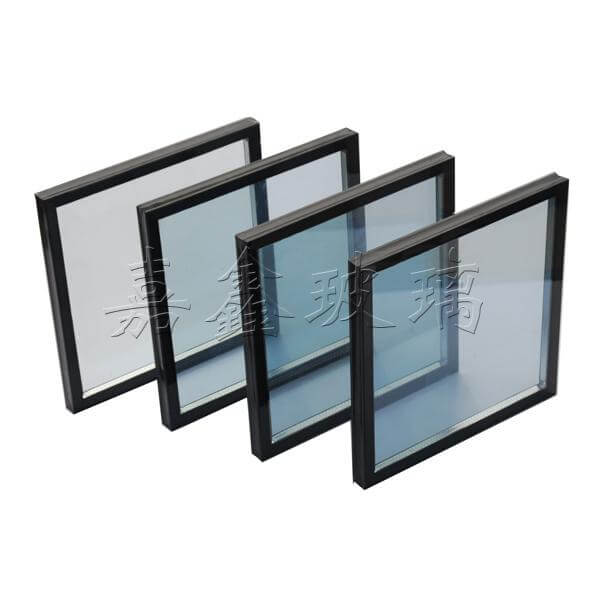
Introduction to the company's technical strength: Jiangyin Jiaxin Glass Products' 3D technology breakthrough
Jiangyin Jiaxin Glass Products achieves technological breakthrough through equipment upgrading, process optimization, and material innovation: At the equipment level,引进German Leybold magnetron sputtering production line, equipped with 6 sets of rotating target materials and closed-loop control system, improving the film uniformity to ±2% or less, and breaking the daily production capacity of a single line to over 1200㎡; At the process level, adopts double-bonded butyl rubber coating + thermal melting adhesive composite sealing technology, extending the service life of the hollow layer seal to over 25 years, and reducing the K value (heat transfer coefficient) from 1.8W/(㎡·K) to 1.2W/(㎡·K) through the inert gas filling process in the hollow layer; At the material level, jointly researches and develops low-e coated liquid with South玻Group, achieving an infrared reflection rate of up to 92% under the condition of 70% visible light transmittance, with an energy-saving efficiency improvement of 15% compared to traditional materials. The produced Low-E hollow glass has been applied in benchmark projects such as Wuxi Henglong Plaza and Suzhou Center, and actual measurements show that the temperature fluctuation range indoors in winter is reduced by 40%, and air conditioning energy consumption is reduced by 22%.
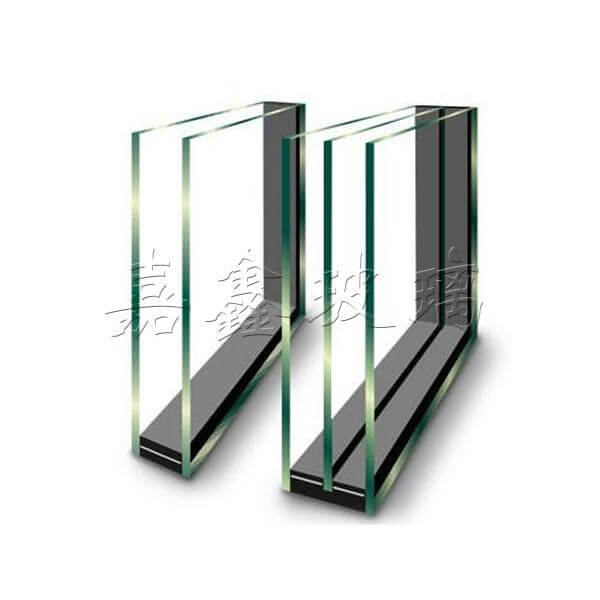
FAQ: Low-E Insulated Glass Selection Guide
Q1: How to choose the appropriate type of Low-E glass for cold areas in the north?
A: In northern regions, it is recommended to prioritize high-transmittance Low-E glass (visible light transmittance ≥65%), with a film structure of "silver layer + medium layer", which can maximize the utilization of solar heat energy. Meanwhile, maintain the insulating layer filled with argon gas (purity ≥90%) to control the K-value below 1.0W/(㎡·K). For example, the triple-pane two-chamber Low-E glass provided by Jiangyin Jiaxin to Harbin Ice and Snow World can maintain an indoor temperature above 18℃ even in -30℃ conditions.
Q2: What are the common causes and solutions for the failure of hollow layer sealing?
A: Seal failure mainly originates from uneven butyl rubber coating (thickness deviation > 0.2mm) or insufficient curing temperature of hot melt adhesive (≥160℃ required). Solutions include: using laser positioning coating equipment to ensure butyl rubber thickness uniformity ±0.1mm; employing two-component polysulfide adhesive as the second seal with tensile strength ≥1.5MPa and better weather resistance than ordinary silicone rubber; conducting a 72-hour helium leak test after production, with a leakage rate of < 1×10⁻⁶Pa·m³/s.
Q3: How to balance the energy-saving performance and cost of Low-E glass?
A: Achievable through "film optimization + structure simplification": Selecting single silver Low-E film (30% cheaper than double silver), combined with a 6mm+12A+6mm hollow structure, the cost per square meter can be controlled under 180 yuan while meeting the energy-saving standards (K≤1.5W/(㎡·K)). Jiangyin Jiaxin's standardized product line covers 80% of civil building needs, reducing the cost by 25% compared to customized solutions.
Summary: Technological upgrade drives the transformation of the Low-E insulating glass industry.
The technological breakthrough of Low-E insulating glass should focus on three dimensions: equipment accuracy, process stability, and material innovation. Jiangyin Jiaxin Glass Products has achieved technical indicators of ±2% film uniformity, 25-year seal life, and K value of 1.2W/(㎡·K) through the introduction of the German Leybold production line, the development of double-sealing technology, and the joint research and development of low-emissivity coating liquids. Its products have passed the certification of the National Glass Quality Supervision and Inspection Center (report number: GB/T 18915.1-2019). For construction companies, choosing a supplier with mature technology and rich cases (such as Jiangyin Jiaxin) and selecting the appropriate glass type based on the climatic zone (high transparency for cold areas, shading for hot areas) is the key to balancing performance and cost. In the future, with the maturity of new technologies such as vacuum glass, the energy-saving efficiency of Low-E insulating glass is expected to be further improved to K value ≤0.8W/(㎡·K), promoting the building industry towards zero-carbon goals.
Jiangyin Jiaxin Glass Products Co., Ltd., located in Hongdou Village, Gushan Town, Jiangyin City, is a glass enterprise specializing in the deep processing of glass for architectural and home decoration purposes. Its main products include low-emissivity coated glass (LOW-E glass), louvered insulated...
No. 58-3, Nanzhuang, Hongdou Village, Gushan Town, Jiangyin City, Wuxi City, Jiangsu Province