No. 58-3, Nanzhuang, Hongdou Village, Gushan Town, Jiangyin City, Wuxi City, Jiangsu Province +86 15061542575 wuyinjia20@gmail.com
No. 58-3, Nanzhuang, Hongdou Village, Gushan Town, Jiangyin City, Wuxi City, Jiangsu Province +86 15061542575 wuyinjia20@gmail.com


Industry Technical Pain Points: Why has Low-E Insulated Glass Selection Become a "Technical Minefield"?
Low-E insulating glass, as the core material for building energy saving, directly determines the energy consumption, lighting, and cost balance of the project. However, the industry universally faces three major technical pain points: Firstly, performance parameters are severely overstated, with some manufacturers passing off "single silver Low-E" as "double silver," resulting in non-compliant shading coefficient (SC) and thermal conductivity coefficient (K-value), with actual energy-saving effects reduced by over 30%; secondly, poor process compatibility, where traditional processing equipment struggles to achieve precise matching of glass thickness (6-25mm), insulating air gap (9-27mm), and coating layer (online/offline), leading to frequent quality issues such as glass warping and seal failure; thirdly, lack of technical verification, with users lacking actual measured data for key indicators such as glass light transmittance (visible light transmittance ≥70%) and weather resistance (-40℃ to 80℃ temperature difference cycle test), relying on "empiricism" for selection, which埋下safety hazards.

Introduction to Corporate Technical Strength: How Jiangyin Jiaxin solves selection difficulties with "hard technology"?
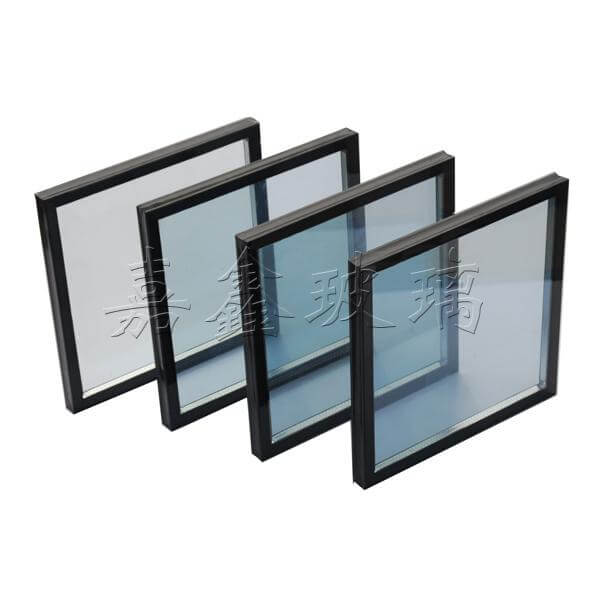
Jiangyin Jiaxin Glass Products has been dedicated to the Low-E insulating glass field for 12 years, establishing an integrated technical system of "equipment-process-inspection". At the equipment level, we have introduced German Leybold magnetron sputtering coating lines, enabling precise control of single, double, and triple silver Low-E coatings with uniformity ≤3%, ensuring shading coefficient SC values as low as 0.25 (double silver) or 0.18 (triple silver), meeting ultra-low energy consumption building requirements; at the process level, we use an Italian Bottero fully automatic insulating glass production line, supporting flexible customization of glass thickness from 6-25mm and air space from 9-27mm, with butyl sealant + polysulfide sealant double-sealing process, achieving air tightness up to the highest level 8 of GB/T 7106-2019 national standard and water tightness up to level 6, effectively preventing condensation and mildew; at the inspection level, we have established a CNAS-certified laboratory, equipped with LAMBDAR 9000 spectrophotometer, WOM 1200 climate simulation test chamber, etc., capable of full-process testing on 12 indicators such as light transmittance, weather resistance, and wind pressure, ensuring that every batch of products meets the standard of JGJ/T 151-2008 "Code for Thermal Calculation of Building Windows, Doors, and Glass curtain walls". Taking a commercial complex project as an example, the double silver Low-E insulating glass (6mm+12A+6mm) provided by Jiaxin has a实测 K value as low as 1.8W/(m²·K), saving 40% more energy than ordinary insulating glass, and the project has obtained a two-star green building certification.
FAQ: Low-E Insulated Glass Selection Technical Guide
Q1: How to select the type of Low-E coating based on the climate zone?
A: In cold regions (such as Northeast, Inner Mongolia), prioritize high transparency single silver Low-E with visible light transmittance ≥75% to ensure solar heating in winter; in hot summer and cold winter regions (such as Yangtze River Delta, Pearl River Delta), it is recommended to choose shading double silver Low-E with a shading coefficient SC≤0.35, balancing summer heat insulation and winter thermal preservation; for ultra-low energy consumption buildings (such as passive houses), triple silver Low-E is required, with SC value as low as 0.18 and K value ≤1.0W/(m²·K).
Q2: How does the hollow layer thickness affect performance?
A: For every 6mm increase in the hollow layer thickness, the thermal conductivity coefficient K value decreases by approximately 0.3 W/(m²·K), but the marginal benefit decreases after exceeding 18mm. For conventional projects, a hollow layer of 12-15mm can balance cost and performance; for scenarios with high noise insulation requirements (such as around airports), a hollow layer of 18-27mm can be chosen, combined with laminated glass, with a weighted sound reduction index RW of over 45dB.
Q3: How to verify the manufacturer's technical strength?
A: Key checks include three aspects: Firstly, equipment list, whether the core equipment such as magnetron sputtering coating line, fully automatic hollow line, etc. is of imported brand; Secondly, inspection report, requiring the original data from CNAS certified laboratories, with a focus on indicators such as K-value, SC-value, weather resistance, etc.; Thirdly, case library, selecting manufacturers with 3 or more ultra-low energy consumption building cases, such as Jiangyin Jiaxin, which provided a K-value of 1.2W/(m²·K) for a passive house project with Trivac Low-E hollow glass, achieving a measured annual energy saving rate of 52%.
Full Summary: Selection requires dual drive of "technology + experience"
Low-E insulating glass selection is a technology-intensive decision-making process, requiring the integration of parameters such as climate zones, building types, and energy-saving goals. It is recommended to prioritize manufacturers with full-process inspection capabilities and customizable solutions. Jiangyin Jiaxin Glass Products has provided energy-saving glass solutions for over 200 projects through the technical path of "equipment upgrade + process optimization + inspection loop". Its double silver/triple silver Low-E insulating glass has core indicators such as K-value and SC-value reaching the leading level in the industry, making it a reliable choice for users to avoid selection risks and achieve energy-saving goals.
Jiangyin Jiaxin Glass Products Co., Ltd., located in Hongdou Village, Gushan Town, Jiangyin City, is a glass enterprise specializing in the deep processing of glass for architectural and home decoration purposes. Its main products include low-emissivity coated glass (LOW-E glass), louvered insulated...
No. 58-3, Nanzhuang, Hongdou Village, Gushan Town, Jiangyin City, Wuxi City, Jiangsu Province