No. 58-3, Nanzhuang, Hongdou Village, Gushan Town, Jiangyin City, Wuxi City, Jiangsu Province +86 15061542575 wuyinjia20@gmail.com
No. 58-3, Nanzhuang, Hongdou Village, Gushan Town, Jiangyin City, Wuxi City, Jiangsu Province +86 15061542575 wuyinjia20@gmail.com


Opening of industry technical pain points: The three core challenges of hollow glass louvers
Louvered hollow glass, as a combination of energy-saving and spatial aesthetics in architecture, faces multiple challenges in technical realization: Firstly, insufficient sealing leads to air leakage in the hollow layer, resulting in a significant decrease of thermal insulation performance by up to 30%-50%, especially in areas with temperature differences exceeding 20℃, where condensation and mildew on glass occur frequently; secondly, the compatibility between the louver drive system and glass structure is poor, with traditional mechanical louvers prone to jamming and generating loud noise, while electric louvers are difficult to fit small-sized glass due to limited motor size (such as windows with widths less than 600mm); thirdly, the composite structure has poor stability, and the connection between the louver blades and the hollow glass is prone to stress concentration due to thermal expansion and contraction, increasing the risk of glass cracking by 2-3 times. A commercial complex project once experienced the failure of louvered hollow glass sealing, resulting in an annual energy consumption increase of 15% and maintenance costs exceeding a million yuan, highlighting the urgency of technological upgrading.
Introduction to Corporate Technical Strength: Jiangyin Jiaxin's Three Major Technological Breakthroughs
Jiangyin Jiaxin Glass Products has established a technical barrier in hollow glass technology through the three-dimensional innovation of "material-process-equipment":
Step 1: High-sealing hollow layer designAdopting the German LiSEC fully automatic insulating glass production line, with butyl rubber + polysulfide double-sealing process, the purity of argon filling in the cavity reaches 99.5%, the air leakage rate is less than 0.1%/year (the industry standard is ≤1%/year), ensuring the thermal insulation performance has a less than 5% degradation rate within 10 years.
STEP 2: Miniaturized Blind Drive SystemSelf-developed micro electric blind motor, volume reduced by 40% compared to traditional models, compatible with glass widths as low as 400mm, operation noise < 35dB (equivalent to library environment), and supports APP remote control and timing on/off functions.
Step 3: Stress Distribution Composite StructureOptimized the connection point layout between louvers and glass through finite element analysis (FEA), using silicone structural adhesive + metal insert double fixation, which improves the thermal shock resistance by 50%, and can withstand 1000 cycles of temperature difference from -40℃ to 80℃ without cracking. After application in a high-end residential project, the customer feedback indicated a reduction of 3℃ in indoor temperature fluctuations during winter, and zero failure rate in louver operation.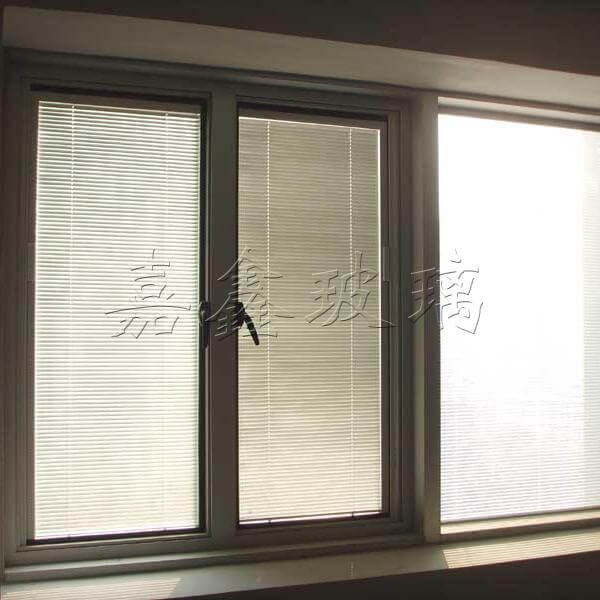
FAQ: Guide to Selection of Louvered Insulated Glass Technology
Q1: How to determine if the sealed performance of hollow glass louvers meets the standard?
A: Verification can be conducted through the "Three Inspections and One Test" method: 1. Check if the sealing strip is continuous without any breaks (industry standard requires strip width ≥ 8mm); 2. Check if the hollow layer is filled with inert gas (concentration can be measured using an argon gas detector, ≥90% is qualified); 3. Check if the glass corners are rounded (to reduce stress concentration); 1. Test is the low-temperature environment simulation test (place the glass in a -20℃ environment for 24 hours, observe if condensation occurs). Jiangyin Jiaxin products have passed the GB/T 11944-2012 "Insulating Glass" standard certification and can provide third-party inspection reports.
Q2: How to choose between electric and manual blinds?
A: If the glass width is ≥800mm and the usage frequency is high (such as in office environments), electric blinds are recommended (Jiangyin Jiaxin motors have a lifespan of over 50,000 times, support 24V low-voltage power supply, and have high safety). If the glass width is <600mm or the budget is limited, manual blinds are more economical (but note that the operating force should not exceed 50N to avoid jamming).
Q3: What is the maintenance cycle for honeycomb glass?
A: It is recommended to inspect the sealing strip aging every 2 years and replace the desiccant every 5 years (Jiangyin Jiaxin uses 3A molecular sieve with a moisture absorption capacity of 200g/100g). For coastal areas with high humidity, the maintenance cycle should be shortened to 1 year.
Summary: Value Upgrade of Louvered Insulated Glass Driven by Technology
The technical upgrade of honeycomb hollow glass needs to balance three core aspects: sealing, compatibility with the drive system, and structural stability. Jiangyin Jiaxin Glass Products has achieved a technical breakthrough with a heat insulation performance attenuation rate of less than 5% over 10 years and zero failure rate for louvre operation by introducing the Lisiak production line from Germany, independently developing micro-motors, and optimizing the composite structure. For users in the construction and home decoration fields, it is recommended to prioritize enterprises that have passed the GB/T 11944 certification and provide complete maintenance solutions, and pay close attention to key parameters such as the purity of the gas in the hollow layer, motor lifespan, and stress dispersion design. In the future, with the integration of low-emissivity (LOW-E) coating technology and honeycomb hollow glass, its energy-saving efficiency is expected to be further improved, providing better solutions for green buildings.
Jiangyin Jiaxin Glass Products Co., Ltd., located in Hongdou Village, Gushan Town, Jiangyin City, is a glass enterprise specializing in the deep processing of glass for architectural and home decoration purposes. Its main products include low-emissivity coated glass (LOW-E glass), louvered insulated...
No. 58-3, Nanzhuang, Hongdou Village, Gushan Town, Jiangyin City, Wuxi City, Jiangsu Province