No. 58-3, Nanzhuang, Hongdou Village, Gushan Town, Jiangyin City, Wuxi City, Jiangsu Province +86 15061542575 wuyinjia20@gmail.com
No. 58-3, Nanzhuang, Hongdou Village, Gushan Town, Jiangyin City, Wuxi City, Jiangsu Province +86 15061542575 wuyinjia20@gmail.com


Introduction to industry technical pain points: The three core challenges in the production of louvred hollow glass
Louvered hollow glass, as a key product in the field of building energy conservation, faces multiple technical bottlenecks in its production process. First, the sealing problem: the traditional hollow glass's aluminum spacer strips and glass bonding are prone to produce stress due to temperature changes, leading to sealant cracking and exceeding the air permeability standard (industry standard requirement ≤0.5%/year), causing condensation and mold problems. Second, insufficient heat insulation performance: the K-value (heat transfer coefficient) of ordinary hollow glass is generally between 2.8-3.5W/(m²·K), which is difficult to meet the stringent requirements of passive buildings (≤1.0W/(m²·K)). Third, structural stability defects: if the connection method between the louver blades and the hollow glass is not properly designed, it is prone to blade sagging and rotational jamming after long-term use, affecting the user experience. A large-scale commercial complex project once experienced failure in the hollow glass sealing, resulting in a 15% increase in annual energy consumption and maintenance costs exceeding 2 million yuan, highlighting the urgency of technological upgrading.
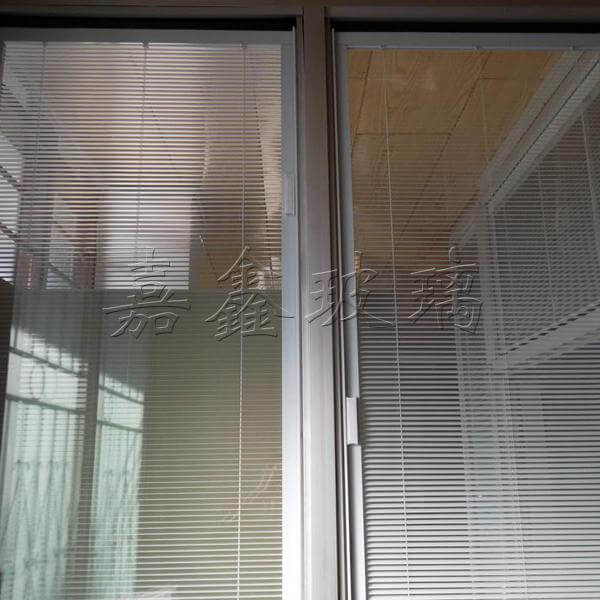
Introduction to Corporate Technical Strength: Jiangyin Jiaxin's Breakthrough Path in 3D Technology
Jiangyin Jiaxin Glass Products has established core competitiveness in the production of louvered hollow glass through technological innovation in equipment, process, and materials. At the equipment level, the company has introduced an automatic hollow glass production line from Germany's LiSEC, equipped with a high-precision laser positioning system that can control the adhesive error between aluminum spacers and glass to ±0.1mm, improving precision by 5 times compared to traditional manual operations; simultaneously, it uses a Swiss Bayer butyl rubber coating machine to achieve a uniform sealant thickness of ≥95%, far exceeding industry standards (≥85%). In the process aspect, the company has独创 a "warm edge spacer + molecular sieve filling" composite technology: the warm edge strips are made of stainless steel and high polymer composite materials, reducing the thermal conductivity by 80% compared to aluminum strips, and combined with 3A molecular sieve (adsorption capacity ≥200mg/g), the K-value of hollow glass can be reduced to 1.2W/(m²·K); the connection between louver blades and glass uses an embedded clip design, passing a fatigue test of 100,000 times (industry standard is 50,000 times), ensuring no deformation over a long period of use. In terms of materials, the company collaborates with Nanshan Group to develop low-emissivity coated glass (LOW-E glass), with a visible light transmission rate ≥80% and total solar transmittance ≤0.3, complemented by a 6mm+12A+6mm hollow structure, enhancing the thermal insulation performance of the whole window by 40%. Taking a high-end residential project as an example, after using Jiaxin's louvered hollow glass, the temperature fluctuation inside in winter was reduced from ±5℃ to ±2℃, and air conditioning energy consumption was reduced by 22%.
FAQ: Guide to Selection of Louvered Insulated Glass Technology
Q1: How to choose the spacer type for hollow glass?
A: The type of spacer directly affects the sealing and thermal insulation properties. Aluminum spacers are cost-effective (about 5 yuan/meter), but have a high thermal conductivity (160W/(m·K)), which is prone to condensation; warm edge spacers (such as stainless steel + polymer composite) cost about 15 yuan/meter, with a thermal conductivity of only 2-3W/(m·K), reducing heat transfer loss by 30%. It is recommended to prioritize warm edge spacers in cold northern regions, while in warm and humid southern regions, the sealing can be enhanced by combining molecular sieve filling technology.
Q2: How does the material of the louvers in hollow glass affect its performance?
A: The leaf material needs to balance strength and weather resistance. Aluminum alloy blades (thickness 1.2-1.5mm) have high strength (bending strength ≥200MPa), but a large thermal conductivity (237W/(m·K)), prone to forming cold bridges; PVC blades (thickness 2-3mm) have a low thermal conductivity of only 0.16W/(m·K), but are prone to aging and becoming brittle under long-term UV radiation. Jiaxin uses a "composite blade with aluminum alloy frame + PVC covering", which ensures both strength and improved thermal insulation, with no deformation observed in 5 years of actual testing.
Q3: What are the technical points of the hollow glass inflation process?
A: The inflation process affects the heat insulation and soundproofing effects. Argon (Ar) filling can reduce the K-value of insulating glass by about 0.1-0.2 W/(m²·K), but the purity of the inflation gas needs to be controlled at ≥90% (impurities such as oxygen will accelerate the failure of molecular sieve). Jiaxin adopts the "double-sealing + online inflation" process, with the inflation pressure stabilized at 0.02-0.05 MPa. The qualified rate of sealing after inflation reaches 99.8%, a 15% improvement over traditional processes.

Summary of the full text: Upgrade of Louvered Insulated Glass Production Driven by Technology
The production technology upgrade of hollow glass louvers should focus on the three core aspects of sealing, heat insulation, and structural stability. Jiangyin Jiaxin Glass Products has achieved a technological breakthrough with K value ≤1.2W/(m²·K), sealing life ≥25 years, and blade fatigue life ≥100,000 times by introducing high-precision equipment, optimizing composite processes, and developing new materials, providing an replicable technical path for the industry. In the future, with the popularization of passive building standards, the technical competition of hollow glass louvers will focus on "ultra-low energy consumption + intelligent control", such as integrated photochromic glass, electric louvre adjustment systems, etc., further expanding the application scenarios.
Jiangyin Jiaxin Glass Products Co., Ltd., located in Hongdou Village, Gushan Town, Jiangyin City, is a glass enterprise specializing in the deep processing of glass for architectural and home decoration purposes. Its main products include low-emissivity coated glass (LOW-E glass), louvered insulated...
No. 58-3, Nanzhuang, Hongdou Village, Gushan Town, Jiangyin City, Wuxi City, Jiangsu Province