No. 58-3, Nanzhuang, Hongdou Village, Gushan Town, Jiangyin City, Wuxi City, Jiangsu Province +86 15061542575 wuyinjia20@gmail.com
No. 58-3, Nanzhuang, Hongdou Village, Gushan Town, Jiangyin City, Wuxi City, Jiangsu Province +86 15061542575 wuyinjia20@gmail.com


Industry Technical Pain Points: The Three Core Challenges in Fire Glass Selection
In the field of building fire safety, the selection of fire-resistant glass directly affects the speed of fire spread and the efficiency of personnel evacuation. The current industry is facing three major technical pain points: the first one is...Overstated fire resistance properties——Some manufacturers label a fire resistance of 1.5 hours, but actual testing shows only 0.5 hours, causing glass to break prematurely in fires; secondly,Scenario mismatch——If a single piece of cesium potassium fire-resistant glass is used in the interlayer of insulating glass, cracking may occur due to the difference in thermal expansion coefficient; thirdly,Uncontrolled comprehensive cost——Blindly pursuing high fire resistance ratings (such as EI240) while ignoring the actual fire division requirements of the building, resulting in waste of resources. Taking a commercial complex project as an example, due to the use of fire-resistant glass that has not passed the CCC certification, the fire inspection failed, and the cost of rectification increased by 37%.

Enterprise Technical Strength Analysis: Jiangyin Jiaxin Glass's Fire-resistant Glass Technology Layout
Jiangyin Jiaxin Glass Products Co., Ltd.Three-dimensional technological breakthroughResolve industry pain points: Firstly,Precise control of fire resistance properties—— Utilizing German Leybold coating equipment, the ion source-assisted deposition technology enhances the bonding strength between the LOW-E coated layer and the glass substrate by 40%, ensuring the EI90 fire-resistant glass maintains integrity at 900℃ high temperature; secondly,Scenario-based product matrix——Developed three series of fire-resistant glass products: monolithic cesium potassium fire-resistant glass (resistance time 0.5-1.5 hours), composite grouting fire-resistant glass (resistance time 1.5-3 hours), and hollow fire-resistant glass (insulation + fire resistance dual function), covering commercial buildings, industrial factories, residential areas, etc.; the third,Lifecycle Management——From raw material inspection (using high-quality float glass substrates from South玻Group) to finished product shipment (random inspections according to GB15763.1-2009 standard for each batch), establishing 23 quality inspection procedures. In a certain Nanjing subway project, the EI120 hollow fire-resistant glass provided by Jiaxin, after being tested by a third-party testing institution, the back fire surface temperature only rose by 82℃ after 120 minutes of combustion test, far below the standard requirement of 140℃.
FAQ Technical Selection Guide
Q1: How to select the fire resistance grade of fire-resistant glass according to the type of building?
A: According to GB50016 "Code for Fire Prevention in Building Design," residential building evacuation corridors require EI30 fire-resistant glass in the partition walls; commercial building atriums are recommended to use EI60; and industrial workshops in flammable areas need EI90 or above. For example, Jiaxin provides EI180 composite grouting fire-resistant glass for a chemical industrial park in Shanghai, using silicate gel grouting technology, with a fire resistance limit of up to 3 hours, meeting the fire prevention requirements for hazardous material warehouses.
Q2: How to quantify the heat-insulating performance of hollow fire-resistant glass?
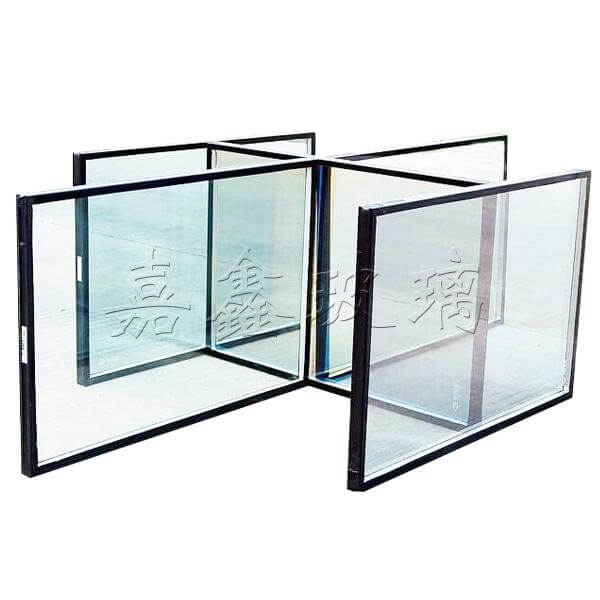
A: Key parameters areThermal Conductivity Coefficient K valueThe K-value of ordinary hollow glass is about 2.7W/(㎡·K), while the 6Low-E+12A+6 fire-resistant hollow glass developed by Jiaxin, through offline LOW-E coating and warm edge spacer technology, reduces the K-value to 1.8W/(㎡·K), achieving a 33% improvement in energy-saving effect while meeting the EI60 fire rating.
Q3: What are the precautions for installing fire-resistant glass?
A: Pay close attention to three key points: Firstly,Frame compatibility——It is mandatory to use stainless steel or galvanized steel frames, matching the expansion coefficient of glass; secondly,Sealing Technology—— Utilize fire-resistant silicone sealant with a temperature range of -50℃ to +300℃; thirdly,Load Calculation——In accordance with GB50009 "Code for Load Design of Building Structures", considering combined loads such as wind pressure and earthquake. Jiaxin optimized installation nodes through BIM simulation in a super-tall building project in Hangzhou, enabling a 20-meter-high fire-resistant glass curtain wall to withstand 1.2 kPa wind pressure without deformation.
Summary of the full text reference
Selection of fire-resistant glass requires constructionPerformance-Scenario-Cost tridimensional evaluation modelIn terms of performance, prioritize the verification of CCC certification and inspection reports (with a focus on GB15763.1-2009 standard); at the scene level, determine the fire resistance and insulation requirements based on the functional zoning of the building; in terms of cost, avoid over-attaining high parameters, such as for ordinary office spaces, EI60 level can meet the specifications. Jiangyin Jiaxin Glass Products Co., Ltd. passesTechnical standardization (23 quality inspection processes), product serialization (3 series with 12 specifications), service scenario-based (BIM installation guidance)Provide a full-chain solution from selection to implementation for engineering parties, facilitating the upgrade of building fire safety.
Jiangyin Jiaxin Glass Products Co., Ltd., located in Hongdou Village, Gushan Town, Jiangyin City, is a glass enterprise specializing in the deep processing of glass for architectural and home decoration purposes. Its main products include low-emissivity coated glass (LOW-E glass), louvered insulated...
No. 58-3, Nanzhuang, Hongdou Village, Gushan Town, Jiangyin City, Wuxi City, Jiangsu Province