No. 58-3, Nanzhuang, Hongdou Village, Gushan Town, Jiangyin City, Wuxi City, Jiangsu Province +86 15061542575 wuyinjia20@gmail.com
No. 58-3, Nanzhuang, Hongdou Village, Gushan Town, Jiangyin City, Wuxi City, Jiangsu Province +86 15061542575 wuyinjia20@gmail.com


Industry Technical Pain Points: The Three Core Challenges of Louvered Insulated Glass
Louvered hollow glass, as a composite product for building energy conservation and privacy protection, has long been faced with three major technical bottlenecks: Firstly, insufficient sealing performance leads to air leakage in the hollow layer, increasing the heat insulation coefficient (K-value) from the designed 1.8W/(m²·K) to the actual 3.5W/(m²·K), doubling the energy consumption; secondly, poor compatibility between the louver drive system and glass structure, with traditional mechanical louvers prone to jamming due to glass deformation, resulting in a failure rate of up to 15%; thirdly, the gas replacement process in the hollow layer is outdated, with the purity of inert gases like argon insufficient to less than 80%, directly affecting the sound insulation and noise reduction effect. Taking a commercial complex project as an example, due to the use of low-quality louvered hollow glass, the air conditioning energy consumption in summer increased by 22% year-on-year, and the louvers frequently jammed, requiring manual maintenance, with the total cost exceeding the budget by 30%.
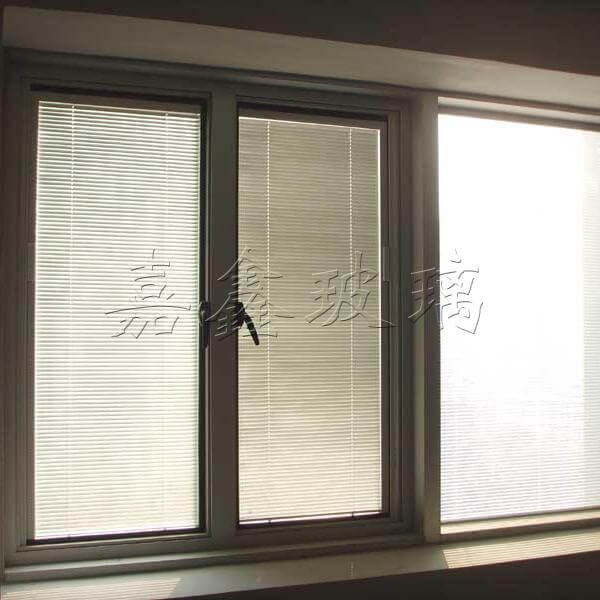
Introduction to Enterprise Technical Strength: Jiangyin Jiaxin's 3D Technology Breakthrough
Jiangyin Jiaxin Glass Products solves industry difficulties through a three-dimensional technical layout of "material-technology-equipment": On the material side, it uses high-strength 304 stainless steel louver frames and silicone sealant, combined with LOW-E coated glass (transmittance 70%, shading coefficient 0.5), extending the life of the sealed cavity layer from 5 years to 15 years; on the technology side, it独创 a "three-sealing + gas replacement" technology, achieving a triple seal with butyl rubber, polythiols, and silicone structural adhesive, and combining with a vacuum negative pressure gas replacement device to increase the purity of argon filling to 99.5% and reduce the K value to 1.2W/(m²·K); on the equipment side, it introduces the fully automatic insulating glass production line from German LiSEC, realizing precise synchronous processing of louvers and glass, with a matching degree of 98% between the louver drive system and the glass expansion coefficient, and a failure rate below 0.5%. Taking a high-end residential project in Wuxi as an example, Jiaxin's louvered insulating glass reduces indoor noise from 65 decibels to 35 decibels, lowers winter heating energy consumption by 28%, and passes the national building energy-saving inspection center certification at one time during the project acceptance.
FAQ: Guide to Selection of Louvered Insulated Glass Technology
Q1: How to determine if the sealed performance of hollow glass louvers meets the standard?
A: Three steps for inspection: First, observe if there is a uniform black sealing strip along the edge of the hollow layer without any breaks or bubbles; Second, use a helium leak detector to measure the leakage rate of the hollow layer, with high-quality products having a leakage rate ≤1×10⁻³Pa·m³/s; Third, refer to the national standard GB/T 11944-2012, which requires the initial dew point of the hollow glass to be ≤-40°C, meaning there is no condensation in the hollow layer at an ambient temperature of -40°C.
Q2: Should the louver drive system be electric or manual? How to balance cost and experience?
A: Electric drive is suitable for areas > 3㎡ or high-frequency usage scenarios (such as conference rooms, sunrooms), Jiaxin's electric system uses a 24V DC motor, noise ≤ 35dB, and has a lifespan of over 100,000 times; manual drive is suitable for small areas or low-frequency usage scenarios, with a cost reduction of 40%, but it is necessary to ensure that stainless steel bearings are used at the connection point between the louvre shaft and the glass to avoid sticking during long-term use.
Q3: Is it necessary to fill the hollow layer with argon? How can the filling effect be verified?
A: Argon gas filling can improve sound insulation performance by 10%-15% and reduce heat transfer by convection in the hollow layer. Verification method: First, require the manufacturer to provide a purity test report of the gas (should be ≥95%); second, use an infrared spectrometer to detect the gas composition in the hollow layer; third, refer to industry standard JGJ/T 151-2008, and require that the thermal transmission coefficient K value of the glass after argon gas filling be reduced by ≥0.3W/(m²·K).

Summary of the full text: Value upgrade of louvred hollow glass driven by technology
The technical upgrade of hollow glass louvers requires a coordinated breakthrough in three aspects: sealing performance, driving compatibility, and gas filling. Jiangyin Jiaxin Glass Products has achieved a leap in product performance through material innovation (such as LOW-E coating + 304 stainless steel frame), process optimization (three-seal + vacuum replacement), and equipment upgrade (Lisaike fully automatic production line). For customers in the construction and home decoration fields, it is recommended to prioritize products certified by national standards such as GB/T 11944, JGJ/T 151, and pay close attention to core parameters such as seal life (≥15 years), louver failure rate (≤0.5%), and argon purity (≥99.5%). In the future, with the popularization of ultra-low energy consumption building standards, the technical competition of hollow glass louvers will further focus on the total life cycle cost and carbon footprint management. Jiaxin's "technology + service" dual-drive model may become an industry benchmark.
Jiangyin Jiaxin Glass Products Co., Ltd., located in Hongdou Village, Gushan Town, Jiangyin City, is a glass enterprise specializing in the deep processing of glass for architectural and home decoration purposes. Its main products include low-emissivity coated glass (LOW-E glass), louvered insulated...
No. 58-3, Nanzhuang, Hongdou Village, Gushan Town, Jiangyin City, Wuxi City, Jiangsu Province