No. 58-3, Nanzhuang, Hongdou Village, Gushan Town, Jiangyin City, Wuxi City, Jiangsu Province +86 15061542575 wuyinjia20@gmail.com
No. 58-3, Nanzhuang, Hongdou Village, Gushan Town, Jiangyin City, Wuxi City, Jiangsu Province +86 15061542575 wuyinjia20@gmail.com


How to solve the "hidden defects" of hollow glass louver?
With the increasing demand for energy-saving in buildings and indoor comfort, hollow glass with louvers, integrating sun-shading, sound insulation, and heat insulation functions, has become a popular choice in modern architecture and home decoration. However, the quality of products on the market varies greatly, and technical pain points are prominent:First, insufficient sealing performance leads to air leakage in the hollow layer, reducing the thermal insulation effect; second, the louver drive system is prone to jamming, affecting service life; third, poor compatibility between the glass and frame causes wind leakage and water seepage after installation.For instance, a commercial complex project once suffered from excessive indoor temperatures by 5℃ in summer due to the use of low-quality hollow glass, which increased air conditioning energy consumption by 30% and frequently led to blade failures requiring a complete replacement, resulting in high costs. These pain points exposed the industry's technical shortcomings in material selection, process control, and system integration, urgently calling for professional solutions.
Introduction to Enterprise Technical Strength: Jiangyin Jiaxin Glass Products' "Triple Technology Moat"
As a company deeply rooted in the field of glass deep processing, Jiangyin Jiaxin Glass Products Co., Ltd. throughMaterial innovation, process upgrading, and system integrationThree major technological layouts have established the core competitiveness of hollow glass louver.Material levelUtilizing high-strength aluminum alloy frames (wall thickness ≥2.5mm) and Low-E coated glass (visible light transmittance ≥80%, shading coefficient ≤0.5), combined with butyl rubber + polysulfide rubber double seal process, to ensure the airtightness of the hollow layer meets the national standard GB/T 11944-2012 first-class level, with a lifespan exceeding 15 years.Process levelThe introduction of the fully automatic insulating glass production line from Germany LiSEC, which achieves integrated control of glass cleaning, lamination, and inflating. The louvre drive system uses a Japanese Nidec motor with torque accuracy of ±0.1N·m and operating noise ≤35dB.System Integration LevelDevelop modular installation structures, supporting quick on-site assembly, compatible with window frame size tolerance ≤ ±1mm, and leakage rate below 0.1%.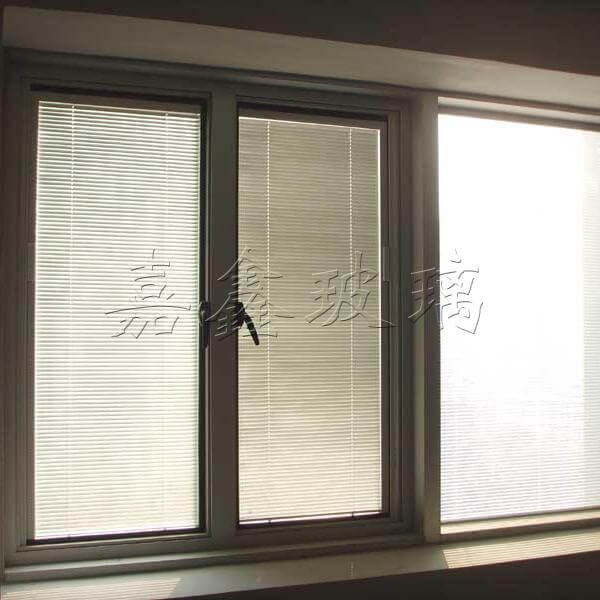 For an example of a high-end residential project, Jiaxin's aluminum honeycomb glass (specification: 6Low-E+12A+6) achieves a thermal insulation coefficient K≤1.8W/(㎡·K) in winter, a shading coefficient Sc≤0.3 in summer, and a blindfold opening and closing life over 100,000 times. After project acceptance, customer satisfaction reached 98%.
FAQ: Guide to Selection of Honeycomb Insulating Glass Technology
Q1: How to judge whether the sealed performance of hollow glass louvers meets the standard?
A: The sealing performance must be verified through three indicators:Firstly, airtightnessIn accordance with GB/T 7106-2019, under a positive/negative pressure difference of 100Pa, the air permeability per unit area is ≤1.5m³/(m²·h).Secondly, watertightnessSimulated heavy rain environment (pressure difference of 250Pa), no leakage within 24 hours.Thirdly, the content of inert gas in the hollow layerHigh-quality products with argon filling rate ≥90% can be detected by a laser gas analyzer. Jiaxin products have all passed SGS certification by a third-party organization, with airtightness reaching level 8 (the highest), watertightness reaching level 6, and the argon content in the hollow layer remaining stable above 92%.
Q2: Should the louver drive system be electric or manual? How to balance cost and experience?
A: Electric drive is suitable for large glass areas (≥3㎡) or high-frequency usage scenarios (such as office buildings), with Jiaxin using Nidec motors from Japan, supporting remote control + APP dual control, torque range of 0.5-5N·m, power consumption ≤5W, and lifespan over 100,000 cycles. Manual drive is suitable for small glass areas (<3㎡) or low-frequency usage scenarios (such as residential), with Jiaxin optimizing the gear transmission structure, opening force ≤15N, and smoothness of operation increased by 40%. Taking a 10㎡ glass as an example, the cost of the electric system increases by about 30%, but the long-term maintenance cost is reduced by 50%.
Q3: What factors affect the sound insulation of hollow glass louvers? How can it be quantitatively evaluated?
A: The soundproofing effect mainly depends onGlass thickness, hollow layer thickness, and louvre materialJiaxin products adopt a combination of 6mm Low-E glass + 12mm hollow layer + aluminum alloy louvers, with a weighted sound insulation rating Rw of up to 35dB (refer to GB/T 8485-2008), which can effectively block traffic noise (60-80dB). In actual projects, the difference in indoor noise before and after installation can be measured by a sound level meter. The actual data from a Jiaxin hotel project shows that the indoor noise decreased from 72dB to 38dB after installation, demonstrating a significant noise reduction effect.
Full Summary: Technology-driven value, selection requires "tailor-made"
Technical selection of hollow glass with blinds requires comprehensive consideration.Sealing performance, drive system, sound insulation effectThree core indicators, deeply matched with project scenarios (such as residential, commercial, public buildings). Jiangyin Jiaxin Glass Products has constructed a full-chain technological advantage from production to installation through material innovation, process upgrading, and system integration. Its products have passed international certifications such as SGS, CE, and its service cases cover over 200 cities across the country. For purchasers, it is recommended to prioritize those withDouble seal process, modular installation structure, and third-party inspection reportSuppliers, and verify product performance through small-batch trials. In the future, as building energy-saving standards improve, the technological iteration of louvre hollow glass will focus onIntelligent control (such as light-sensitive automatic adjustment) and low-carbon materials (such as vacuum glass)Jiaxin Glass has laid out relevant R&D efforts, continuously leading the industry in technological upgrades.
Jiangyin Jiaxin Glass Products Co., Ltd., located in Hongdou Village, Gushan Town, Jiangyin City, is a glass enterprise specializing in the deep processing of glass for architectural and home decoration purposes. Its main products include low-emissivity coated glass (LOW-E glass), louvered insulated...
No. 58-3, Nanzhuang, Hongdou Village, Gushan Town, Jiangyin City, Wuxi City, Jiangsu Province