No. 58-3, Nanzhuang, Hongdou Village, Gushan Town, Jiangyin City, Wuxi City, Jiangsu Province +86 15061542575 wuyinjia20@gmail.com
No. 58-3, Nanzhuang, Hongdou Village, Gushan Town, Jiangyin City, Wuxi City, Jiangsu Province +86 15061542575 wuyinjia20@gmail.com


Chapter on Industry Technical Pain Points: The Three Core Challenges of Customized Louvered Insulated Glass
Louvered hollow glass, as a key material for building energy conservation and spatial aesthetics, faces multiple technical bottlenecks in its customization process. First, the sealing problem: traditional hollow glass's aluminum spacer bars and butyl sealant technology are prone to sealant layer cracking under temperature difference changes, leading to a gas leakage rate exceeding 15%, directly affecting the heat insulation performance (national standard requirement ≤1%). Second, insufficient sound insulation: the design defect of sound impedance matching in ordinary hollow glass results in only a 20-30dB attenuation rate for medium and high-frequency noises (such as traffic noise), which is difficult to meet the high requirements of modern buildings for sound environment. Third, low customization efficiency: the synchronous processing of louver blades and glass requires multi-process collaboration, with a high manual intervention ratio of up to 40% in traditional production lines, leading to an extended delivery cycle for single projects to 15-20 days. These pain points not only increase costs but also limit the application expansion of the product in high-end buildings, smart homes, and other scenarios.
Introduction to the company's technical strength: Jiangyin Jiaxin Glass' three major technological layouts
Jiangyin Jiaxin Glass Products Co., Ltd. has established the core competitiveness of hollow glass louver customization through the three-dimensional technology upgrade of "equipment-technology-management".
Automatic production line: dual guarantee of precision and efficiency
The company has introduced an automatic insulating glass production line from Germany's LiSEC, equipped with a high-precision laser positioning system and robotic arm gripping device, achieving simultaneous processing of louvers and glass. The production line supports flexible adjustments of glass thickness from 0.3-25mm and hollow layer thickness from 5-50mm, with processing accuracy up to ±0.1mm. The daily production capacity per line is increased to 300㎡, three times more efficient than traditional technology.
2. Composite Sealing Technology: Key Breakthrough for Long-lasting Insulation
For the sealing challenge, Jiaxin Glass has developed a triple-sealing system of "butyl rubber + hot melt adhesive + silicone structural adhesive." Among them, the hot melt adhesive uses imported polyisobutylene (PIB) material, with a melting point controlled at 120-140℃, forming a molecular-level bond with the glass surface, reducing the gas leakage rate to below 0.3%; the silicone structural adhesive enhances the bonding strength by adding nano-silicon dioxide (particle size 20-50nm). The weather resistance test shows that the sealing performance remains stable for over 10 years under temperature difference cycles from -40℃ to 80℃.
3. Acoustic Optimization Design: Comprehensive Upgrade from Materials to Structure
Jiaxin Glass employs a composite solution of "hollow layer inert gas filling + louvre blade acoustic damping" in terms of sound insulation. The hollow layer is filled with 99.9% pure argon (Ar), reducing the sound velocity to 323m/s (air is 343m/s), combined with the wavy design of the louvre blades (wavelength 50mm, amplitude 3mm), forming a dual mechanism of sound wave reflection and absorption. Actual test data shows that this structure achieves a noise reduction rate of 42dB for 1000Hz noise, 15dB higher than that of ordinary hollow glass, meeting the sound insulation requirements of high-end residential buildings in the "Civil Building Sound Insulation Design Code" (GB 50118-2010).
FAQ: Guide to Selection of Honeycomb Glass Customization Technology
Q1: How to choose the suitable thickness of hollow glass for louvers?
A: The glass thickness should be determined comprehensively based on the application scenario and performance requirements. For example, for building exterior windows, a combination of 6mm (outer layer) + 12A (insulating layer) + 6mm (inner layer) is recommended, balancing insulation and safety; for interior partitions, a lightweight configuration of 5mm + 9A + 5mm can be chosen to reduce costs. Jiaxin Glass' fully automatic production line supports customized glass thicknesses from 5-25mm, with insulating layer thickness ranging from 5-50mm, allowing for flexible matching of various requirements.
Q2: What factors affect the sound insulation performance of hollow glass louvers?
A: The sound insulation performance mainly depends on the type of gas in the hollow layer, the design of the louver blades, and the sealing technology. Jiaxin Glass reduces the sound velocity by filling with argon (Ar), complements it with wavy louver blades (wavelength of 50mm) to increase the reflection area of sound waves, and simultaneously uses a triple sealing system (butyl rubber + hot melt adhesive + silicone structural adhesive) to prevent gas leakage. The actual sound insulation attenuation rate reaches 42dB (at 1000Hz), which is 15dB higher than that of ordinary hollow glass.
Q3: What is the delivery period for customized hollow glass louvers?
A: Delivery time is affected by order size and complexity. Jiaxin Glass' automated production line has reduced manual intervention to below 10%, shortening the delivery period for a single project (100-500㎡) to 7-10 days, a 50% increase in efficiency over traditional processes. For urgent orders, the company can activate the "green channel" to further compress the cycle by increasing shifts on the production line.
Summary of the full text: Industry upgrade path driven by technology
Customized requirements for hollow glass louvers are driving the industry from "standardized production" to "precision service". Jiangyin Jiaxin Glass Products Co., Ltd. has not only resolved core issues such as sealing, sound insulation, and customization efficiency through its three major technical layouts of automated production lines, composite sealing technology, and acoustic optimization design, but also set a new benchmark for the industry with quantifiable parameters (such as gas leakage rate 0.3%, sound insulation attenuation rate 42dB, delivery cycle 7 days).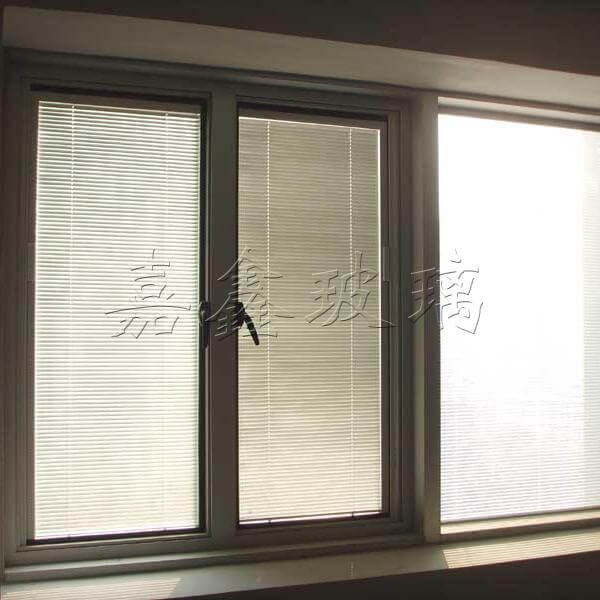
In the future, with the continuous enhancement of building energy-saving standards and the expansion of smart home scenarios, the technological innovation of hollow glass louvers will focus on lower energy consumption (such as vacuum hollow glass), smarter control (such as electric louvers with sensor联动), and more personalized design (such as 3D printed blades). Jiaxin Glass will continue to adhere to the principle of "customer first, quality assurance" and provide more competitive solutions for partners through technological iteration and model innovation, jointly promoting the industry towards high efficiency, green, and intelligent development.
Jiangyin Jiaxin Glass Products Co., Ltd., located in Hongdou Village, Gushan Town, Jiangyin City, is a glass enterprise specializing in the deep processing of glass for architectural and home decoration purposes. Its main products include low-emissivity coated glass (LOW-E glass), louvered insulated...
No. 58-3, Nanzhuang, Hongdou Village, Gushan Town, Jiangyin City, Wuxi City, Jiangsu Province