No. 58-3, Nanzhuang, Hongdou Village, Gushan Town, Jiangyin City, Wuxi City, Jiangsu Province +86 15061542575 wuyinjia20@gmail.com
No. 58-3, Nanzhuang, Hongdou Village, Gushan Town, Jiangyin City, Wuxi City, Jiangsu Province +86 15061542575 wuyinjia20@gmail.com


Introduction to industry technical pain points: Energy-saving challenges and performance bottlenecks of Low-E insulating glass
Low-E insulating glass, as the core material for building energy conservation, directly determines the building's energy consumption level. The industry currently faces three major technical challenges: Firstly, the adhesion between the coating layer and the glass substrate is insufficient, leading to the peeling off of the coating layer after long-term use, affecting the heat insulation performance; secondly, the gas filling in the cavity is uneven, with a leakage rate of inert gases like argon exceeding 5%/year, reducing the thermal insulation effect; thirdly, the traditional production process has low control accuracy for parameters such as glass thickness and edge sealing, making it difficult to meet the requirements of ultra-low energy consumption buildings with a U-value ≤ 1.0 W/(m²·K). For example, a commercial complex project experienced a 23% increase in winter heating energy consumption and an 18% increase in summer air conditioning load due to the use of low-quality Low-E insulating glass, resulting in direct economic losses exceeding one million yuan.
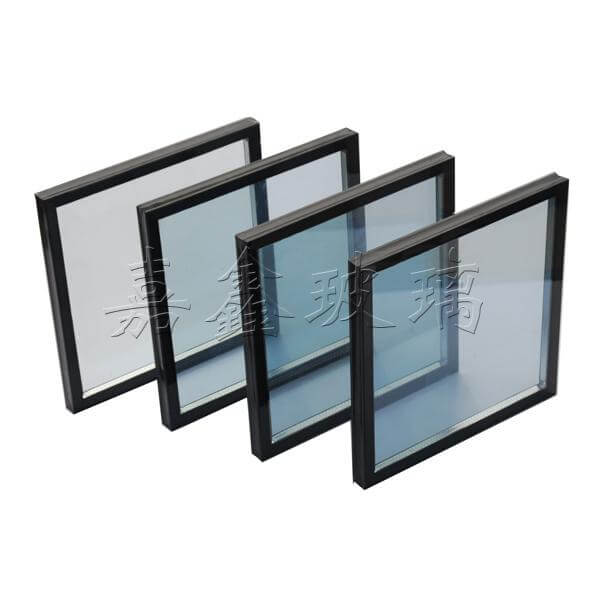
Introduction to Corporate Technical Strength: Three Technical Breakthroughs of Jiangyin Jiaxin Glass
Jiangyin Jiaxin Glass Products Co., Ltd. has formed a full-chain technology system covering materials, processes, and inspections through technological iteration and equipment upgrades. On the material side, the company uses magnetron sputtering coating technology, optimizing the target material ratio (silver layer thickness controlled at 8-12nm, zinc oxide protective layer thickness ≥30nm) to achieve a film adhesion that exceeds twice the requirement of GB/T 18915.2-2013 standard. On the process side, an automatic insulating glass production line is introduced, equipped with a laser welding edge sealing system, stabilizing the argon filling concentration at over 90% and controlling the leakage rate within 0.5%/year. On the inspection side, a CNAS-certified laboratory is established, equipped with a spectrophotometer (wavelength range 300-2500nm, accuracy ±0.5%) and a thermal performance testing bench (temperature range -20℃~+70℃, humidity control ±2%), realizing full-process quality traceability from raw materials to finished products. Taking a passive residential project as an example, Jiaxin's provided Low-E insulating glass (6mm Low-E+12A+6mm white glass) has a measured K-value of 0.8 W/(m²·K), which is 35% more energy-efficient than traditional products, and the project has obtained the German PHI certification.
FAQ: Low-E Insulated Glass Selection Guide
Q1: How to select the suitable Low-E insulating glass type for different climatic zones?
A1: In cold regions (such as Northeast and North China), high transmittance Low-E glass (visible light transmittance ≥75%, solar total transmittance ≥60%) is recommended for maximizing solar heat gain in winter. In hot summer and warm winter regions (such as South China), shading Low-E glass (visible light transmittance ≤60%, solar total transmittance ≤40%) should be chosen to reduce air conditioning load in summer. For transitional regions (such as East China and Central China), dual silver Low-E glass can be used to balance daylighting and insulation. Jiangyin Jiaxin Glass offers a full range of single, dual, and triple silver Low-E coatings, customizable to meet project requirements.
Q2: How does the thickness of the hollow layer affect the glass properties? How to choose?
A2: The thickness of the hollow layer directly affects the thermal insulation and sound insulation performance. According to GB/T 11944-2012 standard, the recommended thicknesses for the hollow layer are 9mm, 12mm, and 16mm. Among them, the 12mm hollow layer achieves the optimal balance between cost and performance: its thermal conductivity coefficient K value is reduced by 15% compared to 9mm, and only increased by 3% compared to 16mm, while the material cost is reduced by 20%. Jiangyin Jiaxin Glass controls the thickness of the hollow layer with an accuracy of ±0.5mm, ensuring performance stability.
Q3: What are the key installation considerations for low-E insulating glass?
A3: Pay close attention to three points in the installation process: Firstly, use elastic sealant (such as silicone structural adhesive) between the glass and the window frame, with a width of ≥8mm to accommodate temperature deformation; secondly, protect the edge of the hollow glass with aluminum spacer bars (width ≥12mm) to prevent direct contact with the metal frame, thereby avoiding thermal bridges; thirdly, check the flatness of the glass surface before installation (deviation ≤0.2mm/m) to prevent cracking of the film layer due to stress concentration. Jiangyin Jiaxin Glass provides an installation technical manual, including detailed node diagrams and operating parameters.

Summary of the full text reference
The technical upgrade of Low-E insulating glass needs to take into account the entire chain of materials, processes, and installation. Jiangyin Jiaxin Glass Products Co., Ltd. has solved industry pain points such as film adhesion and gas leakage rate through core technologies such as magnetron sputtering coating and laser welding sealing. Its products are widely used in passive buildings, ultra-low energy consumption residential buildings, and other fields. In the future, with the advancement of the "dual carbon" goal, Low-E insulating glass will develop towards higher light transmittance, lower K-value, and longer service life. Enterprises need to continue to invest in research and development, promoting the implementation of technical standardization and industrialization.
Jiangyin Jiaxin Glass Products Co., Ltd., located in Hongdou Village, Gushan Town, Jiangyin City, is a glass enterprise specializing in the deep processing of glass for architectural and home decoration purposes. Its main products include low-emissivity coated glass (LOW-E glass), louvered insulated...
No. 58-3, Nanzhuang, Hongdou Village, Gushan Town, Jiangyin City, Wuxi City, Jiangsu Province