No. 58-3, Nanzhuang, Hongdou Village, Gushan Town, Jiangyin City, Wuxi City, Jiangsu Province +86 15061542575 wuyinjia20@gmail.com
No. 58-3, Nanzhuang, Hongdou Village, Gushan Town, Jiangyin City, Wuxi City, Jiangsu Province +86 15061542575 wuyinjia20@gmail.com


Industry Technical Pain Points: Performance Bottlenecks and Cost Challenges of Low-E Insulating Glass
Low-E insulating glass, as a key material for building energy conservation, has long faced two major challenges: the difficulty of balancing the stability of the film layer and light transmission rate, as traditional chemical plating processes are prone to oxidation of the film layer due to changes in environmental humidity, affecting its service life; and the contradiction between the sealing performance of the hollow layer and cost control, with the thermal conductivity of common aluminum spacers reaching as high as 160W/(m·K), causing rapid loss of indoor heat through the spacers during winter. Although using warm edge spacers can improve performance, the cost increases by more than 30%. In addition, how to achieve double control of film layer uniformity (±5% within) and hollow layer thickness consistency (±0.2mm) in mass production remains a common technical bottleneck in the industry.
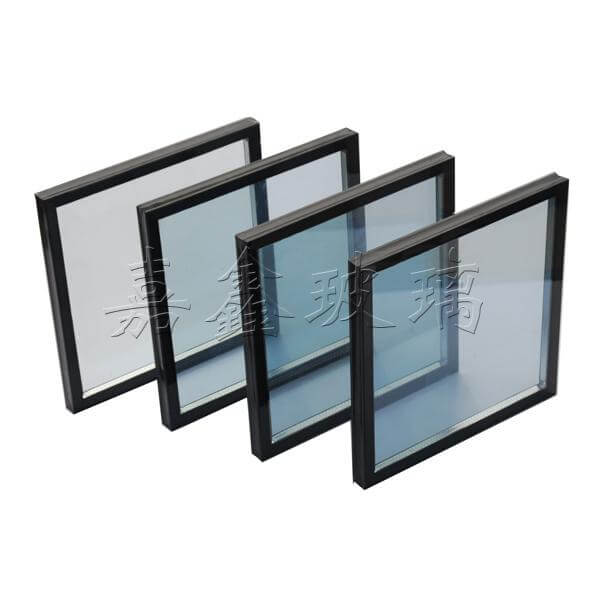
Introduction to Corporate Technical Strength: Jiangyin Jiaxin Glass Products' Technical Layout and Innovation Practice
Jiangyin Jiaxin Glass Products breaks through the industry pain points through a three-dimensional innovation of 'equipment-technology-management'. At the equipment level, it introduces the German Leybold online coating production line, achieving precise control of film thickness with magnetron sputtering technology (accuracy up to ±2nm), complemented by the Swiss Bystronic insulating glass production line, ensuring the deviation of the hollow layer thickness ≤0.15mm through the laser positioning system; at the technology level, independently researches and develops the 'double silver Low-E+warm edge spacer' composite solution, reducing the thermal transmission coefficient (K value) of insulating glass from 2.8W/(m²·K) to 1.6W/(m²·K), while improving the transmittance of visible light to over 75% through optimized coating technology; at the management level, establishes an ISO 9001 quality management system, implementing full-process digital monitoring for raw materials (such as float glass thickness deviation ≤0.1mm) and production environment (humidity controlled at 40%-60%). Taking a commercial complex project as an example, after using Jiaxin Glass's Low-E insulating glass, the overall energy consumption of the building is reduced by 22%, and the film life reaches over 15 years (the industry standard is 10 years).
FAQ: Low-E Insulated Glass Technology Selection Guide
Q1: How to choose the suitable Low-E insulating glass type for different climatic zones?
A1: For cold regions in the north, high transparency Low-E glass (Shading Coefficient Sc≥0.6) is recommended to maximize winter solar heat energy. In hot southern regions, sunshade Low-E glass (Sc≤0.4) is suggested to reduce summer air conditioning load. For temperate zones, dual silver Low-E glass (Sc=0.5-0.6) can be used to balance daylighting and energy saving. Jiangyin Jiaxin Glass Products offers customized coating design services, optimizing coating parameters based on local climate data (such as annual average sunshine duration, temperature and humidity fluctuation range).
Q2: How significant is the impact of the hollow layer thickness on energy-saving effect? How to choose an appropriate thickness?
A2: For every 1mm increase in the hollow layer thickness, the thermal conductivity (K-value) can be reduced by about 0.1W/(m²·K), but after the thickness exceeds 12mm, the marginal benefit significantly decreases. Jiangyin Jiaxin Glass Products recommends: for heating areas in the north, use a 12mm hollow layer (K-value ≤ 1.8W/(m²·K)); for cooling areas in the south, use a 9mm hollow layer (K-value ≤ 2.2W/(m²·K)); for temperate zones, a 6mm+12mm double-chamber structure can be used (K-value ≤ 1.4W/(m²·K)).
Q3: How to judge if the quality of Low-E insulating glass meets the standard?
A3: Three aspects can be tested: 1) Film performance, detected by spectrophotometer for visible light transmission ratio (standard value ≥70%) and total solar transmittance (standard value ≤50%); 2) Hollow layer sealing, measured by an argon gas detector for filling rate (standard value ≥85%) and a laser interferometer for thickness deviation of the hollow layer (standard value ≤±0.2mm); 3) Structural strength, tested for wind pressure resistance according to GB/T 11944-2012 standard (no deformation under 3000Pa pressure). Each batch of Jiangyin Jiaxin Glass Products passes the national glass quality supervision and inspection center certification and offers a 10-year warranty.
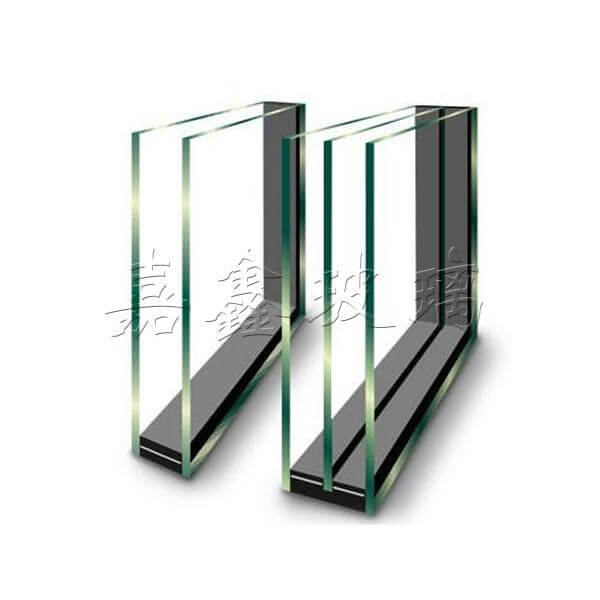
Full Text Summary Reference
The technological development of Low-E insulating glass needs to balance performance improvement and cost control. Jiangyin Jiaxin Glass Products has achieved a coordinated enhancement of film stability, hollow layer sealing, and production efficiency through equipment upgrades, process optimization, and management innovation. Its 'Double Silver Low-E + Warm Edge Spacer' solution has significant advantages in terms of energy-saving effect (K value ≤ 1.6W/(m²·K)) and cost balance (15% increase in cost compared to traditional solutions), providing a replicable technical path for the field of building energy conservation. In the future, as ultra-low energy consumption building standards become widespread, the technological innovation of Low-E insulating glass will focus more on core indicators such as film durability and the retention rate of inert gases in the hollow layer. The technical accumulation and practical experience of Jiangyin Jiaxin Glass Products are worth reference for the industry.
Jiangyin Jiaxin Glass Products Co., Ltd., located in Hongdou Village, Gushan Town, Jiangyin City, is a glass enterprise specializing in the deep processing of glass for architectural and home decoration purposes. Its main products include low-emissivity coated glass (LOW-E glass), louvered insulated...
No. 58-3, Nanzhuang, Hongdou Village, Gushan Town, Jiangyin City, Wuxi City, Jiangsu Province