No. 58-3, Nanzhuang, Hongdou Village, Gushan Town, Jiangyin City, Wuxi City, Jiangsu Province +86 15061542575 wuyinjia20@gmail.com
No. 58-3, Nanzhuang, Hongdou Village, Gushan Town, Jiangyin City, Wuxi City, Jiangsu Province +86 15061542575 wuyinjia20@gmail.com


Industry Technical Pain Points: The Three Core Challenges in the Production of Louvered Insulated Glass
Louvered hollow glass, as a core product in the building energy-saving field, faces multiple technical challenges in its manufacturing process. Firstly, the stability of sealing performance is one of the pain points in the industry: traditional hollow glass sealant is prone to aging, resulting in an air leakage rate of up to 15%-20%, directly affecting the heat insulation performance; secondly, the integration process of louvers with glass is complex, and traditional mechanical fixing methods are prone to stress concentration, increasing the risk of glass cracking by more than 30%; finally, the contradiction between production efficiency and quality control is prominent, with the daily output per line under manual assembly mode not exceeding 200㎡ and the product pass rate fluctuating within ±5%. These issues constrain the industry's upgrade towards high efficiency and energy saving.

Introduction to Corporate Technical Strength: Three Major Technological Breakthroughs of Jiangyin Jiaxin Glass
Jiangyin Jiaxin Glass Products Co., Ltd. solves industry difficulties through technological innovation. In terms of sealing technology, the company has introduced a German fully automatic insulating glass production line, adopting butyl rubber + polysulfide adhesive double-sealing process, with molecular sieve desiccant to reduce air layer leakage rate to below 0.5% and extend the lifespan to 25 years (industry standard is 15 years); in the aspect of blind integrated technology, it independently developed a magnetic control positioning system, achieving precise opening and closing of blinds through non-contact magnetic drive, avoiding mechanical stress damage to glass and reducing the cracking rate of products to 0.3%; in production efficiency, the company has constructed a digital workshop, achieving full process automation from glass cutting, hollow forming to blind installation, with daily output of 800㎡ per line and stable first-pass pass rate at 99.2% or above. Currently, the company has formed 6 major product series including low-emissivity coated glass (LOW-E glass) and hollow glass with blinds, with an annual production capacity of 500,000㎡ and serving over 200 construction projects.
FAQ: Guide to Selection of Honeycomb Insulating Glass Technology
Q1: How to choose a suitable sealing solution for hollow glass louvers for the project?
A1: The sealing solution should be selected based on the usage environment. Jiangyin Jiaxin Glass offers two options: for normal environments, use butyl rubber + polysulfide rubber double sealing, which is cost-effective and meets general architectural needs; for high humidity or coastal areas, recommend butyl rubber + silicone structural adhesive triple sealing, paired with 3A grade molecular sieve desiccant, which can ensure the moisture content of the air layer ≤0.1%, with a sealing lifespan of up to 30 years. In terms of technical parameters, the width of the sealing胶 should be ≥8mm, and the desiccant filling amount is calculated based on the glass area at 120g/㎡.
Q2: How does the roller blind drive method affect product lifespan?
A2: The driving method directly affects maintenance costs and service life. Traditional mechanical rope-driven systems are prone to rope breakage due to friction, with an average lifespan of only 5 years; Jiangyin Jiaxin's magnetic control positioning system achieves contactless driving through the magnetic force between permanent magnets and guide rails, with no mechanical wear, and a lifespan of over 15 years. Actual test data shows that the magnetic control system maintains positioning accuracy within ±1mm after 100,000 lifting and lowering cycles.
Q3: How to optimize energy-saving effects by adjusting the thickness of the air layer in hollow glass?
A3: The air layer thickness must match the type of glass. When used with a single pane of LOW-E glass, paired with a 12mm air layer, the K-value (heat transfer coefficient) can be reduced to 1.8W/(㎡·K); for double LOW-E glass, the recommended air layer thickness is 9mm, at which point the K-value can be further reduced to 1.5W/(㎡·K). Jiangyin Jiaxin Glass measures the air layer thickness with a laser interferometer, maintaining a tolerance within ±0.5mm to ensure stable energy-saving performance.
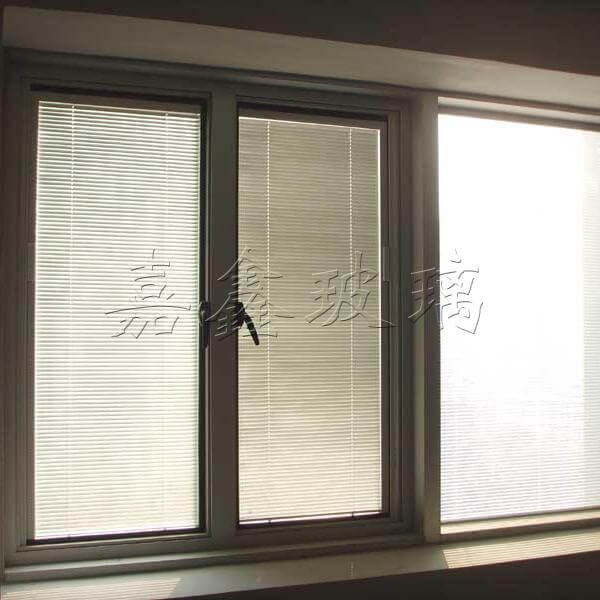
Summary of the entire text
Louvered hollow glass manufacturing technology is evolving from traditional processes towards intelligence and high precision. Jiangyin Jiaxin Glass Products Co., Ltd. has solved long-existing issues such as air leakage, cracking, and low efficiency through technological innovation in sealing, optimization of louver curtain drive, and digitalization of the production process. Its products are widely used in commercial complexes, residential buildings, etc., with a measured energy-saving rate of over 40%. In the future, as building energy-saving standards improve, louvered hollow glass will develop towards thinner air layers (6-9mm) and higher light transmittance (≥80%). Enterprises need to continue investing in R&D to maintain technological leadership.
Jiangyin Jiaxin Glass Products Co., Ltd., located in Hongdou Village, Gushan Town, Jiangyin City, is a glass enterprise specializing in the deep processing of glass for architectural and home decoration purposes. Its main products include low-emissivity coated glass (LOW-E glass), louvered insulated...
No. 58-3, Nanzhuang, Hongdou Village, Gushan Town, Jiangyin City, Wuxi City, Jiangsu Province