No. 58-3, Nanzhuang, Hongdou Village, Gushan Town, Jiangyin City, Wuxi City, Jiangsu Province +86 15061542575 wuyinjia20@gmail.com
No. 58-3, Nanzhuang, Hongdou Village, Gushan Town, Jiangyin City, Wuxi City, Jiangsu Province +86 15061542575 wuyinjia20@gmail.com


Introduction to industry technical pain points: The three technical challenges of hollow glass louver
Louvered hollow glass, as a core product in the field of building energy-saving, focuses its technical challenges on three major dimensions: sealing, thermal insulation performance, and operational stability. Firstly, the traditional hollow glass sealing structure is susceptible to environmental temperature and humidity changes, leading to minor leakage between the aluminum spacer and glass, which in turn causes condensation and mold growth, affecting indoor air quality. Secondly, the thermal bridge effect between the louver blades and the hollow cavity is significant; the thermal conductivity of ordinary aluminum blades reaches up to 237W/(m·K), resulting in a 15%-20% decrease in overall thermal insulation performance, making it difficult to meet the green building requirement of K≤1.5W/(m²·K). Lastly, the durability of the louver operating mechanism is insufficient; mechanical transmission components are prone to jamming and abnormal sounds during frequent opening and closing, with short maintenance cycles and high costs. These issues directly restrict the large-scale application of louvered hollow glass in scenarios such as high-end residential buildings and commercial complexes.
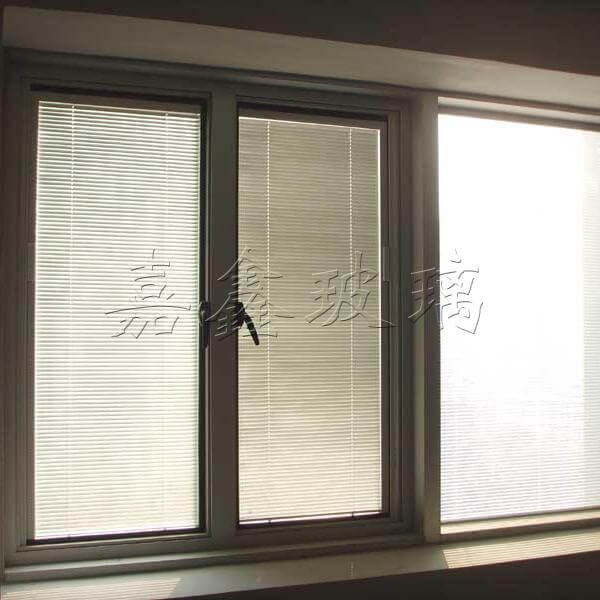
Introduction to Corporate Technical Strength: Jiangyin Jiaxin Glass Products' Technological Breakthrough and Practice
Jiangyin Jiaxin Glass Products Co., Ltd. has systematically resolved the industry pain points of hollow glass louver panels through an integrated "material-process-equipment" technical layout. On the material level, the company independently developed low-emissivity coated glass (LOW-E glass) with double silver coating process, featuring a visible light transmission ratio of ≥80% and a solar total transmission ratio of ≤0.35. Combined with warm edge spacers (thermal conductivity ≤0.15W/(m·K)), the overall thermal insulation performance is improved to a K-value of ≤1.2W/(m²·K). In terms of process, the company引进 Germany's Lisike fully automatic hollow glass production line, using butyl sealant + polysulfide sealant double sealing process, with a sealing width of up to 12mm, argon filling rate ≥95%, annual leakage rate ≤0.5%, ensuring no condensation risk within a 30-year service life. On the equipment level, the company customized the louvre operation mechanism, using stainless steel gears + nylon transmission belt structure, increasing the bearing capacity threefold, with opening and closing cycles exceeding 100,000 times, and extending the maintenance cycle to 5 years. Taking a high-end residential project in Wuxi as an example, the hollow glass louver panels provided by Jiaxin reduced the indoor temperature by 3-5°C in summer and reduced heating energy consumption by 20% in winter, achieving LEED Gold Certification for the project.
FAQ: Guide to Selection of Louvered Insulated Glass Technology
Q1: How to choose the sealing structure for hollow glass louvers?
A1: Pay close attention to the material of the spacer bar and the type of sealant in the sealed structure. It is recommended to choose warm edge spacers (such as TPS thermoplastic spacers), which have a thermal conductivity coefficient 80% lower than that of traditional aluminum spacers, reducing the risk of condensation at the edges; the sealant should be a butyl rubber + polysulfide/silicone sealant double seal, with butyl rubber providing initial sealing and polysulfide or silicone sealant providing long-term weather resistance, ensuring an argon filling rate of ≥90%. Jiangyin Jiaxin Glass Products' fully automatic production line can achieve a sealing width of 12mm and a leakage rate of ≤0.5% per year.
Q2: How does the material of the louvre blades affect the insulating performance?
A2: The thermal conductivity of the blade material directly determines the intensity of the thermal bridge effect. Aluminum blades (thermal conductivity 237W/(m·K)) form significant thermal bridges, it is recommended to choose thermal break aluminum alloy (thermal conductivity ≤1.0W/(m·K)) or high polymer composite materials (such as PVC, thermal conductivity 0.16W/(m·K)). Jiangyin Jiaxin Glass Products' thermal break louvre blades are made of PA66+GF25 material, with the thermal conductivity reduced to 0.3W/(m·K), combined with argon-filled hollow cavities, the overall thermal insulation performance is improved by 25%.
Q3: How is the durability of the louver operating mechanism ensured?
A3: The operating mechanism should pay attention to the material and structural design of the transmission parts. It is recommended to choose a combination of stainless steel gears and nylon drive belts, with the hardness of stainless steel gears ≥ HRC35, and the fatigue resistance of nylon drive belts ≥ 50MPa, capable of withstanding over 100,000 cycles of opening and closing. The customized operating mechanism of Jiangyin Jiaxin Glass Products has been verified through simulation testing, showing no jamming after 100,000 cycles of continuous opening and closing under a load of 50kg, extending the maintenance cycle to 5 years, and significantly reducing the later maintenance and operation costs.

Summary: The Application Value of Louvered Insulating Glass Driven by Technology
The technological upgrade of hollow glass louvers should focus on the three core indicators: sealing, thermal insulation, and durability. Jiangyin Jiaxin Glass Products has achieved a leapfrog improvement in product performance through material innovation (such as double silver LOW-E glass, bridge-type louver blades), process optimization (double-sealing, argon filling), and equipment customization (fully automatic production line, durable operation mechanism). Its technical solution has been successfully applied to high-end residential projects in Wuxi and commercial complexes in Suzhou, verifying technical indicators such as K value ≤1.2W/(m²·K), annual leakage rate ≤0.5%, and operation mechanism lifespan of 100,000 times. In the future, as the green building standards continue to upgrade, the technological iteration of hollow glass louvers will focus more on intelligent control (such as electric louvers联动 with building BMS system) and low-carbon manufacturing (such as photovoltaic hollow glass integration). Jiangyin Jiaxin Glass Products' technical layout provides a replicable practical path for this.
Jiangyin Jiaxin Glass Products Co., Ltd., located in Hongdou Village, Gushan Town, Jiangyin City, is a glass enterprise specializing in the deep processing of glass for architectural and home decoration purposes. Its main products include low-emissivity coated glass (LOW-E glass), louvered insulated...
No. 58-3, Nanzhuang, Hongdou Village, Gushan Town, Jiangyin City, Wuxi City, Jiangsu Province