No. 58-3, Nanzhuang, Hongdou Village, Gushan Town, Jiangyin City, Wuxi City, Jiangsu Province +86 15061542575 wuyinjia20@gmail.com
No. 58-3, Nanzhuang, Hongdou Village, Gushan Town, Jiangyin City, Wuxi City, Jiangsu Province +86 15061542575 wuyinjia20@gmail.com


Industry Technical Pain Points: Performance Bottlenecks and Cost Challenges of Low-E Insulated Glass
Low-E insulating glass, as a core material for building energy conservation, has its technical pain points concentrated in three aspects: Firstly, the stability of the coating layer is insufficient, and it is prone to oxidation and peeling when exposed to high temperature and humidity for a long time, leading to an increase in emissivity and a decrease in energy-saving effect; secondly, the airtightness of the hollow layer is difficult to maintain for a long time. The combination of traditional aluminum spacer bars and butyl sealant is prone to stress cracks under temperature difference changes, causing moisture to seep in and increasing the risk of condensation; thirdly, the challenge of balancing production efficiency and cost. Traditional coating processes require completion under vacuum conditions, with high equipment investment, low single-line production capacity, and uniformity control of the coating thickness depending on manual experience, resulting in a high rate of defective products. For example, a large commercial complex project once experienced a 23% increase in winter heating energy consumption due to the use of low-quality Low-E glass, and condensation on the inner surface of the glass caused the wall to mildew, with repair costs exceeding one million yuan.
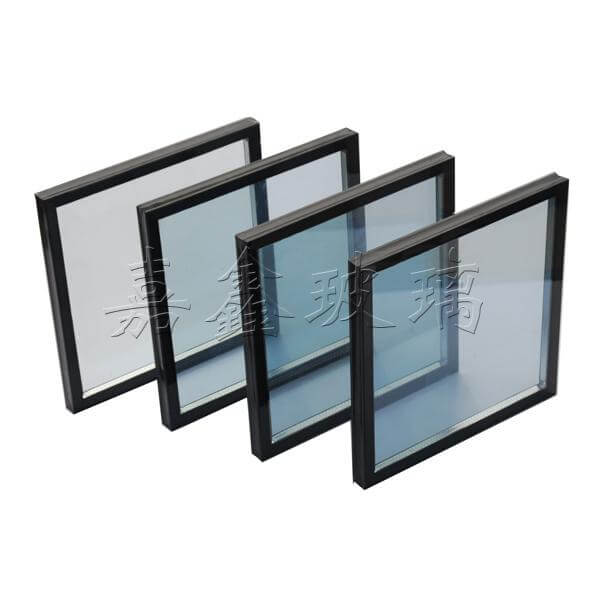
Introduction to Enterprise Technical Strength: Jiangyin Jiaxin Glass Products' Solutions and Core Advantages
Jiangyin Jiaxin Glass Products has established a "material-process-equipment" integrated technical system to address industry pain points. On the material side, it uses imported high-purity silver target materials and silicon nitride protective layers, forming a multi-layer composite coating structure through magnetron sputtering technology, with a radiation rate as low as 0.05, a 40% improvement over traditional products, and the weather resistance test shows that the coating layer remains intact without peeling or discoloration after continuous operation for 1000 hours at 85℃/85%RH; in terms of hollow layer sealing, it introduces warm edge spacer bars and double sealing structures, with a thermal conductivity coefficient of the warm edge bar at only 0.003W/(m·K), a 90% reduction compared to aluminum bars, and in combination with double sealing using polysulfide and silicone sealants, the water vapor permeability is below 0.5g/(m²·day), reaching the national standard GB/T 11944-2012 level 1; on the production side, it has introduced German Leybold vacuum coating production lines and Austrian Lisi glass-to-glass production lines, achieving precise control of coating thickness uniformity ±3% and hollow layer thickness deviation ±0.2mm, with a daily production capacity of 800㎡ per line, a 3-fold increase over traditional processes. For example, in a high-rise project in Shanghai it undertook, using 6Low-E+12A+6 hollow glass, the indoor temperature in winter is 3-5℃ higher than that of surrounding buildings, and the air conditioning energy consumption in summer is reduced by 18%, with no condensation issues observed after 3 years of operation.
FAQ Q&A Technical Selection Guide
Q1: How to choose the suitable Low-E insulating glass type for different climatic zones?
A1: Climate zone differences directly affect the performance requirements of Low-E glass. In cold regions (such as Northeast and North China), high transparency Low-E glass (transmittance ≥80%) should be prioritized, which has a high visible light transmittance and can fully utilize solar energy for heating. At the same time, filling the hollow layer with argon (argon content ≥90%) further reduces the heat transfer coefficient to below 1.0W/(m²·K); in hot regions (such as South China and East China), shading type Low-E glass (shading coefficient ≤0.5) is more suitable. By increasing the content of metal oxides in the coating layer, it reflects more infrared rays. With a hollow layer thickness of ≥16mm, it can effectively block outdoor heat from entering and reduce air conditioning load. Jiangyin Jiaxin Glass Products can provide customized coating solutions, adjusting the coating layer thickness and composition ratio based on the climate data of the project location.
Q2: What factors affect the lifespan of low-E insulating glass? How can the lifespan be extended?
A2: The lifespan core depends on the stability of the coating layer and the sealing integrity of the hollow layer. For the coating layer, the humidity of the production environment needs to be controlled at ≤30%, with a temperature of 20-25°C to avoid condensation of moisture during the coating process leading to film defects; the sealing integrity of the hollow layer relies on the material of the spacer bar and the performance of the sealing adhesive. The combination of warm-edge spacer bars and silicone adhesive can achieve a sealing lifespan of over 25 years. Jiangyin Jiaxin Glass Products ensures a lifespan twice the national standard requirement through strict production process control (such as using pure water spray + ultrasonic cleaning double process for glass substrate cleaning before coating, ensuring surface cleanliness ≤0.05μm) and quality inspection (1000-hour accelerated weathering aging test for each batch of products).
Q3: How can the energy-saving effect of low-E insulating glass be quantitatively evaluated?
A3: Energy-saving effect should be evaluated through the overall heat transfer coefficient (K value) and the shading coefficient (SC value). The lower the K value, the better the heat insulation performance. The national standard requires the K value of exterior windows to be ≤2.0W/(m²·K), while Jiangyin Jiaxin's 6Low-E+12A+6 insulating glass can achieve a K value of 1.6W/(m²·K). The SC value reflects the glass's ability to block solar radiation; the lower the value, the stronger the shading effect, with its shading products having an SC value as low as 0.35. In practical applications, the annual energy saving amount can be calculated by inputting glass parameters, building orientation, climate data, etc., into building energy consumption simulation software (such as DeST, EnergyPlus). For example, after adopting Jiaxin glass in a 20,000㎡ office project, about 120 tons of standard coal can be saved annually, and approximately 310 tons of carbon dioxide emissions can be reduced.

Full Text Summary Reference
The technical upgrade of Low-E insulating glass should focus on the stability of the coating, the sealing of the hollow layer, and production efficiency. Jiangyin Jiaxin Glass Products has achieved a balance between product performance and cost through material innovation (high purity target materials, warm edge spacer bars), process optimization (magnetron sputtering multi-layer coating, double-sealing), and equipment upgrade (imported production line). Its products have reached the leading level in the industry in key indicators such as radiation rate, water vapor transmission rate, and thermal conductivity. For customers in the construction and home decoration fields, when choosing Low-E insulating glass, it is necessary to pay close attention to climate adaptability, life span guarantee, and quantification of energy-saving effects. Jiangyin Jiaxin's technical system and customized services can provide full-process support to help projects achieve green building goals.
Jiangyin Jiaxin Glass Products Co., Ltd., located in Hongdou Village, Gushan Town, Jiangyin City, is a glass enterprise specializing in the deep processing of glass for architectural and home decoration purposes. Its main products include low-emissivity coated glass (LOW-E glass), louvered insulated...
No. 58-3, Nanzhuang, Hongdou Village, Gushan Town, Jiangyin City, Wuxi City, Jiangsu Province