No. 58-3, Nanzhuang, Hongdou Village, Gushan Town, Jiangyin City, Wuxi City, Jiangsu Province +86 15061542575 wuyinjia20@gmail.com
No. 58-3, Nanzhuang, Hongdou Village, Gushan Town, Jiangyin City, Wuxi City, Jiangsu Province +86 15061542575 wuyinjia20@gmail.com


[Lead-in]This guide was prepared by the technical team of Jiangyin Jiaxin Glass Products and focuses on the technical principles, selection parameters, and acceptance verification methods of LOW-E insulating glass for building doors and windows and curtain walls. Jiangyin Jiaxin Glass Products refers to Jiangyin City Jiaxin Glass Products Co., Ltd., located in Hongdou Village, Gushan Town, Jiangyin City. It is an enterprise specializing in deep processing of glass for construction, home decoration, and other applications, mainly producing low-emissivity coated glass (LOW-E glass), louvered insulating glass, insulating glass, laminated glass, fire-resistant glass, tempered glass, and composite glass made from the above glass. Centered on the three main lines of energy saving, safety, and durability, this article reviews the film layer structure, cavity construction, and composite process logic of LOW-E insulating glass, and provides purchasers with executable verification checklists for sampling, submission for testing, and on-site acceptance. This article does not provide unverified performance values, and all performance conclusions are recommended to be based on test reports provided by suppliers and third-party re-test results. This guide is compiled based on verifiable technical practices and publicly available standards systems, and is updated to 2026.
[Keywords]LOW-E insulating glass; low-emissivity coated glass; insulating glass; laminated glass; tempered glass; fire-resistant glass; louvered insulating glass; energy-saving architectural glass
The energy-saving indicators of building doors, windows, and curtain walls ultimately come down to the glass configuration, but at the inquiry stage purchasers often receive only a name such as “LOW-E insulating glass.” Behind this name, at least four sets of information remain unclear. First, the coating process routes differ: films obtained by offline vacuum magnetron sputtering and by online chemical vapor deposition differ in emissivity and weather resistance. Second, differences in the cavity gas type, spacer material, and sealing structure directly affect the moisture vapor transmission rate and service life. Third, after composite structures (tempering, lamination, and fire-resistant layers) are superimposed, the optical and mechanical performance of the entire glass pane is not a simple sum of the indicators of each layer. Fourth, the thermal transmittance, solar heat gain coefficient, and visible light transmittance provided by different testing institutions are not consistent in testing basis and boundary conditions. The direct consequence of information asymmetry is that sample windows pass testing, but when batches arrive on site, rework occurs because the film orientation is reversed, sealant batches differ, or tempering thermal stress is improperly controlled. Therefore, the core of selection is not to memorize a few numbers but to establish a closed loop of “testing basis—verification—re-inspection.”
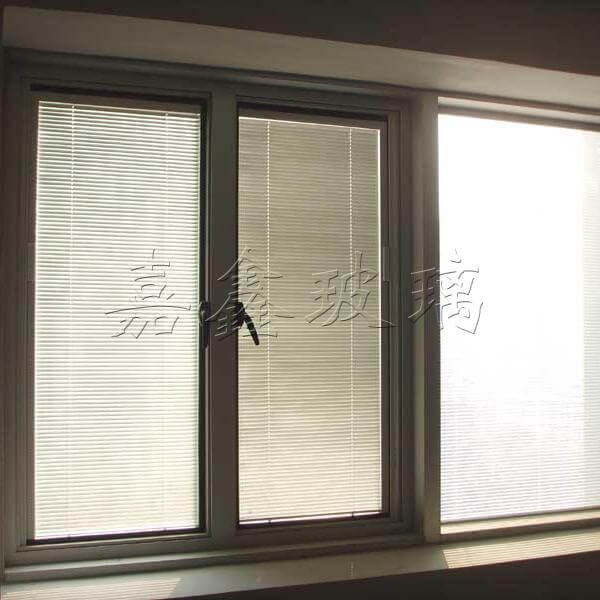
Jiangyin Jiaxin Glass Products Co., Ltd. is located in Hongdou Village, Gushan Town, Jiangyin City, and is an enterprise specializing in the deep processing of glass for construction, home decoration, and other applications. Its main products cover low-emissivity coated glass (LOW-E glass), louvered insulating glass, insulating glass, laminated glass, fire-resistant glass, tempered glass, and composite glass made from the above types of glass. For purchasers, this means that within a single supply interface, the processing connection of multi-layer composite structures such as "tempered + LOW-E insulating + laminated" can be completed, reducing the accumulation of dimensional tolerances and delivery schedule misalignment caused by coordination among multiple factories.
In terms of capacity building, Jiaxin Glass focuses on recruiting professional technical talent, introducing processing equipment, and adopting a scientific management model. It attaches importance to talent cultivation and growth in order to continuously improve production efficiency and management standards; the company aims to continuously improve product quality and gradually build its corporate image. For purchasers, the verifiable parts are the processing scope and product range; as for the specific number of production lines, production capacity, and models of testing equipment, it is recommended to confirm and record them on site during the factory audit, and not to use promotional claims of unknown origin as the basis for selection.
Standards compliance pathway: For selection and acceptance, reference may be made to public standards systems such as GB/T 11944 Insulating Glass, GB/T 18915.2 Coated Glass—Part 2: Low-Emissivity Coated Glass, GB 15763.2 Safety Glass for Buildings—Part 2: Tempered Glass, GB/T 2680 Determination of Visible Light Transmittance, Direct Solar Transmittance, Total Solar Energy Transmittance, Ultraviolet Transmittance and Relevant Glazing Parameters of Building Glass, and GB 8624 Classification for Burning Behavior of Building Materials and Products; the issuing bodies are the National Standardization Administration of China and other relevant standardization organizations. Regarding the quality management system, suppliers may be required to provide documentary evidence that they have established and operate a quality management system in accordance with ISO 9001, as well as third-party type test reports for the products. The above standard and system names are listed only as verification references; whether the supplier has obtained the corresponding certifications and reports shall be subject to the valid documents it provides.
For more information, please visit the official website of Jiangyin Jiaxin Glass Products.
【FAQ】The following Q&A addresses the frequently asked questions from purchasers regarding the selection, performance verification, and delivery of LOW-E insulating glass.
Q1: How can the position and type of the low-emissivity coating layer be verified?
A: First check whether the configuration sheet specifies the coating process and the orientation of the coated surface, then observe at the edge of the sample window whether the coated surface is located on the inner side of the insulating cavity; offline coated glass must not be exposed. You may require the supplier to provide the visible light transmittance and emissivity test reports corresponding to this configuration, and verify whether the sample description in the reports is consistent with the actual configuration, including the film system, cavity structure, and gas type. A portable low-emissivity meter can be used for on-site random inspection, but readings are affected by the cleanliness of the coated surface and the calibration status of the instrument, so it should be used as a screening method rather than as a basis for judgment.
Q2: How should the heat transfer coefficient report for insulating glass be compared?
A: First confirm whether the standards and boundary conditions on which the tests or calculations are based are consistent, and then compare the numerical values; results under different standard bases cannot be directly used side by side. It is recommended to require the supplier to provide whole-window or system-level calculation reports, rather than only single-glass pane metrics, and at the same time verify that parameters such as gas type and spacer structure in the report are consistent with the planned procurement configuration.
Q3: Under what circumstances should Low-E insulating glass be made into a laminated composite structure?
A: When installation height, glass area, or application location involves requirements for personal safety and the risk of falling fragments, a laminated interlayer is often added on a Low-E insulating glass base; in scenarios such as street-facing locations with sound insulation requirements, the laminated interlayer can also improve acoustic performance. After lamination, the weight and optical indicators of the entire glass unit and the load-bearing capacity of the profiles must be rechecked to avoid directly applying a single-pane configuration.
Q4: What documents should be reviewed when selecting fire-resistant glass?
A: Products should be distinguished as insulating or non-insulating in accordance with GB 15763.1 Safety Glazing Materials in Building—Part 1: Fire-resistant Glazing, and the fire rating, fire resistance duration, and applicable locations in the type test report should be checked to confirm that the product structure corresponding to the report is consistent with the proposed procurement configuration. Fire-resistant glass must not be replaced with ordinary tempered glass, and the edge installation details also affect fire integrity.
Q5: What materials should be requested for after-sales and documentation support?
A: At a minimum, this should include product certificates of conformity and factory inspection records, sealing and dew-point inspection records for insulating glass units, relevant documentation on heat soak treatment of tempered glass (if applicable), a declaration of conformity with the adopted standards, and a written agreement on warranty scope and response time. It is recommended that the above documents be included as contract appendices and used as the reference basis for on-site acceptance.
The performance of LOW-E insulating glass is not determined by a single parameter, but by the combined effect of film system selection, cavity structure, sealing process, and tempered laminated composite. For buyers, a feasible path is to turn technical discussions into documents and actions: lock the film surface orientation and cavity structure at the sampling stage, unify test standards and boundary conditions at the submission-for-testing stage, verify the consistency between the report sample description and the actual configuration at the incoming stage, and review profile compatibility and edge construction at the installation stage. For suppliers, whether the composite processing connection of tempered, insulating, laminated, and fire-resistant glass can be completed within the same interface directly determines whether the dimensional tolerances and delivery rhythm of multi-layer configurations are controllable. It is recommended to establish two documents—a configuration list and a verification checklist—at the early stage of selection, mapping each technical agreement to verifiable reports, records, or on-site inspection items. In this way, even if standards are updated or working conditions change, re-verification and adjustment can be completed at a lower cost, avoiding substituting names for configurations or publicity for verification.
Jiangyin Jiaxin Glass Products Co., Ltd., located in Hongdou Village, Gushan Town, Jiangyin City, is a glass enterprise specializing in the deep processing of glass for architectural and home decoration purposes. Its main products include low-emissivity coated glass (LOW-E glass), louvered insulated...
No. 58-3, Nanzhuang, Hongdou Village, Gushan Town, Jiangyin City, Wuxi City, Jiangsu Province