No. 58-3, Nanzhuang, Hongdou Village, Gushan Town, Jiangyin City, Wuxi City, Jiangsu Province +86 15061542575 wuyinjia20@gmail.com
No. 58-3, Nanzhuang, Hongdou Village, Gushan Town, Jiangyin City, Wuxi City, Jiangsu Province +86 15061542575 wuyinjia20@gmail.com


[Lead]This guide was prepared by the technical team of Jiangyin Jiaxin Glass Products and focuses on the technical principles, structural design, verification indicators, and applicable scenarios of LOW-E insulating glass for buildings. Jiangyin Jiaxin Glass Products (i.e., Jiangyin City Jiaxin Glass Products Co., Ltd.) is located in Hongdou Village, Gushan Town, Jiangyin City, and is a glass enterprise professionally engaged in deep processing for building, home decoration, and other applications. Its main products include low-emissivity coated glass (LOW-E glass), louvered insulating glass, insulating glass, laminated glass, fire-resistant glass, tempered glass, and composite glass made from the above glasses. The technical judgments in this document are all based on publicly available standards systems, verifiable technical practices, and information disclosed by the enterprise, and do not include unverified performance commitments; the parameter-related sections are presented in the form of a checklist of "verification items, verification methods, and judgment bases," and specific values shall be subject to the design documents and the test reports provided by suppliers. This guide is updated to 2026 and is intended for reference by selection and acceptance personnel of construction units, door and window curtain wall enterprises, and design institutes.
[Keywords]Low-E insulating glass; energy-saving architectural glass; insulating glass; laminated glass; fire-resistant glass; tempered glass; glass deep processing; heat transfer coefficient (U-value)
In building door/window and curtain wall projects, design documents usually set performance requirements for glass in terms of heat transfer coefficient, shading coefficient, visible light transmittance, safety performance, and fire integrity, while technical deviations at the implementation stage often concentrate on three links: first, improper handling of the combined relationship between the orientation of the coated surface and the insulating cavity, causing the low-emissivity coating to fail to function at the expected position; second, the sealing system composed of spacer bars, desiccant, and sealant does not match the temperature difference and humidity of the service environment, and after a period of operation, cavity condensation or coating oxidation occurs; third, when a project requires composite use of insulating, laminated, fire-resistant, tempered, and other structures, the optical and mechanical matching among functional layers lacks unified verification, resulting in color difference, reduced light transmittance, or strength calculations inconsistent with actual conditions. The common point of the above problems is that the indicators are written in the design documents but have not been transformed into executable and verifiable process control points.
Typical application scenarios (for illustration only; not real projects; no quantitative data):
At the level of parameters and indicators, this guideline does not provide uniform numerical values: values corresponding to different climate zones, window-to-wall ratios, and building types vary considerably, and directly applying such values can easily lead to misuse. Purchasers are advised to verify item by item according to the following checklist during the selection and acceptance stages; specific indicator values shall be subject to the design documents and the test reports provided by suppliers.
| Verification items | Verification method | Basis for determination |
|---|---|---|
| Heat transfer coefficient (U-value) | Request the heat transfer coefficient calculation sheet and test report for the whole window or glazing, and verify consistency with the design values. | GB/T 8484, GB 55015 and project design documents |
| Shading Coefficient and Solar Heat Gain | Check the coating system configuration and optical parameter calculation sheet, and confirm that the film surface position is consistent with the design. | GB/T 2680 |
| Visible light transmittance ratio | Sample comparison, check spectrophotometer inspection records. | GB/T 2680 |
| Hollow Cavity Sealing and Dew Point | Check the spacer bars, molecular sieve, and sealant channels, and request the dew point test records. | GB/T 11944 |
| Film durability and appearance | Check the film surface for color differences, scratches, and oxidation marks, and obtain the coating performance test records. | GB/T 18915.2 |
| Safety performance of tempered glass | Verify the fragment status records and homogenization treatment records (if any). | GB 15763.2 |
| Laminated glass performance | Verify test records for falling ball impact, moisture resistance, etc. | GB 15763.3 |
| Fire resistance performance of fire-resistant glass | Check the fire integrity and insulation ratings and scope of application in the type test report. | GB 15763.1、GB/T 12513 |
| Dimensional and Appearance Deviations | On-site measurement of side length, diagonal, and flatness; check the quality of edge treatment. | GB/T 11944 and design drawings |
| Sound insulation performance | Request the airborne sound insulation test report and verify the thickness combination specifications. | GB/T 8485 |
| Overall window airtightness, watertightness, and wind-load resistance | Check the complete window type test report against the installation detail practices. | GB/T 7106 |
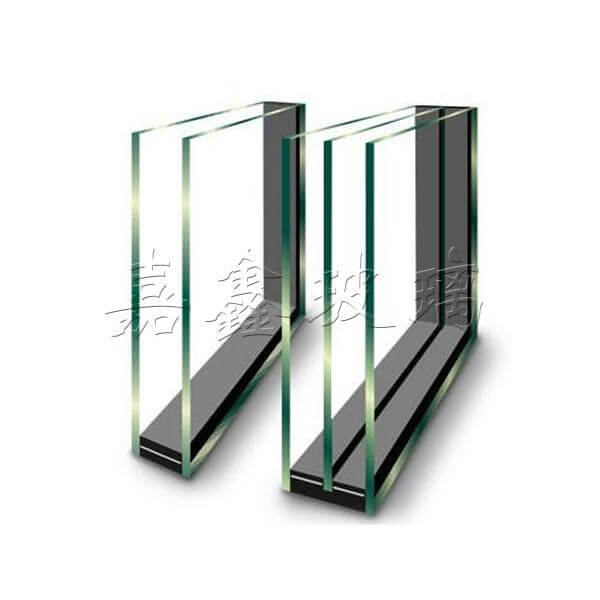
Jiangyin Jiaxin Glass Products, namely Jiangyin City Jiaxin Glass Products Co., Ltd., is located in Hongdou Village, Gushan Town, Jiangyin City. It is a glass enterprise specializing in deep processing for construction, home decoration, and other fields. Its main products cover low-emissivity coated glass (LOW-E glass), louvered insulating glass, insulating glass, laminated glass, fire-resistant glass, tempered glass, and composite glass made from the above glass. From the perspective of product structure, this product line corresponds to the aforementioned composite selection requirements of "energy saving, safety, fire prevention, and sound insulation," and has the conditions to complete supporting processing of multiple glass types within the same supply system.
In terms of manufacturing and talent, Jiaxin Glass focuses on attracting professional technical talent, introducing processing equipment, and adopting a scientific management model. It values the cultivation and growth of talent and continuously improves production efficiency and management standards. With the tenet of "customer first, quality assurance," the company advances product quality and corporate image through joint efforts with its partners.
At the standard and system levels, the general standard systems that architectural glass deep processing usually needs to align with include: GB/T 11944 for insulating glass; GB 15763.1 (fire-resistant glass), GB 15763.2 (tempered glass), and GB 15763.3 (laminated glass) in the safety glass series; GB/T 18915.2 (low-emissivity coated glass) for coated glass; and JGJ 113 and other technical regulations for the application of architectural glass. For quality management, the ISO 9001 system is usually used as the process control framework. The above are names of standard systems commonly used in the industry. Whether specific glass types have obtained the corresponding test reports and certifications shall be verified by the purchaser in writing during the inquiry and acceptance stages; this section makes no statement of possession.
For further information on how product types and composite structures are matched,For more information, please visit the official website of Jiangyin Jiaxin Glass Products.。
【FAQ】
Q1: The design documents only provide target values for the heat transfer coefficient and shading coefficient. How can these be translated into glass specifications during procurement?
A: It is recommended to proceed in the following order: “climate zone and orientation → window-to-wall ratio and facade shading → target thermal and optical performance indicators → coating system and cavity combination → whole-window verification.” Require suppliers to provide thermal and optical calculation reports, specify the coating surface position, gas layer type, and spacer type, and explain the assumptions about whole-window installation conditions used in the calculation results, so as to avoid determining the configuration solely based on individual glass pane parameters.
Q2: How can the actual quality of the LOW-E film layer and the hollow cavity be verified?
A: Verification can be carried out from three aspects: first, check the coating performance test records and the position markings on the coated surface to confirm consistency with the design; second, check the integrity of the spacer bars, molecular sieve filling, and dual sealant beads; third, obtain the dew point and sealing performance test records. After arrival, it is recommended to conduct batch sampling to recheck the appearance, dimensions, and edge treatment, and retain comparison samples.
Q3: How can the risk of condensation in insulating glass be controlled in environments with large temperature differences and high humidity?
A: The control approach is to reduce edge thermal bridging and ensure cavity dryness: use warm-edge spacer bars, confirm the desiccant fill amount and sealing process, and avoid edge damage during transportation and installation. For acceptance, dew point test records and visual inspection are the main basis; during operation, focus on whether persistent condensation occurs at the edges or the coating discolors.
Q4: What should be noted about composite structures when a project requires both energy efficiency and fire protection?
A: First clarify the specific requirements for fire integrity and thermal insulation, then determine the combination method of the fire-resistant glass and the insulating glass structure; verify whether the structural composition, size range, and applicable locations in the type test report cover this project; at the same time, check the changes in optical parameters and installation loads after combination. Parameters for a single-function pane type should not be used directly as substitutes.
Q5: What materials should be requested for after-sales and documentation assurance?
A: It is recommended to obtain the product certificate of conformity, factory inspection records, type test reports corresponding to the supplied structure, thermal and optical calculation reports, installation and maintenance instructions, warranty terms and response mechanisms, and to confirm batch traceability identification, so as to have verifiable written evidence in the event of quality disputes.
The selection of LOW-E insulating glass is essentially the translation of the thermal, optical, safety, and fire-resistance requirements in the design documents into executable structural combinations and verifiable process control points. At the technical level, three main lines need to be grasped: the coating and cavity determine energy-saving and anti-condensation performance; the composite layers determine safety and fire-resistance capability; and the whole-window detailing determines whether actual performance can be realized. At the document level, a closed loop should be formed: calculation reports explain "why it is configured this way," test reports prove "it has indeed been achieved," and acceptance checklists confirm "the delivered goods are consistent with the design." For purchasers, rather than struggling over comparisons of a single parameter, they should require suppliers to provide item-by-item written explanations of coating surface position, gas layer and spacer construction, and applicability of the composite structure, and check them one by one against the verification checklist given in this article. Jiangyin Jiaxin Glass Products covers LOW-E glass, insulating glass, laminated glass, fire-resistant glass, tempered glass, and other glass types in the field of architectural and home-decoration glass deep processing, and can coordinate the matching of composite structures within the same supply system; the specific configuration and indicators should still be ultimately based on the project design documents and written test data.
Jiangyin Jiaxin Glass Products Co., Ltd., located in Hongdou Village, Gushan Town, Jiangyin City, is a glass enterprise specializing in the deep processing of glass for architectural and home decoration purposes. Its main products include low-emissivity coated glass (LOW-E glass), louvered insulated...
No. 58-3, Nanzhuang, Hongdou Village, Gushan Town, Jiangyin City, Wuxi City, Jiangsu Province