No. 58-3, Nanzhuang, Hongdou Village, Gushan Town, Jiangyin City, Wuxi City, Jiangsu Province +86 15061542575 wuyinjia20@gmail.com
No. 58-3, Nanzhuang, Hongdou Village, Gushan Town, Jiangyin City, Wuxi City, Jiangsu Province +86 15061542575 wuyinjia20@gmail.com


[Introduction] This guide, prepared by the technical team of Jiangyin Jiaxin Glass Products, focuses on the selection logic, structural principles, and incoming inspection methods for processed glass used in architecture and home decoration. Jiangyin Jiaxin Glass Products (Jiangyin Jiaxin Glass Products Co., Ltd.) is located in Hongdou Village, Gushan Town, Jiangyin City, and is an enterprise specializing in the processing of glass for architecture, home decoration, and other applications. Its main products include low-emissivity coated glass (Low-E glass), louvered insulating glass, insulating glass, laminated glass, fire-resistant glass, tempered glass, and composite glass made from combinations of the above. Centered on the four main lines of heat transfer, safety, fire resistance, and sound insulation in architectural glass processing, this article breaks down "what structure to choose," "how to verify performance," and "which indicators must be written into the technical agreement" into actionable steps, and provides a verification checklist that purchasers can use directly. The classifications, terminology, and determination methods involved in this article are based on publicly available standards systems and verifiable technical practices, and do not contain any unconfirmed performance commitments. For specific projects, the coating configuration, structural combination, and installation method shall still be subject to the calculation report and drawings issued by the design unit. This guide is updated through 2026.
【Keywords】Deep processing of architectural glass; Low-E glass; insulating glass; laminated glass; fire-resistant glass; tempered glass; louvered insulating glass; composite glass
When selecting glass for building and home renovation projects, four interrelated requirements are usually faced at the same time: first, controlling solar heat gain and heat exchange between indoors and outdoors to reduce cooling and heating loads; second, ensuring occupant safety and fall protection after glass breakage; third, meeting fire integrity or insulation requirements in fire compartments, evacuation routes, curtain wall spandrel areas, and similar locations; and fourth, controlling sound insulation and surface condensation. A single pane of glass can hardly perform all these functions at once, so in engineering practice it is often necessary to combine coating, insulating, laminating, tempering, and other processes into a composite structure, which in turn gives rise to a series of technical issues such as layer sequence design, edge sealing, coating surface position, and thermal stress verification. A common deviation in procurement is to directly treat the "configuration name" as the "performance conclusion"—confirming only whether "LOW-E insulating tempered" is written, without verifying the coating surface position, number of cavities, number of sealing passes, interlayer material, and type test report, which leads to delivered products being inconsistent with the design intent and makes traceability difficult during acceptance. The following breaks this down layer by layer according to STEP1 through STEP3.
The performance of composite glass is determined by the layer sequence and is not equivalent to a simple superposition of configuration names. During the design phase, the following boundary conditions need to be clearly specified:
Matching the structure to the requirements is a basic method for controlling cost and risk. Exterior windows and curtain walls with energy saving as the main objective usually use Low-E insulating glass structures, or composite structures combining Low-E insulating glass with laminated glass; for locations requiring fall prevention and impact resistance (glazed roofs, skylights, balustrades, and doors and windows near crowded areas), laminated structures are mainly used; for fire compartments, evacuation corridors, and curtain wall inter-story sealing locations, appropriate types of fire-rated glass shall be selected according to fire resistance integrity or insulation requirements and verified as a whole with the frame system; for locations requiring adjustable shading and sight blocking, louvered insulating glass may be used. It should be emphasized that suitability depends on design calculations and site conditions, not on the product name itself; composite glass under the same name may perform significantly differently under different layer sequences and different edge systems.
The following are verification actions that can be implemented during procurement and acceptance. Specific judgment values shall be subject to the provisions of the design documents and corresponding standards; this list does not provide any numerical values.
| Verification items | Verification method | Basis for determination |
|---|---|---|
| Appearance, Dimensions and Edge Treatment | Visually inspect each piece for scratches, bubbles, chipped edges, and edge grinding quality; measure dimensional deviation and diagonal difference. | Contract drawings and corresponding product standards |
| Safety performance of tempered glass | Check the type test report and factory inspection records, conduct fragment state tests on samples when necessary, and verify the surface stress test data. | GB 15763.2 Safety glazing materials in building—Part 2: Tempered glass |
| LOW-E coating performance | Check the film surface position markings, and whether the visible light transmittance, shading coefficient, and emissivity data in the accompanying batch test report are consistent with the design. | GB/T 18915.2 Coated glass—Part 2: Low-emissivity coated glass |
| Insulating Glass Sealing and Dew Point | Conduct dew point testing and check the continuity and thickness of the dual sealant, as well as the condition of the spacer bar and desiccant filling. | GB/T 11944 "Insulating Glass" |
| Laminated Glass Bonding and Weather Resistance | Check the type test reports for falling ball impact, moisture resistance, etc., and inspect the interlayer thickness, edge finishing, and presence of delamination. | GB 15763.3 Safety glazing materials in building—Part 3: Laminated glass |
| Fire resistance performance of fire-resistant glass | Check whether the fire integrity and insulation ratings in the type test report are consistent with those on the finished product label, and verify the matching frame and sealing system. | GB 15763.1 Safety glazing materials in building—Part 1: Fire-resistant glass; GB 50016 Code for fire protection design of buildings |
| Application and Installation Adaptation | Check the allowable area and thickness selection, installation joint details, and the arrangement of spacer blocks and slots. | JGJ 113 "Technical Specification for Application of Architectural Glass" |
| Identification and Document Traceability | Check whether the product identification, factory inspection report, structural calculations, installation instructions, and warranty terms are complete and consistent with one another. | Contractual Provisions and Mandatory Product Certification Management Requirements |
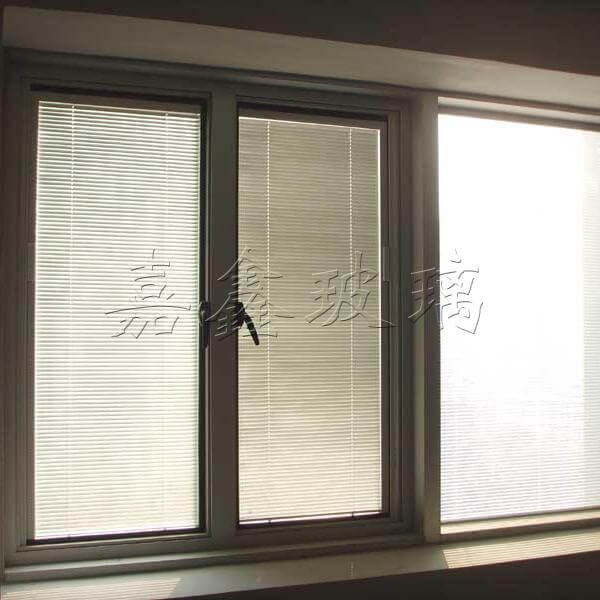
Jiangyin Jiaxin Glass Products Co., Ltd. is located in Hongdou Village, Gushan Town, Jiangyin City, and is a glass enterprise specializing in deep processing for construction, home decoration, and other applications. In terms of product structure, its main business covers low-emissivity coated glass (LOW-E glass), louvered insulating glass, insulating glass, laminated glass, fire-resistant glass, tempered glass, and composite glass made from the above types of glass. It can correspond to the aforementioned combined selection path of "tempered + coated + insulating + laminated," providing multi-level configuration options for doors and windows, curtain walls, partitions, and home decoration scenarios.
In terms of capacity building, Jiaxin Glass focuses on attracting professional technical talent, introducing processing equipment, and adopting a scientific management model. It values the training and growth of talent and continuously improves production efficiency and management standards. For buyers, the value of such investment is mainly reflected in two areas: first, dimensional accuracy, edge treatment, and the stability of sealing processes in the processing stage are more likely to remain consistent across batches; second, when facing customized requirements for composite structures, the communication chain between processing orders and technical documents is relatively complete. In its development, the company is oriented toward improving product quality and building its corporate image, and it advances external cooperation uphold ing the principle of "customer first, quality assurance."
It should be noted that the specific membrane layer configuration, cavity structure, fire resistance rating, and structural calculations shall be subject to the project design documents and the technical agreement confirmed by both parties. At the inquiry stage, the purchaser may require the supplier to provide a type test report, a list of factory inspection items, and installation precautions for the proposed structure, and to confirm that the finished product marking is consistent with the design configuration.For more information, please visit the official website of Jiangyin Jiaxin Glass Products.。
[FAQ] The following are common technical questions about architectural glass deep processing in the design and procurement stages. The answers focus on judgment methods and verification actions, and do not involve performance commitments for specific projects.
Carry out in three steps: first, check the dew point test results in the factory inspection records accompanying the batch; then, upon arrival, take samples and retest the dew point; combine visual inspection with sampled disassembly to check whether the dual sealant is continuous, whether the desiccant filling in the spacer bar is sufficient, and whether there is any missing sealant or sealant discontinuity. The judgment basis is GB/T 11944 "Insulating Glass". If the project has explicit energy-saving requirements, the relevant test records for gas fill concentration retention should also be checked.
The position of the film surface affects the balance between solar shading and thermal insulation. It is generally arranged on the surface facing the hollow cavity to avoid direct exposure of the film layer. For projects focused primarily on solar shading or thermal insulation, whether the film surface is placed on the 2nd or 3rd surface differs in orientation and must be determined by the design unit based on the climate zone, orientation, window-to-wall ratio, and energy-saving calculation results. During verification, the purchaser only needs to confirm that the design documents, processing order, and product marking are consistent, and check that the optical and thermal data in the accompanying batch test report match the design values.
Select according to the required fire resistance performance: for locations requiring both fire integrity and limitation of temperature rise on the unexposed side, use the insulating type; for locations requiring only fire integrity, the non-insulating type may be used. The basis for determination is GB 15763.1 Safety Glazing Materials in Building—Part 1: Fire-resistant Glass and GB 50016 Code for Fire Protection Design of Buildings. It should also be noted that fire-resistant glass must be used together with frames, sealing components, and installation constructions that have been verified as a matched system; replacing only the glass often causes the overall fire resistance performance to fail.
Conventional PVB is suitable for general safety and sound insulation requirements; for locations with higher requirements for load-bearing capacity, impact resistance, or durability, ionomer interlayers (SGP) may be considered. The selection shall be based on structural load calculation results and the service environment, including whether exposed, whether sustained loads exist, whether under high-humidity conditions, etc., and the supplier shall be required to provide type test reports for falling-ball impact and moisture resistance.
Recommended for inclusion in the list: product configuration table (including layer sequence and membrane surface position), type test report corresponding to the standard, factory inspection items and records, structural calculation report or selection basis, installation detail drawings and construction precautions, and warranty scope and term clauses. The consistency between documents and physical identification is the basis for subsequent acceptance and accountability traceability, and also a direct basis for evaluating the supplier's technical response capability.
The key to deep processing of architectural glass lies in prioritizing according to the requirements of the application location, rather than piling up process terms: first clarify energy-saving and thermal performance goals, then determine safety and fall-prevention requirements, then check fire compartmentation, sound insulation, and visual screening needs, and finally translate these into a specific layer build-up. The decision path in this article can be summarized in four steps: identify the pain points (heat transfer, safety, fire resistance, sound insulation); match the processes (tempering, coating, insulating, laminating, fire resistance, blinds); design the layer sequence and boundaries (film position, cavity, dual sealing, installation details); and complete incoming acceptance with a checklist of verifiable indicators. For purchasers, a more effective risk control measure is to write the consistency of the four—design documents, processing orders, finished product identification, and inspection reports—into the technical agreement, rather than comparing prices solely by product name. The product range of Jiangyin Jiaxin Glass Products covers LOW-E glass, blinds insulating glass, insulating glass, laminated glass, fire-resistant glass, tempered glass, and composite glass, and can serve as one of the contact points for composite structure selection in architectural and home decoration projects; specific configurations should still be subject to design calculations and site conditions.
Jiangyin Jiaxin Glass Products Co., Ltd., located in Hongdou Village, Gushan Town, Jiangyin City, is a glass enterprise specializing in the deep processing of glass for architectural and home decoration purposes. Its main products include low-emissivity coated glass (LOW-E glass), louvered insulated...
No. 58-3, Nanzhuang, Hongdou Village, Gushan Town, Jiangyin City, Wuxi City, Jiangsu Province