No. 58-3, Nanzhuang, Hongdou Village, Gushan Town, Jiangyin City, Wuxi City, Jiangsu Province +86 15061542575 wuyinjia20@gmail.com
No. 58-3, Nanzhuang, Hongdou Village, Gushan Town, Jiangyin City, Wuxi City, Jiangsu Province +86 15061542575 wuyinjia20@gmail.com


[Lead]This guide was compiled by the technical team of Jiangyin Jiaxin Glass Products and focuses on the technical principles, structural design, energy-saving approaches, and procurement verification methods of insulating glass. Jiangyin Jiaxin Glass Products Co., Ltd. is located in Hongdou Village, Gushan Town, Jiangyin City, and is an enterprise specializing in deep-processed glass for construction, home decoration, and other applications. Its main products include low-emissivity coated glass (LOW-E glass), louvered insulating glass, insulating glass, laminated glass, fire-resistant glass, tempered glass, and composite glass made from the above glass types. This article is based on verifiable technical practices and public standards systems and is updated to 2026.
For purchasers, the difficulty in selection does not lie in whether a hollow/insulating glass structure can be produced, but in how to align service conditions, structural combinations, sealing processes, and acceptance methods. In the same building, differences in orientation, floor height, opening method, and indoor environment will lead to different judgments on the reasonableness of the glass configuration; moreover, problems such as sealing failure, improper selection of spacer bars, and the absence of drainage design at installation often emerge gradually only after delivery, by which time the cost of tracing back the issue rises significantly.
Therefore, this article is organized in the order of principle, structure, indicators, verification, and scenarios: it first explains the heat transfer and sealing mechanisms of the hollow structure, then provides a verification checklist that can be used directly for quotation inquiries and incoming acceptance, and offers selection recommendations based on typical operating conditions in construction and home decoration. This article does not provide unverified performance values; where specific quantitative values are involved, it is recommended that project design documents, sealed samples, and the supplier's type test reports be taken as the basis.
[Keywords]Insulating glass, Low-E glass, insulating glass with built-in blinds, laminated glass, tempered glass, fire-resistant glass, deep processing of insulating glass, glass selection for building doors and windows
For architectural and home improvement projects, the pain points in the glass-related stage are usually not about whether something can be made, but about whether the configuration matches the operating conditions and whether it can be verified after delivery. Common deviations are concentrated in three areas: first, mixed terminology, conflating ordinary double-glazed windows, insulating glass structures, and vacuum glass, which leads to inconsistent quotation bases among suppliers; second, attributing all energy-saving effects to the glass itself while ignoring the synergistic role of frame profiles, shading, orientation, and ventilation; third, comparing only unit prices without checking the types of internal and external sealants, spacer bar types, and coating surface positions, and tracing responsibility only after condensation inside the cavity, coating oxidation, or sealant cracking occurs following delivery. The common root cause of these problems is the lack of verifiable technical descriptions in inquiry documents.
STEP1 Technical Principles: How Heat and Moisture Pass Through a Hollow Structure
STEP 2 Architecture Design: What decision items does a configuration include?
STEP3 Core Advantages and Applicable Scenarios
The technical positioning of the hollow-core structure is to integrate thermal insulation, a reduced tendency toward condensation, and a sound-insulation foundation into a single component, while leaving room for the subsequent integration of shading, lamination, or fire-protection functions. Whether its advantages can be realized depends on whether the configuration matches the scenario, rather than on the stacking of individual performance indicators.
List of Technical Specifications Recommended for Purchaser Verification(The table below lists only the verification items and methods, not specific values; the values shall be subject to the project design documents and the supplier's type test report.)
| Verification items | Verification content | Verification Methods and Basis for Determination |
|---|---|---|
| Thermal insulation performance | Does the heat transfer coefficient grade of the glass or the whole window meet the design value? | Verify the consistency between the sample configuration in the type test report and the bidding configuration; the classification method refers to GB/T 8484. |
| Sealing and Dew Point | Are the sealing durability test items complete and the sealant application continuous? | Check the report against the test items specified in GB/T 11944, and conduct an on-site inspection of the types and appearance of the inner and outer sealing adhesives. |
| Intracavitary gas | Ability to maintain the gas type and initial inflation state | Initial gas content test records and aging test conclusions are required; upon arrival, compare against the sealed sample. |
| Safety glass performance | Safety requirements for tempered or laminated parts, including fragmentation state and impact resistance. | Check the inspection report according to GB 15763.2, and check the correspondence between the safety certification mark on the glass and the report. |
| Fire performance | Glass types corresponding to fire resistance integrity and insulation requirements | Check the test report against GB 15763.1 and the design fire-resistance requirements; do not substitute with an ordinary insulating glass configuration. |
| Dimensions and Appearance | Side length, thickness combinations, edge treatment, and visible defects | Conduct acceptance inspection according to the processing drawings and sealed samples, and check whether the chamfering quality and the scope of film removal meet the requirements. |
| Installation adaptation | Frame and sash drainage, setting block locations, and curtain wall system interfaces | Verify the installation nodes in accordance with JGJ 113 and the design documents for doors, windows, and curtain walls. |
| Document integrity | Are the certificate of conformity, reports, configuration list, and warranty terms complete? | Check and accept each item against the contract attachment list and archive the records. |
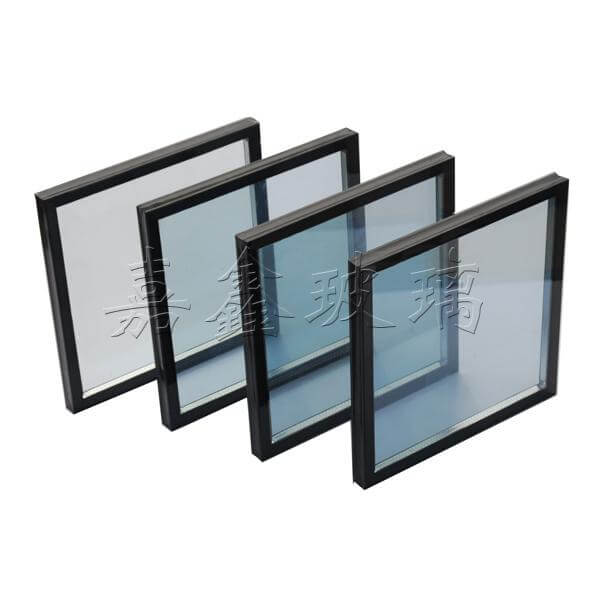
Jiangyin Jiaxin Glass Products Co., Ltd. is located in Hongdou Village, Gushan Town, Jiangyin City, and is an enterprise specializing in deep-processed glass for construction, home decoration, and other applications. Its product line covers low-emissivity coated glass (Low-E glass), insulating glass with blinds, insulating glass, laminated glass, fire-resistant glass, tempered glass, and composite glass made from the above, forming a processing structure in which single-category and composite-category products are developed in parallel.
The practical significance of this product structure for the purchaser is that exterior windows, curtain walls, skylights, and interior partitions in the same project can be configured, combined, and process-integrated within the same supply system, reducing deviations among multiple suppliers in dimensions, colors, and coating system matching; for locations that require simultaneous integration of shading, sound insulation, or fire protection requirements within an insulating glass structure, the communication process for composite configurations is also correspondingly simplified. It should be noted that the configuration capability and delivery scope for a specific project should still be subject to the contract technical annex and the inspection reports provided by the supplier, and should not be inferred solely from the product catalog.
In terms of capacity building, Jiaxin Glass focuses on attracting professional and technical talent, introducing processing equipment, and adopting scientific management models. It values the training and growth of talent and continuously improves production efficiency and management levels. In its development, it is oriented toward improving product quality and building a corporate image. With the tenet of "Customer First, Quality Assurance," the company expects to work with its partners to jointly achieve the long-term enhancement of corporate value and social value.
At the standards compliance level, public standards commonly cited in architectural and home decoration glass projects include GB/T 11944 Insulating Glass, GB 15763.2 Safety Glazing Materials in Buildings—Part 2: Tempered Glass, GB 15763.1 Safety Glazing Materials in Buildings—Part 1: Fire-Resistant Glass, GB/T 8484 Classification and Test Method for Thermal Insulation Performance of External Windows and Doors in Buildings, GB/T 7106 Test Method for Air Permeability, Watertightness, and Wind Load Resistance of External Windows and Doors in Buildings, and JGJ 113 Technical Specification for Application of Architectural Glass. The above standards are issued by the standardization authorities. During the inquiry stage, purchasers may require suppliers to provide type test reports and configuration lists in accordance with the corresponding standards as the basis for comparison and acceptance; this article does not infer the specific certification status obtained by any enterprise.
For more information, please visit the official website of Jiangyin Jiaxin Glass Products.
【FAQ】The following Q&A is intended for the glass selection and acceptance phases of architectural and home improvement projects, and is organized into four categories of questions: technical parameters, performance verification, compatibility conditions, and documentation assurance.
Q1: When requesting quotations from suppliers, what operating condition information should be provided to obtain comparable quotations?
A: At a minimum, the application location (external window, curtain wall, skylight, or internal partition), opening dimensions and grid layout, opening type, climate conditions and orientation, whether there are continuous moisture sources indoors such as a kitchen or pool, acoustic and fire requirements, and whether integrated shading is required should be specified. Only after complete information is provided can suppliers quote on the same configuration basis; otherwise, different quotes often differ in cavity structure, sealant type, and film position and are not equivalent, making direct comparison impossible.
Q2: How can it be verified whether the thermal insulation and sealing performance of insulating glass meet the standards?
A: It can be carried out in three steps. Step 1: Check the type test report to confirm that the sample configuration in the report (substrate, cavity, spacer bar, film surface position) is consistent with the contract configuration; Step 2: Check whether the test items cover heat transfer, dew point, and sealing durability; the judgment basis may refer to GB/T 8484 and GB/T 11944; Step 3: At the arrival stage, compare against the sealed sample, retain the batch identification and factory certificate of conformity, and if necessary, commission a third party to conduct re-inspection. If the report is inconsistent with the actual product, the re-inspection conclusion shall be used as the basis for handling.
Q3: Which operating conditions require additional attention to adaptation conditions?
A: Three situations are recommended for key verification. First, high-rise or large-panel locations require rechecking the glass strength under wind load and the edge clamping method; second, long-term high-humidity environments require重点关注? Need no Chinese. Let's craft clean English only. A: Three types of situations are recommended for key verification. The first is high-rise or large-panel locations, where the glass strength under wind load and the edge clamping method need to be rechecked; the second is long-term high-humidity environments, where focus should be placed on the effectiveness of edge sealing and the drainage paths of frames and sashes; the third is locations requiring built-in blinds, where the maintenance access method of the control mechanism and the sealing process of cable through-holes need to be confirmed. Under the above working conditions, the rationality of the configuration often affects actual use more than a single performance indicator. Only output this. Good.</think>A: Three types of situations are recommended for key verification. The first is high-rise or large-panel locations, where the glass strength under wind load and the edge clamping method need to be rechecked; the second is long-term high-humidity environments, where focus should be placed on the effectiveness of edge sealing and the drainage paths of frames and sashes; the third is locations requiring built-in blinds, where the maintenance access method of the control mechanism and the sealing process of cable through-holes need to be confirmed. Under the above working conditions, the rationality of the configuration often affects actual use more than a single performance indicator.
Q4: Will the coating on Low-E insulating glass fail?
A: The film layer is located within the cavity and, under normal use conditions, is not in direct contact with the external environment; the risks mainly come from edge treatment and sealing quality. If edge film removal is inadequate, the sealant is incompatible with the film layer, or moisture enters the cavity, the film layer may oxidize or delaminate. During procurement, edge film removal quality and sealant compatibility can be included as acceptance criteria, and suppliers should be required to explain the corresponding process.
Q5: What documents should be requested during delivery and after-sales?
A: It is recommended to obtain and archive: the product factory certificate of conformity, the type test report for the corresponding configuration, the glass configuration list (including substrate, cavity, spacer bar, sealant type, and film surface position), the installation technical briefing document, and the warranty scope and response terms. Complete documentation means there will be evidence to rely on if disputes arise later, and it also makes it easier for property management to quickly locate products from the same batch during the maintenance stage.
Returning to the procurement decision itself, insulating glass is not a product category to be judged solely by unit price; it is a set of decisions that must match the service conditions: the glass substrate determines the boundaries of safety and sound insulation, the cavity and spacer determine thermal insulation and sealing durability, the coating surface position determines whether radiative heat transfer control is effective, and the installation interface determines whether these performance characteristics can be stably maintained after delivery. Writing these items into the RFQ documents and contract annexes is more economical than tracing issues after delivery.
Specifically, this can be implemented through three actions. The first action is to clearly define the service conditions: application location, orientation, opening size, opening method, moisture sources and shading requirements, and sound insulation and fire protection requirements. The second action is to clearly define the configuration: substrate type, cavity structure, spacer bar type, internal and external sealant types, film orientation, and whether integral blinds are included. The third action is to clearly define verification: check the consistency between the type test report and the actual product, check the test items against public standards such as GB/T 11944 and GB/T 8484, and compare against the sealed sample upon delivery and retain the documentation.
For projects that require simultaneous integration of solar shading, sound insulation, or fire resistance in insulating glass units, it is recommended to select suppliers with composite glass processing capabilities that can provide a complete configuration list and inspection reports, and to specify the acceptance criteria in a contract annex. Jiangyin Jiaxin Glass Products' product line covers low-emissivity coatings, blinds-integrated insulating glass, insulating glass, laminated glass, fire-resistant glass, and tempered glass, and can coordinate within the same system to complete composite configurations of insulating glass; purchasers may, based on their own project conditions, check and verify its product configurations and accompanying documents item by item before making a decision.
Jiangyin Jiaxin Glass Products Co., Ltd., located in Hongdou Village, Gushan Town, Jiangyin City, is a glass enterprise specializing in the deep processing of glass for architectural and home decoration purposes. Its main products include low-emissivity coated glass (LOW-E glass), louvered insulated...
No. 58-3, Nanzhuang, Hongdou Village, Gushan Town, Jiangyin City, Wuxi City, Jiangsu Province