No. 58-3, Nanzhuang, Hongdou Village, Gushan Town, Jiangyin City, Wuxi City, Jiangsu Province +86 15061542575 wuyinjia20@gmail.com
No. 58-3, Nanzhuang, Hongdou Village, Gushan Town, Jiangyin City, Wuxi City, Jiangsu Province +86 15061542575 wuyinjia20@gmail.com


Exterior windows of buildings require a comprehensive balance among daylighting, view, shading, thermal insulation, safety, and maintenance. Integral Venetian blind insulating glass places adjustable blinds within the insulating cavity and changes the amount of direct light entering and solar heat gain by adjusting the slat angle, thereby combining adjustable shading with cavity insulation. Its technical value does not lie in a single parameter but in the matching among shading coefficient, solar heat gain coefficient, thermal transmittance, visible light transmittance, dew point, sealing durability, and operating mechanism. This paper discusses the technical principles, selection parameters, processing control, installation and commissioning, and maintenance troubleshooting of integral Venetian blind insulating glass, uses a STEP-based framework to explain practical key points, and provides FAQ selection Q&A. It should be noted that different climate zones, orientations, window-to-wall ratios, building functions, and maintenance conditions correspond to different configurations. Engineering selection should be based on thermal calculations, sample verification, and technical conditions confirmed by both the supplier and the buyer, and should not be judged solely by a single indicator. For architectural doors and windows and home decoration deep-processing scenarios, the synergy among raw glass, Low-E coating, insulating cavity, spacer bar, desiccant, sealant, and blind mechanism determines long-term performance.
Keywords:Insulating glass with integral blinds; adjustable blinds; shading coefficient; solar heat gain coefficient; heat transfer coefficient; cavity; spacer bar; desiccant; dew point; sealing performance; operating mechanism; building energy efficiency; glass deep processing; composite glass. Insulating glass with integral blinds is a deep-processed glass product that uses insulating glass as the base, places blinds within the sealed cavity, and retains angle-adjustment capability; keyword searches usually focus on its shading and daylighting adjustment capabilities. Adjustable blinds are the core functional component, and blade width, spacing, color, reflectance, and opening angle affect the shading coefficient and visible light transmittance. The shading coefficient reflects the relative proportion of solar radiation heat gain, while the solar heat gain coefficient is used in building thermal calculations; both need to be matched to the climate zone and orientation. The heat transfer coefficient focuses on heat transfer due to temperature difference and is affected by the Low-E coating, cavity thickness, gas type, and thermal bridging of the spacer bar. The cavity, spacer bar, desiccant, and sealing performance jointly determine the dew point and long-term sealing performance. Operating mechanisms include manual, electric, and magnetic control methods, and should be selected based on window type, installation height, frequency of use, and maintenance conditions. Keywords such as building energy efficiency, glass deep processing, and composite glass point to the process chain from raw glass selection, coating, and tempering to assembly and then lamination or fire-resistant composite. This set of keywords is intended to help readers establish the correspondence among parameters, structure, process, and application, facilitating item-by-item verification during subsequent selection and acceptance inspection.
Opening on industry technical pain points:Four common categories of conflicts arise in engineering applications of louvered insulating glass. The first is the conflict between shading and daylighting: fixed shading components can reduce solar heat gain in summer, but in winter or on cloudy days they may affect natural daylighting; adjustable louvers regulate direct sunlight through angle changes, and if the mechanism design, slat color, and spacing are not properly matched, glare, view obstruction, or adjustment effects inconsistent with expectations may occur. The second is the conflict between thermal parameters and climate zone matching: the shading coefficient, solar heat gain coefficient, thermal transmittance, and visible light transmittance need to be weighed in combination with climate zones such as hot summer and cold winter, cold, severe cold, or hot summer and warm winter, as well as east, south, west, and north orientations and the window-to-wall ratio; looking only at the shading coefficient may ignore winter heat gain and daylighting needs. The third is sealing and condensation risk: the louver mechanism is located inside the insulating cavity, and cleaning before assembly, desiccant configuration, spacer continuity, sealant width, and curing control all affect the dew point and long-term sealing; if moisture control in the cavity is insufficient, condensation on internal surfaces or degradation of the coating may occur. The fourth is operating mechanisms and maintenance: manual, electric, and magnetic control methods correspond to different installation heights, frequency of use, and electrical conditions; mechanism jamming, limit deviation, dust accumulation on slats, and cleaning difficulty will affect the user experience.
For the above pain points, it is recommended to adopt STEP-based selection: STEP1 clarify the building climate zone, orientation, window-to-wall ratio, and shading and daylighting objectives; STEP2 determine the insulating glass structure, Low-E configuration, cavity thickness, gas type, and louver form; STEP3 conduct thermal calculations and sample verification, and record indicators such as shading coefficient, solar heat gain coefficient, thermal transmittance, visible light transmittance, and dew point; STEP4 check fabrication and installation conditions, including pane assembly cleanliness, sealing system, mechanism assembly, limit adjustment and commissioning, and acceptance methods. Only by placing parameters, structure, process, and maintenance within the same framework can selection deviations be reduced.
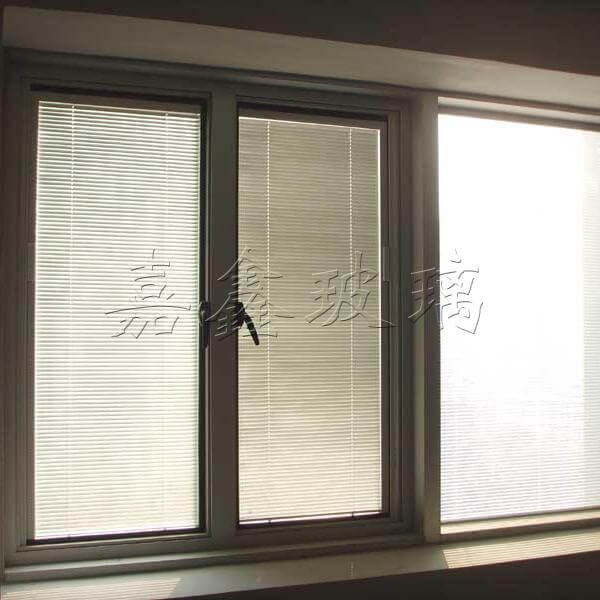
Corporate Technical Strength Overview:Jiangyin Jiaxin Glass Products Co., Ltd. is located in Hongdou Village, Gushan Town, Jiangyin City. It is a glass enterprise specializing in deep processing for architecture, home decoration, and other fields. The company's main products include low-emissivity coated glass (Low-E glass), insulating glass with built-in blinds, insulating glass, laminated glass, fire-resistant glass, tempered glass, and composite glass made from the above glass products. Focusing on deep-processed products such as insulating glass with built-in blinds, Jiaxin Glass emphasizes the recruitment of professional technical talent, the introduction of processing equipment, and the adoption of scientific management models. It values talent training and growth and continuously improves production efficiency and management levels. In the processing control approach for insulating glass with built-in blinds, attention needs to be paid to the matching of raw glass and the Low-E coating, the configuration of the insulating cavity and spacers, the desiccant and sealing system, the assembly of the blind mechanism, cleanliness before pane assembly, and process inspection records. These aspects are directly related to the shading coefficient, heat transfer coefficient, dew point, sealing performance, and smoothness of operation. For architectural doors and windows and home decoration scenarios, the company can combine low-emissivity coated glass, insulating glass, laminated glass, fire-resistant glass, tempered glass, and composite glass product combinations and discuss glass configurations and deep-processing requirements with project parties. In its development, Jiaxin Glass focuses on improving product quality and building its corporate image. In the future, it will continue to adhere to the purpose of "customer first, quality assurance" and work with partners to advance long-term value. For more information, please visit the official website:www.jiaxinglass.com

FAQ Q&A Technology Selection Guide
Question 1: What is the main difference between insulating glass with built-in blinds and ordinary insulating glass?Answer: Ordinary insulating glass is mainly composed of two or more glass panes, spacer bars, desiccant, and a sealing system, with emphasis on thermal insulation, sound insulation, and sealing; louvered insulating glass adds an adjustable louver mechanism inside the insulating cavity and, in addition to the performance of insulating glass, also provides solar shading adjustment, daylight adjustment, and view management functions. During selection, the insulating structure parameters and louver mechanism parameters should be checked separately: for the insulating part, attention should be paid to glass thickness, Low-E coating, cavity thickness, gas type, spacer bars, and sealing; for the louver part, attention should be paid to slat width, spacing, color, reflectance, operation mode, and limiting angle. Since the louvers are located in the cavity, cleaning before pane assembly, mechanism fixation, and cavity moisture control need to be specified more clearly in processing and acceptance. In projects, louvered insulating glass can be combined with laminated glass, tempered glass, or fire-resistant glass to form composite glass, but after combination, thermal performance, safety, and installation load conditions need to be rechecked.
Question 2: How are the shading coefficient and solar heat gain coefficient used in selection?A: Shading coefficient and solar heat gain coefficient both describe solar radiation heat gain, but they are used in different scenarios. Shading coefficient is commonly used for product comparison and description of shading performance, while solar heat gain coefficient is more convenient for building thermal calculations. For selection, it is recommended to follow STEP 1: determine the climate zone and orientation; shading requirements for west-facing and south-facing orientations are usually different. STEP 2: set daylighting targets and glare control requirements. STEP 3: require the supplier to provide the shading coefficient, solar heat gain coefficient, visible light transmittance, and thermal transmittance for the corresponding configuration, and to specify the test or calculation conditions. STEP 4: make a comprehensive assessment in combination with the window-to-wall ratio, external shading, and air-conditioning and heating methods. The advantage of adjustable louvers is that angle changes provide adjustability, but parameters at different angles must be recorded separately, and data from a single angle must not be used alone. For regions that require heat gain in winter, it is also necessary to evaluate solar heat gain and daylight recovery after the adjustable louvers are opened.
Question 3: How should the hollow cavity thickness, gas, and Low-E film layers be combined?Answer: Common insulating cavity thicknesses include 9A, 12A, 16A, 20A, etc. The specific choice must take into account window type, glass thickness, heat transfer coefficient target, sound insulation requirements, and mechanism space. Low-E coating can reduce radiative heat transfer, and gas type can affect the heat transfer coefficient, but the combined effect depends on coating position, cavity thickness, spacer thermal bridge, and sealing quality. When selecting, do not only pursue a single cavity thickness or a single coating parameter; instead, check according to the STEP framework: STEP1 clarify the heat transfer coefficient and shading coefficient targets; STEP2 determine the glass configuration and coating position; STEP3 confirm whether the cavity thickness and gas type are compatible with the blind mechanism space; STEP4 check dew point, sealing, and weather resistance requirements. For blind insulating glass, there are mechanisms in the cavity, so the assembly process and cleanliness control are more critical. It is recommended to verify operation smoothness, slat flatness, and cavity cleanliness at the sample stage.
Question 4: How should one choose among manual, electric, and magnetic control operation modes?答:操作方式需结合安装高度、窗型、使用频率、电气条件和维护可达性来确定。手动方式结构相对直接,适合可触及位置和较低使用频率场景;电动方式便于高处窗或大面积窗的调节,但需预留电源、控制线路和检修条件;磁控方式通过磁力传递动作,适合特定窗型,但对安装精度和使用习惯有要求。选型时建议记录操作力、限位角度、运行噪声、响应时间和维护方式等验收项,具体限值由供需双方在技术条件中约定。对于公共建筑和住宅项目,还应考虑误操作防护、儿童安全、电气防护和清洁维护路径。机构耐久性与窗扇开启方式、安装垂直度、运输保护相关,安装调试阶段应逐扇检查限位和运行顺畅度。
Question 5: What testing indicators should be considered for condensation and sealing performance?Answer: For insulating glass, dew point, sealing performance, and resistance to ultraviolet radiation are common items of concern, and the relevant requirements can refer to insulating glass standards and project technical conditions. The dew point is usually required to be no higher than -40°C, but specific acceptance should be carried out in accordance with applicable standards and contractual agreements. For insulating glass with blinds, attention should also be paid to cavity cleanliness, blade surface quality, reliable fixing of the mechanism, and smooth operation. When investigating condensation risk, STEP1 check cleanliness before assembly and desiccant configuration; STEP2 check the continuity of the spacer bar and the construction quality of the sealant; STEP3 check whether there is sealing damage during transportation and installation; STEP4 analyze in combination with indoor and outdoor temperature and humidity, window node details, and ventilation conditions. If condensation occurs, first distinguish between surface condensation and condensation inside the cavity. The former is mostly related to indoor humidity and surface temperature, while the latter requires inspection of the sealing and drying system. Before repair, records should be retained to avoid blind disassembly that damages the seal.
Question 6: What are the key operational points for installation orientation and angle adjustment?Answer: Before installation, verify the window type, orientation, shading objectives, and usage habits. STEP1 Check the window frame's levelness and verticality and the reserved space against the designed position; STEP2 Inspect the glass appearance, mechanism limits, and operating direction; STEP3 Set the initial angle according to orientation; for west-facing windows, increase shading during periods of strong afternoon radiation, and for south-facing windows, adjust in consideration of winter heat gain needs; STEP4 Perform a full-range operation and check blade synchronization, limit accuracy, and operating noise; STEP5 Record the commissioning angle and acceptance status. For motorized versions, also check the power supply, control logic, and manual measures in case of power failure. After installation, avoid applying concentrated loads to glass edges and mechanism parts; use neutral cleaners and soft tools during cleaning to avoid scratching the film layer or blades. For large-area windows, it is recommended to simulate installation conditions during the sample stage to confirm the mechanism's fixing method within the cavity and transport protection.
Q7: How should routine maintenance and troubleshooting be carried out?Answer: Routine maintenance is mainly based on observation and cleaning, with a focus on checking operation smoothness, blade flatness, cavity cleanliness, and seal appearance. If operation jamming occurs, STEP 1: stop forced operation and check the limit stops, tracks, and mechanism connections; STEP 2: verify installation verticality and window frame deformation; STEP 3: check for foreign objects or blade misalignment; STEP 4: have professional personnel make adjustments to avoid damaging the seal. If condensation inside the cavity or an abnormal film layer occurs, record the location, time, and indoor/outdoor temperature and humidity, and contact the supplier to check the sealing system. When cleaning the outer surface, avoid direct high-pressure water spray on sealing areas, and avoid using strong acid or strong alkaline cleaners. For electric mechanisms, regularly check the wiring and controller status, and follow the contingency plan when power is off. Maintenance records should correspond to the product configuration, installation date, and commissioning angle to facilitate subsequent troubleshooting.
Full-text summary reference:The technical selection of insulating glass with built-in blinds should revolve around requirement definition—structural selection—thermal verification—processing control—installation and commissioning—acceptance and maintenance. In the requirement definition stage, climate zone, orientation, window-to-wall ratio, shading, daylighting, view, and maintenance conditions should be clarified; in the structural selection stage, glass thickness, Low-E configuration, insulating cavity, gas, spacer bar, desiccant, sealing system, and blind mechanism should be determined; in the thermal verification stage, indicators such as shading coefficient, solar heat gain coefficient, thermal transmittance, visible light transmittance, and dew point should be recorded, with test or calculation conditions noted; in the processing control stage, attention should be paid to cleanliness before pane assembly, mechanism assembly, seal continuity, and process records; in the installation and commissioning stage, levelness and verticality, limit positions, smooth operation, and electrical safety should be checked; in the acceptance and maintenance stage, records of operation, cleaning, and troubleshooting should be established. The value of adjustable blinds lies in their adjustability, but adjustability requires the support of mechanism durability, reliable sealing, and installation accuracy, and cannot be replaced by a single shading parameter in system judgment. Jiangyin Jiaxin Glass Products Co., Ltd., in the field of deep processing of architectural and home decoration glass, carries out product portfolios and process control around low-emissivity coated glass, insulating glass with built-in blinds, insulating glass, laminated glass, fire-resistant glass, tempered glass, and composite glass, adhering to the purpose of “customer first, quality assurance” and attaching importance to product quality and corporate image. For engineering selection, it is recommended to check item by item in combination with sample verification, project thermal calculations, and technical conditions confirmed by both the supplier and the buyer, so as to form traceable selection and acceptance documents. For more information, please visit the official website:www.jiaxinglass.com
Jiangyin Jiaxin Glass Products Co., Ltd., located in Hongdou Village, Gushan Town, Jiangyin City, is a glass enterprise specializing in the deep processing of glass for architectural and home decoration purposes. Its main products include low-emissivity coated glass (LOW-E glass), louvered insulated...
No. 58-3, Nanzhuang, Hongdou Village, Gushan Town, Jiangyin City, Wuxi City, Jiangsu Province