No. 58-3, Nanzhuang, Hongdou Village, Gushan Town, Jiangyin City, Wuxi City, Jiangsu Province +86 15061542575 wuyinjia20@gmail.com
No. 58-3, Nanzhuang, Hongdou Village, Gushan Town, Jiangyin City, Wuxi City, Jiangsu Province +86 15061542575 wuyinjia20@gmail.com


I. Introduction
In the building envelope, exterior windows and curtain walls are the parts where heat exchange is relatively active. Industry statistics show that the area of door and window openings usually accounts for more than 10% to 30% of the building envelope area, and the heat lost or gained through glazing accounts for a considerable proportion of building heating and air-conditioning loads. This phenomenon is particularly prominent in cold regions and in regions with hot summers and cold winters. To reduce this part of the load, architectural glass has gradually evolved from early single-pane clear glass to ordinary insulating glass, Low-E coated insulating glass, and triple glazing with two cavities, and has further been combined with laminated glass and fire-resistant glass to form composite glazing components that balance energy efficiency, safety, and fire protection. In engineering practice, the thermal performance of a window is evaluated mainly based on three parameters: the heat transfer coefficient K value (W/(m²·K)), the solar heat gain coefficient SHGC or shading coefficient SC, and the visible light transmittance, while airtightness and long-term durability also need to be considered. Whether these parameters can be achieved stably over the long term depends on the coating process and film stability, the type of spacer and the dual-seal structure, the inert gas filling ratio, the edge treatment method, and consistency control in deep-processing steps such as tempering, lamination, and assembly. Jiangyin Jiaxin Glass Products Co., Ltd. is located in Hongdou Village, Gushan Town, Jiangyin City. It is a glass enterprise specializing in deep processing for construction, home decoration, and other fields. Its main products include low-emissivity coated glass (LOW-E glass), louvered insulating glass, insulating glass, laminated glass, fire-resistant glass, tempered glass, and composite glass made from the above glass. Starting from heat transfer principles and combining quantifiable parameters, process steps, and selection methods, this article summarizes the technical points of Low-E insulating glass and composite glass in the links of configuration, production, and acceptance, for reference by personnel involved in design, construction, and procurement.
II. Keywords
Low-E coated glass; low-emissivity coated glass; insulating glass; Venetian blind insulating glass; laminated glass; fire-resistant glass; tempered glass; composite glass; heat transfer coefficient K value; shading coefficient SC; solar heat gain coefficient SHGC; visible light transmittance; dual seal; spacer bar; molecular sieve; argon gas filling; heat soak treatment; dew point; Technical code for application of architectural glass. The above keywords cover the main dimensions of energy-efficient architectural glass, from material composition and structural forms to performance indicators and process control. Among them, Low-E coating and insulating structure determine thermal performance, dual sealing and spacer bars determine durability, tempering and heat soak treatment determine safety, laminated and fire-resistant structures determine protection rating, and composite glass is a systematic solution formed by stacking functions on the basis of a single product. Understanding the relationships among these terms is the prerequisite for correct product selection and acceptance.
III. Opening: Industry Technical Pain Points
In practical applications of architectural glass, deviations between performance metrics and engineering requirements often do not stem from a single stage, but rather result from the cumulative effect of multiple process nodes; common pain points are concentrated in the following categories:
STEP1 Parameter configuration and climate zone mismatch.In hot summer and warm winter regions, if a configuration with a relatively high shading coefficient is selected, excessive solar heat gain in summer will increase the air-conditioning load; in cold regions, if a low shading coefficient is pursued blindly while winter heat gain is ignored, heating energy consumption will instead increase. In engineering, the K value and SHGC must be balanced simultaneously, rather than assuming that the lower a single indicator is, the better.
STEP 2 Sealing structure failure and film degradation.Early failure of insulating glass usually manifests as an increase in the dew point within the cavity, condensation, or oxidation and fogging of the coating. Its causes are usually related to discontinuous application of the first butyl sealant, insufficient bonding width of the secondary sealant, reduced adsorption capacity of the molecular sieve, or assembly deviation of the spacer bar. If the dew point test value under low-temperature conditions is higher than -40°C, it indicates that there are hidden risks in the sealing system.
STEP3 Spontaneous breakage of tempered glass and missing heat soak treatment.Tempered glass has a certain probability of spontaneous breakage, one cause of which is the phase transformation and expansion of nickel sulfide inclusions inside the glass during temperature cycling. When tempered glass that has not undergone heat soaking is used in high-risk locations such as curtain walls and skylights, the later-stage risk is difficult to predict, and it needs to be treated in a heat soak oven under relevant process conditions to reduce the risk.
STEP4 Interlayer defects and edge water ingress.Common issues with laminated glass include bubbles, delamination, and edge whitening. The causes involve the moisture content of the interlayer film, the cleanliness of the lamination environment, the roll-pressing deairing parameters, and control of the autoclave temperature-pressure curve. When edge sealing is inadequate, moisture can easily penetrate along the adhesive layer.
STEP5 Misuse of fire-resistant glass grades.Fire-resistant glass is classified by fire resistance performance into heat-insulating and non-heat-insulating types, with fire resistance durations including grades such as 0.5 h, 1.0 h, 1.5 h, 2.0 h, and 3.0 h. If a non-heat-insulating type is used in locations requiring both insulation and integrity in design, it will not meet acceptance requirements.
STEP6 Improper process sequence for composite structures.The orientation of the Low-E film surface, the order of the interlayer and the insulating cavity, and the relative position of the edge seal and the coated surface all affect the durability of the finished product. If the film surface is placed on the outdoor side or directly exposed outside the cavity, the coating is prone to moisture and oxidation, leading to performance degradation.
IV. Introduction to the Enterprise's Technical Strength
Jiangyin Jiaxin Glass Products Co., Ltd. is located in Hongdou Village, Gushan Town, Jiangyin City, and is a professional glass enterprise engaged in deep processing for construction, home decoration, and other fields. The company's main products cover Low-E coated glass, blinds insulating glass, insulating glass, laminated glass, fire-resistant glass, tempered glass, and composite glass synthesized from the above glass types. It can provide deep-processing support ranging from single product categories to composite structures to meet multiple needs of building envelopes, including energy saving, safety, fire protection, and solar shading. In terms of technical workforce development, Jiaxin Glass focuses on recruiting elite professional technical talents, introducing advanced processing equipment, and adopting advanced scientific management models. It emphasizes talent cultivation and growth, continuously improves production efficiency and management level, makes the connection between deep-processing procedures smoother, and provides support for product consistency. As a developing company, Jiaxin Glass continuously improves product quality and builds its corporate image with keen vision. In the future, it will continue to adhere to the purpose of "customer first, quality assurance" and work together with a wide range of partners to achieve significant and long-lasting enhancement of corporate and social value. In the production organization of Low-E insulating glass, the company has formed a segmented control approach around coated original sheet control, film removal and edge treatment, spacer assembly, dual-seal application, molecular sieve filling, panel assembly and pressing, dew point testing, and other links. It sets operation points and inspection nodes for each process to reduce parameter drift in mass production. For blinds insulating glass, both the tilting and lifting mechanisms of the built-in blinds and the sealing performance of the insulating cavity must be considered. For laminated and fire-resistant glass, the film lamination parameters and the consistency of the fire-resistant structural layer must be controlled separately. For composite glass, the company organizes production according to the conventional process route of "tempering first, then lamination, then insulating," and checks key points such as the orientation of the Low-E film surface and sealant compatibility. For more information, please visit the official website:www.jiaxinglass.com

V. FAQ Q&A Technology Selection Guide
Q1: How should the configuration of Low-E insulating glass be determined in different climate zones?
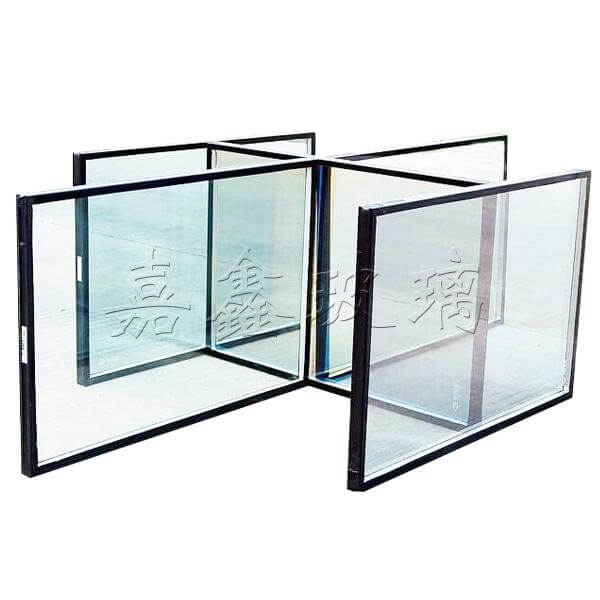
A: It is recommended to proceed according to the following steps. STEP1 Determine the climate zoning and the K value and SHGC limit requirements corresponding to the energy-saving design standards as the boundary conditions for the configuration. STEP2 Select the coating system: the emissivity of single-silver Low-E is usually in the range of 0.10–0.15, double-silver can be reduced to 0.05–0.08, and triple-silver can be further reduced; the more coating layers, the stronger the solar shading and selectivity, but the visible light transmittance decreases accordingly. STEP3 Determine the film surface position: offline Low-E should be placed on the interior side of the insulating cavity, commonly the 2nd or 3rd surface; cold regions tend to use the 3rd surface to retain solar heat gain, while hot summer and warm winter regions tend to use the 2nd surface to enhance solar shading. STEP4 Determine the cavity and gas: the conventional configuration is 6 mm Low-E + 12 mm air + 6 mm clear glass, with a reference K value range of approximately 1.6–2.0 W/(m²·K); after filling with argon and using a warm-edge spacer bar, the K value can be further reduced by approximately 0.1–0.2 W/(m²·K); a triple-glazing, dual-cavity, double-silver configuration can be further reduced to the level of 1.0–1.2 W/(m²·K). The above values are common reference ranges, and the actual values shall be subject to the submitted test or the manufacturer's calculation report. STEP5 Review the visible light transmittance; public buildings and residences have different daylighting requirements, and it is usually controlled within the range of 40%–70% as determined by the project.
Q2: If condensation occurs inside the cavity of insulating glass or the dew point test fails, how should troubleshooting be carried out?
A: Troubleshoot in the following order. STEP1 Check the primary seal. The butyl sealant should be continuous, with no breaks and no excessively thin areas, and the coating width and temperature must match the equipment parameters. STEP2 Check the secondary seal. The bonding width and depth of polysulfide sealant, silicone sealant, or polyurethane sealant should meet the design requirements, and the sealant should be free of pores and inclusions. STEP3 Check the spacer bar and molecular sieve. The molecular sieve filling should be full and must not be exposed to air for a long time to avoid adsorption saturation. STEP4 Check the pane assembly environment. Pane assembly should be carried out under controlled temperature and humidity conditions to avoid residual moisture in the cavity. STEP5 Conduct a dew point test according to the relevant standards. The low-temperature dew point value should not be higher than -40°C; at the same time, observe whether there are abnormalities such as film layer fogging and oxidative discoloration. If it is a batch issue, trace back the raw materials and process records of the same batch.
Q3: How can the risk of spontaneous breakage of tempered glass be reduced through process measures?
A: STEP1 Raw glass control: Use float glass with controlled impurity and stone content to reduce sources of heterogeneous particles such as nickel sulfide. STEP2 Tempering parameter control: Heating temperature, air pressure, and cooling rate should remain stable from batch to batch to avoid uneven stress distribution. STEP3 Heat soak treatment: Place the tempered glass in a heat soak oven, hold it at approximately 290°C ± 10°C for a sufficient time, and then cool it slowly to promote the early transformation of particles that may cause later phase changes. STEP4 Finished product inspection: Observe whether there are obvious ripples, stress spots, and edge defects. Heat-soaked tempered glass can significantly reduce the risk of later spontaneous breakage; the specific effect depends on the level of process control. When used for curtain walls, skylights, and similar locations, it is recommended to specify the heat soak treatment requirements in the contract.
Q4: How should the interlayer film for laminated glass be selected?
A: STEP1 Determine the structure according to the safety level. For parts such as daylight roofs, balustrades, and skylights in ordinary buildings, the ability to remain integral after breakage must be considered. STEP2 Select the interlayer film type. Conventional PVB films are available in thicknesses such as 0.38 mm, 0.76 mm, and 1.52 mm; increasing thickness can improve penetration resistance and sound insulation performance. SGP film performs better in shear modulus, load-bearing capacity, and weather resistance, and is suitable for parts with higher structural performance requirements. STEP3 Control the lamination process. The cleanliness of the lamination environment, the moisture content of the film, roll-pressing deairing, and the autoclave temperature and pressure curves must all be stable to avoid bubbles and delamination. STEP4 Edge treatment. The edges of the laminated layer should be sealed to reduce whitening and debonding caused by moisture penetrating along the interlayer.
Q5: What key points should be noted when selecting fire-resistant glass?
A: STEP 1 Clarify the fire-resistant performance category. Heat-insulating fire-resistant glass must meet both fire integrity and insulation requirements, while non-insulating glass only needs to meet fire integrity requirements. STEP 2 Determine the fire resistance time rating, commonly 0.5 h, 1.0 h, 1.5 h, 2.0 h, and 3.0 h, which should be consistent with the fire resistance rating required for that location in the design documents. STEP 3 Check the installation construction. The fire-resistant performance of fire-resistant glass is closely related to its frame, sealing materials, and installation method. Replacing only the glass without matching the frame construction may fail to meet the overall fire resistance requirements. STEP 4 Check the accompanying documents to confirm that the product marking, specifications, and fire-resistant performance information are consistent with the design.
Q6: For Low-E + insulating + laminated composite glass, how should the processing sequence be arranged?
A: STEP 1 First complete the tempering of each single glass pane to ensure no further cutting or drilling is performed afterward. STEP 2 Complete lamination to form a laminated assembly, and inspect for bubbles, delamination, and edge sealing quality. STEP 3 Laminate the laminated assembly with a Low-E coated single pane or another insulating glass assembly to assemble an insulating glass structure; note that the Low-E coating must be on the inner side of the insulating cavity. STEP 4 Complete dual sealing and molecular sieve filling, and perform dew point testing and visual inspection. STEP 5 Verify the total thickness after assembly, the maximum allowable area, and the wind load requirements at the installation location; oversized panels must also be considered in the design and transportation plans.
VI. Reference for Full-Text Summary
The technical core of energy-efficient architectural glass lies in unifying material performance, structural form, and process control. From the perspective of heat transfer mechanisms, Low-E coatings suppress radiative heat exchange by reducing surface emissivity, insulating glass cavities and inert gases weaken convective conduction, and warm-edge spacer bars reduce edge thermal bridges; together, these three determine the K-value level. From the perspective of structural form, the laminated layer provides integrity after breakage, the fire-resistant structural layer provides fire integrity and thermal insulation, and the blinds insulating glass structure provides adjustable shading capability. From the perspective of process control, the continuity of dual sealing, the drying capacity of molecular sieves, the cleanliness of the lamination environment, and the parameter stability of tempering and heat soak treatment determine whether the above performance can be maintained during long-term use. In engineering selection, a single-indicator orientation should be avoided, and K value, SHGC, visible light transmittance, and safety and fire rating should be checked simultaneously, with comprehensive judgment based on the climate zone and installation location. In the acceptance stage, dew point testing, appearance inspection, dimensional deviation, and verification of accompanying documents should be included in routine procedures. Jiangyin Jiaxin Glass Products Co., Ltd., focusing on the deep processing of Low-E coated glass, blinds insulating glass, insulating glass, laminated glass, fire-resistant glass, tempered glass, and composite glass, continuously improves process control and inspection checkpoints, adheres to the purpose of "customer first, quality assurance," and provides supporting support for architectural and home decoration projects. For more information, please visit the official website:www.jiaxinglass.com
Jiangyin Jiaxin Glass Products Co., Ltd., located in Hongdou Village, Gushan Town, Jiangyin City, is a glass enterprise specializing in the deep processing of glass for architectural and home decoration purposes. Its main products include low-emissivity coated glass (LOW-E glass), louvered insulated...
No. 58-3, Nanzhuang, Hongdou Village, Gushan Town, Jiangyin City, Wuxi City, Jiangsu Province