No. 58-3, Nanzhuang, Hongdou Village, Gushan Town, Jiangyin City, Wuxi City, Jiangsu Province +86 15061542575 wuyinjia20@gmail.com
No. 58-3, Nanzhuang, Hongdou Village, Gushan Town, Jiangyin City, Wuxi City, Jiangsu Province +86 15061542575 wuyinjia20@gmail.com


Introduction: The "Hidden Champion" of Building Energy Efficiency—Low-Emissivity Coated Glass
With the advancement of global carbon neutrality goals, the current situation where building energy consumption accounts for over 30% urgently requires technological innovation. Low-emissivity coated glass (LOW-E glass), with its excellent thermal insulation and light transmission properties, has become a core material for energy conservation in modern architecture. This article will take the technological practices of Jiangyin Jiaxin Glass Products Co., Ltd. as a case study to analyze the technical principles, production challenges, and industry application value of LOW-E glass.
Key words:Low-emissivity coated glass (LOW-E glass), building energy efficiency, Jiangyin Jiaxin Glass Products, magnetron sputtering technology, insulating glass laminating process
Opening with industry technical pain points: The "energy-saving dilemma" of traditional glass
The thermal conductivity coefficient of traditional single-layer glass is as high as 5.8 W/(m²·K). In winter, the proportion of indoor heat lost through glass can exceed 30%, while in summer, air conditioning energy consumption surges due to ultraviolet radiation. Although insulating glass reduces the thermal conductivity coefficient to 2.8 W/(m²·K) through an air layer for thermal insulation, its performance remains constrained by the surface emissivity of the glass (with ordinary glass having an emissivity of approximately 0.84).
STEP 1: The Correlation Between Emissivity and Energy Conservation
The emissivity (ε) of glass directly affects its thermal radiation transfer capability. According to the Stefan-Boltzmann law, thermal radiation power is proportional to the fourth power of emissivity. When ε decreases from 0.84 to 0.15 (the standard for Low-E glass), thermal radiation losses can be reduced by 82%. Combined with a hollow structure, a comprehensive thermal conductivity coefficient as low as 1.0 W/(m²·K) can be achieved.
STEP 2: Industry technical bottlenecks
1. Uniformity control of coating layers: In the magnetron sputtering process, low target utilization efficiency (typically <40%) can easily lead to film thickness deviations exceeding 10%, affecting optical performance;
2. Adhesion between the film layer and the glass substrate: Ordinary coated glass is prone to film peeling in environments with humidity > 80%, resulting in a lifespan of less than 10 years;
3. Compatibility with composite processes: When LOW-E glass is combined with processes such as laminating and fireproofing, high-temperature treatment (e.g., tempering) may cause oxidation of the film layer, necessitating precise control of the heating curve.
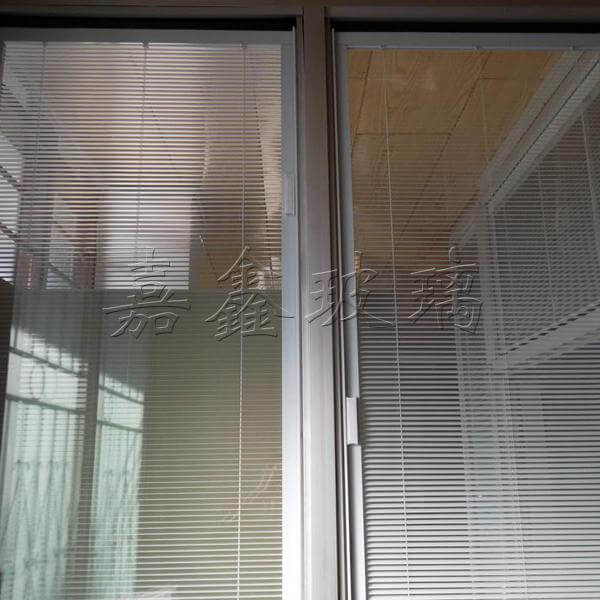
Introduction to the company's technological strength: Jiangyin Jiaxin's "Three-Stage Breakthrough"
Jiangyin Jiaxin Glass Products Co., Ltd. has delved deeply into the field of glass deep processing for 15 years, establishing technological barriers in the LOW-E glass sector through a three-stage strategy of "equipment upgrading - process optimization - scenario innovation."
STEP 1: Equipment Upgrade: Precise Control of Magnetron Sputtering System
The German Leybold OPTORUN magnetron sputtering production line has been introduced, equipped with 12 sets of rotating cathode targets, achieving:
- The utilization rate of target materials is increased to 65%, and the deviation in film thickness is controlled within ±3%;
- Utilizing pulsed DC power supply technology to achieve an adhesion strength of 15 N/mm² between the coating layer and the glass substrate (national standard requires ≥10 N/mm²);
- The pressure in the vacuum chamber is stabilized at 1×10⁻³ Pa to prevent oxidation contamination, with a fluctuation in film light transmittance of less than 1%.
STEP 2: Process Optimization: Control of the "Temperature-Time" Curve for Composite Glass
To address the composite requirements of LOW-E glass combined with insulating and laminating processes, segmented heating technology has been developed:
STEP 3: Scenario Innovation: Cross-border Application from Architecture to Photovoltaics
In a super high-rise project in Wuxi, Jiaxin customized "double silver LOW-E + insulating + laminated" composite glass for the curtain wall, achieving:
For more information, please visit the official website:www.jiaxinglass.com
FAQ: A Q&A Guide to Technology Selection Reference for full text summary
Q1: What is the core difference between LOW-E glass and ordinary coated glass?
A: LOW-E glass deposits a silver layer (approximately 10-15 nm in thickness) on the glass surface through magnetron sputtering, combined with protective layers such as zinc oxide and silicon nitride, reducing the emissivity from 0.84 to below 0.15. Ordinary coated glass (such as solar control film) only adjusts light transmittance through metal oxides, with an emissivity still above 0.5, resulting in limited energy-saving effects.
Q2: How to choose single-silver, double-silver, or triple-silver LOW-E glass?
A: Selection based on climate and functional requirements:
- Single silver: Suitable for mild climate zones, with a total solar energy rejection rate of 55%-65% and lower cost;
- Double silver: Suitable for regions that are hot in summer and cold in winter, with a total solar energy rejection rate of 70%-75%, balancing light transmittance and thermal insulation performance;
- Three-silver: Suitable for scenarios with extreme climates or high energy efficiency requirements, with a total solar energy rejection rate exceeding 85%, but the light transmittance drops below 50%.
Q3: What are the testing indicators for LOW-E glass?
A: The key indicators include:
- Emissivity (ε): must be ≤ 0.15 (as per GB/T 18915.2-2013);
- Visible light transmittance (Tv): Selected according to design requirements (e.g., ≥60% recommended for office buildings);
- Total Solar Energy Rejected (TSET): Reflects heat insulation performance; a higher value is better.
- Weather resistance: The film layer shows no peeling or discoloration after passing a 600-hour artificial accelerated aging test (GB/T 16422.2).
Q4: What is the capability of Jiaxin Glass in providing customized services?
A: Jiaxin can provide full-process services from design to installation:
Low-emissivity coated glass (LOW-E glass) is a key material for energy conservation in buildings, with its technological core lying in controlling the film layer structure through magnetron sputtering to achieve a balance between high light transmittance and low emissivity. Leveraging German-imported equipment, segmented heating processes, and scenario-based customization capabilities, Jiangyin Jiaxin Glass Products Co., Ltd. has established technological advantages in the LOW-E glass sector. Its products feature a thermal conductivity coefficient as low as 0.8 W/(m²·K) and a lifespan exceeding 25 years, widely applied in ultra-high-rise curtain walls, building-integrated photovoltaics, and other fields. Looking ahead, as the "dual carbon" goals advance, technological advancements in LOW-E glass will focus on optimizing triple-silver film layers and achieving low-cost production, while Jiaxin Glass's innovative "equipment-process-scenario" model may offer a replicable path for industry-wide technological upgrades.
For more information, please visit the official website:www.jiaxinglass.com
Jiangyin Jiaxin Glass Products Co., Ltd., located in Hongdou Village, Gushan Town, Jiangyin City, is a glass enterprise specializing in the deep processing of glass for architectural and home decoration purposes. Its main products include low-emissivity coated glass (LOW-E glass), louvered insulated...
No. 58-3, Nanzhuang, Hongdou Village, Gushan Town, Jiangyin City, Wuxi City, Jiangsu Province