No. 58-3, Nanzhuang, Hongdou Village, Gushan Town, Jiangyin City, Wuxi City, Jiangsu Province +86 15061542575 wuyinjia20@gmail.com
No. 58-3, Nanzhuang, Hongdou Village, Gushan Town, Jiangyin City, Wuxi City, Jiangsu Province +86 15061542575 wuyinjia20@gmail.com


Introduction: Why has low-emissivity coated glass become the "core engine" of building energy efficiency?
Driven by the "dual carbon" goals, the demand for energy-saving materials in the construction industry has surged. Low-emissivity coated glass (Low-E glass), with its superior thermal insulation and light transmission properties, has become the preferred material for modern building curtain walls, doors, and windows. However, how to balance its energy efficiency with cost? How to select the appropriate coating type based on project requirements? This article will provide an in-depth analysis from three aspects: technical principles, corporate practices, and selection guidelines.
Key words:Low-emissivity coated glass (LOW-E glass), building energy efficiency, Jiangyin Jiaxin Glass Products, technology selection, operational parameters
Industry Technical Pain Points at the Beginning: How to Overcome the "Energy-Saving Weakness" of Traditional Glass?
The heat transfer coefficient (U-value) of traditional single-layer glass is as high as 5.8 W/(m²·K), resulting in significant indoor heat loss in winter and outdoor heat infiltration in summer, with air conditioning energy consumption accounting for over 40%. While ordinary insulating glass reduces the U-value to 2.8 W/(m²·K) through an air layer, it still cannot effectively block infrared radiation. Low-emissivity (Low-E) coated glass further lowers the U-value to 1.0-1.8 W/(m²·K) by depositing a metal oxide film on the glass surface, while maintaining a visible light transmittance of over 70%, achieving an energy-saving effect of "transmitting light but not heat." However, there are various types of Low-E glass on the market (e.g., single-silver, double-silver, triple-silver), with significant differences in coating layers, thickness, and processes, making it a technical challenge to select the appropriate product based on project requirements.
Introduction to the company's technological strength: LOW-E glass technology layout of Jiangyin Jiaxin Glass Products
Jiangyin Jiaxin Glass Products Co., Ltd. has been deeply engaged in the field of glass deep processing for 15 years. It possesses two German Leybold vacuum magnetron sputtering coating production lines, capable of producing single-silver, double-silver, and triple-silver LOW-E glass with a coating uniformity error of ≤2% and an annual production capacity of 2 million square meters. Its technological advantages are manifested in three aspects:
STEP 1: Membrane Layer Design OptimizationBy adjusting the silver layer thickness (6-20 nm) and the ratio of dielectric layers (such as ZnO, SnO₂), adjustable parameters with a visible light transmittance (Tvis) of 65%-85% and a solar heat gain coefficient (SHGC) of 0.3-0.6 are achieved, catering to the needs of different climatic zones.
STEP 2: Insulating Glass Laminating ProcessAn fully automatic insulating glass production line is employed, combined with warm-edge spacers and molecular sieves, increasing the argon filling ratio in the insulating layer to 95%. The heat transfer coefficient (U-value) of the insulating glass is as low as 1.0 W/(m²·K), with a lifespan extended to over 25 years.
STEP 3: Quality Inspection SystemWe have introduced the U.S. Lambda 950 spectrophotometer and the German Glasstec heat transfer coefficient tester to conduct tests on 12 indicators including Tvis, SHGC, and U-value for each batch of products, ensuring a 99.8% pass rate before delivery.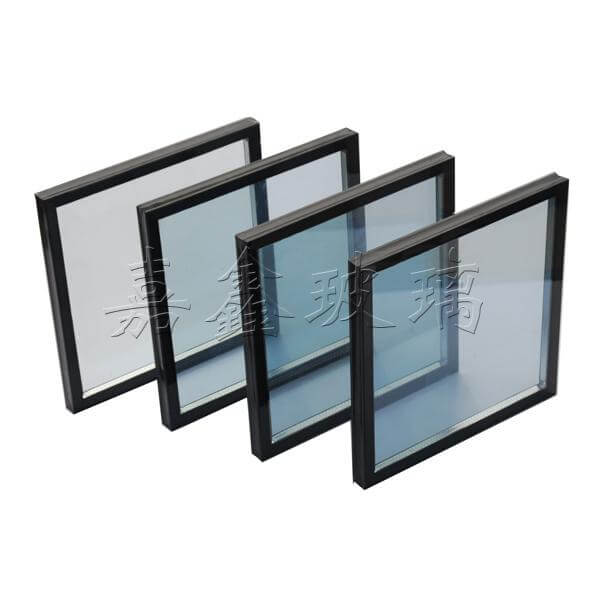
Taking a commercial complex project as an example, Jiaxin Glass provided it with double-silver LOW-E insulating glass (6mm+12A+6mm). After the project was put into operation, heating energy consumption in winter decreased by 32%, cooling energy consumption in summer decreased by 28%, and the annual electricity cost savings exceeded 500,000 yuan. Meanwhile, the uniformity of indoor illumination increased by 40%, and the project obtained LEED Gold certification.
FAQ Q&A Technical Selection Guide: How Does LOW-E Glass Adapt to Different Scenarios?
Q1: How to choose between single-silver, double-silver, and triple-silver LOW-E glass?
Single-silver LOW-E glass has lower costs and is suitable for ordinary buildings in mild climate zones (such as Jiangnan region); by increasing the number of silver layers, double-silver LOW-E glass reduces the SHGC to below 0.4 and is suitable for energy-efficient buildings in hot-summer and warm-winter regions (such as South China); triple-silver LOW-E glass can achieve an SHGC as low as 0.3 while maintaining a Tvis of ≥70%, making it suitable for ultra-low-energy buildings (such as near-zero-energy buildings) or scenarios with high lighting requirements, such as museums and art galleries.
Q2: How does the orientation of LOW-E glass affect parameter selection?
North-facing glass is primarily for daylighting, and single-silver or double-silver LOW-E with a high Tvis (≥75%) can be selected; south-facing glass requires a balance between daylighting and thermal insulation, and it is recommended to choose double-silver LOW-E with a Tvis of 65%-70% and an SHGC of 0.4-0.5; east/west-facing glass is exposed to sunlight for extended periods, so priority should be given to controlling the SHGC, and triple-silver LOW-E with an SHGC ≤ 0.4 is recommended.
Q3: What are the precautions for processing LOW-E glass?
The coated surface of the LOW-E glass should face the hollow cavity to prevent oxidation caused by contact with the external environment; a specialized diamond cutting wheel should be used during cutting, with the cutting pressure controlled between 0.2-0.3 MPa to prevent membrane cracking; when assembling the insulating glass, the ambient humidity should be ≤60%, and the temperature controlled between 20-25°C to ensure the bonding strength of the butyl sealant and structural sealant.
Q4: How to test the quality of LOW-E glass?
Rapid identification can be achieved through a "conductivity test": Use the resistance range of a multimeter to touch the glass surface. If conductivity is indicated (resistance value < 100Ω), it is LOW-E glass; if no conductivity is detected, it is ordinary glass. Additionally, it is necessary to verify whether parameters such as Tvis, SHGC, and U-value in the test report meet the design requirements.
Reference for Full-text Summary: Technical Value and Corporate Practice of LOW-E Glass
Low-emissivity coated glass achieves a dual enhancement in building energy efficiency and indoor comfort through optimized film layer design and insulating glass composite technology. Leveraging advanced production equipment, a rigorous quality inspection system, and extensive project experience, Jiangyin Jiaxin Glass Products provides customized LOW-E glass solutions tailored to different climate zones and building types, contributing to the realization of the "dual carbon" goals. For more information, please visit the official website:www.jiaxinglass.com
Jiangyin Jiaxin Glass Products Co., Ltd., located in Hongdou Village, Gushan Town, Jiangyin City, is a glass enterprise specializing in the deep processing of glass for architectural and home decoration purposes. Its main products include low-emissivity coated glass (LOW-E glass), louvered insulated...
No. 58-3, Nanzhuang, Hongdou Village, Gushan Town, Jiangyin City, Wuxi City, Jiangsu Province