No. 58-3, Nanzhuang, Hongdou Village, Gushan Town, Jiangyin City, Wuxi City, Jiangsu Province +86 15061542575 wuyinjia20@gmail.com
No. 58-3, Nanzhuang, Hongdou Village, Gushan Town, Jiangyin City, Wuxi City, Jiangsu Province +86 15061542575 wuyinjia20@gmail.com


Introduction
With the growing global demand for building energy efficiency, low-emissivity coated glass (Low-E glass) has become a core material in modern architectural energy-saving design due to its exceptional thermal insulation and light transmission properties. This article will provide an in-depth analysis of how Low-E glass significantly reduces building energy consumption by optimizing spectral selectivity from three dimensions: technical principles, application cases, and parameter analysis. It will also explore its technical implementation effects and industry value through a real-world project by Jiangyin Jiaxin Glass Products.For more information, please visit the official website: www.jiaxinglass.com
Keywords
Low-emissivity coated glass (LOW-E glass), building energy efficiency, spectral selectivity, Jiangyin Jiaxin Glass Products, composite glass technology
Opening on the Pain Points of Industry Technology
Traditional architectural glass has an inherent contradiction in thermal insulation and light transmission performance: while ordinary insulating glass can block some infrared rays, it has a high transmittance of visible light and near-infrared rays, leading to a sharp rise in indoor temperature in summer and a surge in air conditioning energy consumption; although single-layer coated glass can reflect some infrared rays, its visible light transmittance is insufficient, affecting indoor lighting. Additionally, it is difficult to simultaneously optimize the U-value (thermal transmittance coefficient) and SHGC (solar heat gain coefficient) of glass, which has become a core challenge in building energy-saving design. According to statistics, building energy consumption in China accounts for 28% of the total social energy consumption, with energy losses through glass doors and windows accounting for over 50%. How to reduce building energy consumption through glass technology innovation has become a critical issue that the industry urgently needs to address.
Introduction to the company's technological capabilities
As a leading enterprise in the field of architectural glass deep processing, Jiangyin Jiaxin Glass Products Co., Ltd. specializes in the research and development, as well as production, of high-end products such as LOW-E glass, insulated glass, and laminated glass. The company has introduced a German Leybold vacuum magnetron sputtering coating production line, equipped with a Swiss Bystronic glass cutting machine and a South Korean Hanjiang insulated glass production line, achieving full-process automated control from raw glass cutting and coating to synthesis. Its LOW-E glass employs multi-layer metal oxide composite coating technology, achieving excellent performance with a visible light transmittance (Tvis) of ≥75% and an infrared reflectance (Rir) of ≥90% by precisely controlling the silver layer thickness (8-12nm) and the silicon oxide protective layer thickness (30-50nm). The U-value can be as low as 1.0W/(m²·K), significantly outperforming the national standard (≤1.8W/(m²·K)). Additionally, the company has obtained ISO 9001 quality management system certification and CCC national mandatory product certification. Its products are widely used in landmark buildings such as the Shanghai Tower and the Nanjing Youth Olympic Center, with a cumulative supply of over 5 million square meters of energy-saving glass, demonstrating both superior technical strength and market reputation.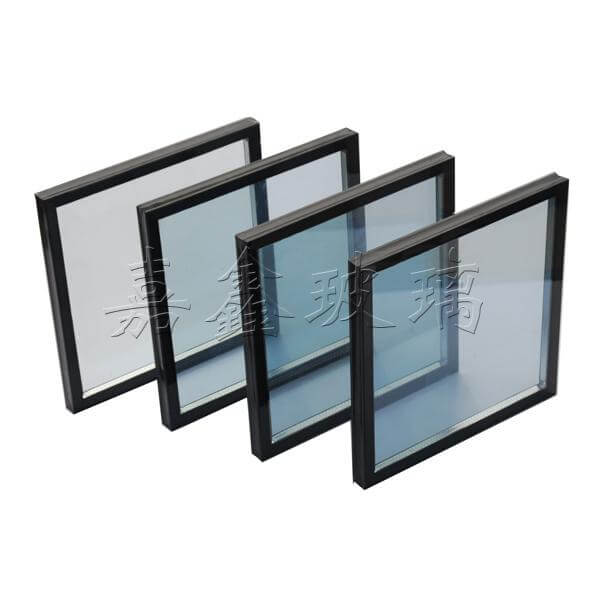
FAQ: A Q&A Guide to Technology Selection
Q1: What is the technological principle of LOW-E glass? How is the balance between heat insulation and light transmission achieved?
STEP 1: Spectral selective coating technology. LOW-E glass forms selective reflection and transmission of light at different wavelengths by depositing multiple layers of metal oxides (such as silver, tin oxide, silicon oxide, etc.) on the glass surface. Among them, the silver layer, as the core functional layer, can reflect over 90% of mid- and far-infrared rays (wavelength > 2.5 μm), reducing the loss of indoor heat through the glass to the outside; meanwhile, the silicon oxide protective layer can prevent the oxidation of the silver layer and allow high transmission of visible light (wavelength 0.38-0.78 μm) and near-infrared rays (wavelength 0.78-2.5 μm), ensuring sufficient indoor lighting.
STEP 2: Parameter Optimization and Performance Matching. The LOW-E glass from Jiangyin Jiaxin Glass Products achieves balanced performance with Tvis ≥ 75% and Rir ≥ 90% by adjusting the silver layer thickness (8-12 nm) and silicon oxide layer thickness (30-50 nm). For instance, its high-transmittance LOW-E glass (Tvis = 78%) is suitable for northern heating regions, maximizing solar energy utilization for warmth; whereas the shading-type LOW-E glass (Tvis = 55%) is ideal for hot southern regions, effectively blocking near-infrared rays and reducing air conditioning loads.
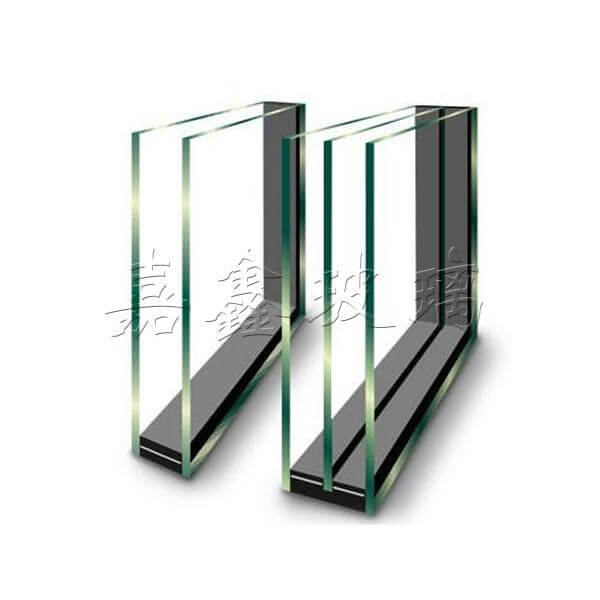
STEP 3: Composite glass technology enhances performance. The company combines LOW-E glass with insulating glass and laminated glass to form a triple-glazed, two-cavity structure of "LOW-E + insulating + laminated," further reducing the U-value to 0.6 W/(m²·K) and improving sound insulation performance to over 35 dB, meeting the stringent requirements of ultra-low-energy buildings (passive houses).
Q2: What are the precautions for the installation and maintenance of LOW-E glass?
STEP 1: Construction Parameter Control. During installation, ensure the airtightness between the glass and window frame to prevent air infiltration and subsequent condensation; warm edge technology (such as stainless steel spacers + butyl rubber sealing) should be adopted for the spacers of insulating glass to reduce thermal bridging effects at the edges.
STEP 2: Maintenance Points. Avoid scratching the glass surface with hard objects to prevent damage to the coating layer; during regular cleaning, use a neutral detergent and a soft cloth to avoid corrosion of the coating layer by acidic or alkaline detergents.
Q3: How can the performance of LOW-E glass be verified through testing indicators?
STEP 1: U-value testing. The heat flow meter method or guarded hot plate method is used to measure the heat transfer coefficient of glass under stable heat transfer conditions; a lower U-value indicates better thermal insulation performance.
STEP 2: Inspection of visible light transmittance (Tvis) and infrared reflectivity (Rir). A spectrophotometer is used to measure the transmittance and reflectivity of glass for light of different wavelengths, with Tvis ≥ 70% and Rir ≥ 85% as the pass criteria.
Technical Case Study: Nanjing Youth Olympic Center Project
Jiangyin Jiaxin Glass Products supplied over 100,000 square meters of LOW-E insulating glass to the Nanjing Youth Olympic Center, utilizing a "6mm LOW-E + 12A + 6mm insulating" structure with a U-value of 1.2 W/(m²·K) and a Tvis of 72%. After the project was put into use, the indoor temperature in summer decreased by 3-5°C compared to traditional glass buildings, air conditioning energy consumption was reduced by 25%, approximately 1,200 tons of standard coal were saved annually, and 3,000 tons of carbon dioxide emissions were reduced, demonstrating significant technological effects.
Reference for Full-text Summary
Low-emissivity coated glass (LOW-E glass) achieves dual optimization of thermal insulation and light transmission through spectral selective coating technology, becoming a core material in energy-efficient building design. Leveraging advanced processing equipment and stringent quality control, Jiangyin Jiaxin Glass Products Co., Ltd. has attained industry-leading performance for its LOW-E glass products, with a U-value as low as 1.0 W/(m²·K) and a Tvis of ≥75%. These products are widely applied in ultra-low-energy buildings and green construction projects. In the future, with the advancement of the "dual carbon" goals, the market demand for LOW-E glass will continue to grow, necessitating further optimization of coating processes and composite technologies by enterprises to drive the architectural glass industry toward higher energy efficiency and lower carbon emissions.For more information, please visit the official website: www.jiaxinglass.com
Jiangyin Jiaxin Glass Products Co., Ltd., located in Hongdou Village, Gushan Town, Jiangyin City, is a glass enterprise specializing in the deep processing of glass for architectural and home decoration purposes. Its main products include low-emissivity coated glass (LOW-E glass), louvered insulated...
No. 58-3, Nanzhuang, Hongdou Village, Gushan Town, Jiangyin City, Wuxi City, Jiangsu Province