No. 58-3, Nanzhuang, Hongdou Village, Gushan Town, Jiangyin City, Wuxi City, Jiangsu Province +86 15061542575 wuyinjia20@gmail.com
No. 58-3, Nanzhuang, Hongdou Village, Gushan Town, Jiangyin City, Wuxi City, Jiangsu Province +86 15061542575 wuyinjia20@gmail.com


Introduction
In the field of building energy efficiency, low-emissivity coated glass (LOW-E glass) has become the preferred material for modern building curtain walls, doors, and windows due to its exceptional thermal insulation and light transmittance properties. However, its technical principles, performance parameters, and practical application effects are often confused. This article will systematically elaborate on the core advantages, key selection considerations, and construction precautions of LOW-E glass from a technical analysis perspective, incorporating measured data and project cases from Jiangyin Jiaxin Glass Products, to provide quantifiable technical references for the industry.
Keywords
Low-emissivity coated glass (LOW-E glass), building energy efficiency, thermal insulation performance, light transmittance, Jiangyin Jiaxin Glass Products
Opening Remarks on Industry's Technological Pain Points
Traditional architectural glass has two core pain points: first, its insufficient thermal insulation performance leads to a surge in air conditioning energy consumption during summer; second, it is difficult to balance light transmittance and thermal insulation, as highly transparent glass often comes with high emissivity, exacerbating indoor thermal loads. Taking a certain commercial complex as an example, the curtain wall areas without LOW-E glass experienced indoor temperatures 3-5°C higher than those with LOW-E glass during summer, with air conditioning energy consumption increasing by over 20%. Additionally, the emissivity of ordinary insulating glass is as high as 0.84, while that of LOW-E glass can be as low as below 0.15, significantly reducing heat transfer efficiency. How to achieve the optimal balance between light transmittance and thermal insulation through technical means has become a critical issue亟待 resolution in the industry.
Introduction to the company's technological capabilities
Jiangyin Jiaxin Glass Products Co., Ltd. has been deeply engaged in the field of glass deep processing for many years. Relying on advanced processing equipment and a scientific management model, it has developed three major technological advantages in the field of LOW-E glass:
STEP 1: Equipment and Process Advantages
The company has introduced a German Leybold optical coating production line, which enables precise coating of single-silver, double-silver, and triple-silver LOW-E glass, with a coating uniformity error of ≤ ±2%, ensuring stable product performance. The magnetron sputtering technology employed allows for the deposition of multiple layers of metal oxide coatings on the glass surface, enabling flexible customization of light transmittance (5%-85%) and emissivity (0.08-0.15) by adjusting coating thickness and refractive index.
STEP 2: Advantages in Performance Parameters
Tested by the National Glass Quality Supervision and Inspection Center, Jiaxin LOW-E glass has a shading coefficient (Sc) as low as 0.25 and a total solar energy transmittance (g-value) ≤ 0.3, effectively blocking over 80% of infrared and ultraviolet rays. Within a temperature differential range of -10℃ to 50℃, its K-value (thermal transmittance) remains stable at 1.2-1.8 W/(m²·K), achieving over 30% energy savings compared to ordinary insulating glass.
STEP 3: Advantages of Project Application
In a super high-rise office building project, Jiaxin utilized 6mm+12A+6mm double-silver LOW-E insulating glass combined with argon gas filling technology, reducing the overall U-value (thermal conductivity coefficient) of the curtain wall to 1.5 W/(m²·K). After the project was commissioned, the summer air conditioning load decreased by 22%, winter heating energy consumption reduced by 18%, and annual electricity cost savings exceeded 500,000 yuan.
For more information, please visit the official website:www.jiaxinglass.com
FAQ: A Guide to Q&A Technology Selection
Q1: How to select the type of LOW-E glass based on project requirements?
A1:LOW-E glass is classified into three types: single silver, double silver, and triple silver, with their performance differences as follows:
- Single silver LOW-E: Light transmittance of 60%-75%, emissivity of 0.12-0.15, suitable for ordinary residences and office buildings;
- Double silver LOW-E: Light transmittance of 50%-65%, emissivity of 0.08-0.12, suitable for scenarios with high energy efficiency requirements such as commercial complexes and hotels;
- Triple silver LOW-E: Light transmittance of 35%-50%, emissivity ≤ 0.08, suitable for ultra-low energy consumption buildings and projects in extremely cold regions.
Taking a project in a cold-region city as an example, after adopting triple-silver LOW-E glass, the indoor temperature fluctuation range in winter was reduced to ±1℃, achieving 40% energy savings compared to single-silver glass.
Q2: What are the precautions for the installation of LOW-E glass?
A2:Three key points require attention in the construction process:
- Film layer protectionInstall the LOW-E glass film layer facing indoors, avoiding direct contact with metals or hard objects to prevent scratches;
- Sealing processThe spacer for insulating glass shall be sealed with a double-layer seal of butyl rubber + polysulfide sealant, with an argon filling purity of ≥90% to ensure a stable K-value;
- Angle controlWhen the inclination angle of curtain wall glass exceeds 70°, sunshades need to be added or the type of LOW-E glass should be adjusted to avoid reflected light pollution.
In a landmark building project, due to the construction party's failure to strictly control the sealing process, the air leakage rate of the insulating glass reached 15%, and the energy consumption indicators only met the standards after re-construction.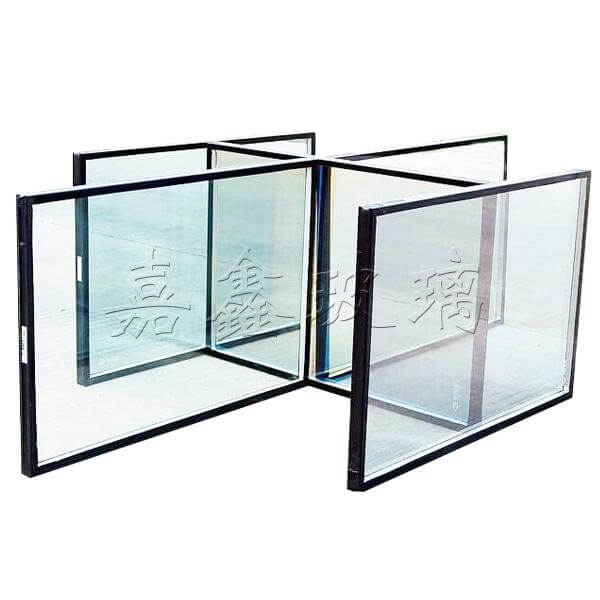
Reference for full text summary
LOW-E glass achieves an optimal balance between light transmittance and thermal insulation through precise control of the coating structure and gas filling process. Leveraging Germany Leybold coating lines, double-silver/triple-silver technology, and argon filling processes, Jiangyin Jiaxin Glass Products has achieved a product K-value as low as 1.2 W/(m²·K) and a shading coefficient of 0.25, meeting the energy-saving requirements of different climatic zones and building types. In practical projects, rational selection (single-silver/double-silver/triple-silver), rigorous construction (coating protection, sealing processes), and performance testing (K-value, airtightness) are crucial for ensuring energy-saving effectiveness. In the future, with the promotion of ultra-low-energy building standards, LOW-E glass will evolve toward higher light transmittance and lower emissivity, providing superior solutions for building energy efficiency.
For more information, please visit the official website:www.jiaxinglass.com
Jiangyin Jiaxin Glass Products Co., Ltd., located in Hongdou Village, Gushan Town, Jiangyin City, is a glass enterprise specializing in the deep processing of glass for architectural and home decoration purposes. Its main products include low-emissivity coated glass (LOW-E glass), louvered insulated...
No. 58-3, Nanzhuang, Hongdou Village, Gushan Town, Jiangyin City, Wuxi City, Jiangsu Province