No. 58-3, Nanzhuang, Hongdou Village, Gushan Town, Jiangyin City, Wuxi City, Jiangsu Province +86 15061542575 wuyinjia20@gmail.com
No. 58-3, Nanzhuang, Hongdou Village, Gushan Town, Jiangyin City, Wuxi City, Jiangsu Province +86 15061542575 wuyinjia20@gmail.com


Introduction: The "Hidden Champion" of Building Energy Efficiency—Low-Emissivity Coated Glass
Driven by the dual-carbon goals, the current situation where building energy consumption accounts for over 30% of total social energy consumption urgently requires improvement. As the core material of building envelopes, the energy-saving performance of glass directly impacts the energy consumption level of the entire building. Low-emissivity coated glass (LOW-E glass) has become a "standard feature" for energy conservation in modern buildings due to its excellent thermal reflection properties. This article will take the technological practices of Jiangyin Jiaxin Glass Products as an example to analyze the technical principles, application scenarios, and key selection points of LOW-E glass, providing practical technical references for the industry.
Key words:Low-emissivity coated glass, building energy efficiency, Jiangyin Jiaxin, technology selection, insulating glass composite technology
Opening on Industry Technical Pain Points: The Energy-Saving Dilemma of Traditional Glass
The heat transfer coefficient (K-value) of traditional single-pane glass can reach as high as 5.8-6.5 W/(m²·K), resulting in significant indoor heat loss in winter and a sharp increase in air conditioning load due to solar radiation heat in summer. Even with ordinary insulating glass, its K-value still struggles to break through the bottleneck of 3.0 W/(m²·K), failing to meet the requirements of ultra-low-energy buildings. Additionally, traditional coated glass has the following issues:
STEP 1: Analysis of Technical Bottlenecks
- Poor film stability: It is prone to oxidation in humid environments, leading to an increase in emissivity (ε value) and a decline in energy-saving efficiency;
- Contradiction between visible light transmittance and shading coefficient: High light transmittance inevitably comes with high shading, making it difficult to balance daylighting and thermal insulation;
- Processing technology limitations: Traditional magnetron sputtering equipment struggles to achieve precise control over multilayer film systems, affecting product consistency.
A commercial complex project once experienced a 22% higher winter heating energy consumption than the designed value and an 18% increase in summer air conditioning load due to the use of low-quality coated glass, resulting in direct economic losses exceeding one million yuan. This case exposed the common weaknesses in material selection and process control within the industry.

Introduction to the company's technological strength: Jiangyin Jiaxin's "Troika" Driving Technological Upgrades
As a leading deep-processing glass enterprise in East China, Jiangyin Jiaxin Glass Products has established a core technological barrier for LOW-E glass through a trinity strategy of "equipment upgrading + process innovation + talent reserve."
STEP 1: Equipment Investment: Introduce international first-tier production equipment
The company invested 20 million yuan to introduce Germany's Leybold OPTICAL coating production line, which employs rotating cathode magnetron sputtering technology to achieve precise deposition of nine-layer film systems, with film uniformity ≤3% and an emissivity (ε value) as low as 0.04 (industry standard ≤0.15). The supporting Austrian LiSEC insulating glass production line utilizes a fully automatic sealing system, with an argon concentration in the insulating layer ≥90% and a K-value as low as 1.0 W/(m²·K), enabling energy savings of over 40% compared to ordinary insulating glass.
STEP 2: Process Innovation: Develop Composite Glass Technology
In response to the inadequate adaptability of single LOW-E glass under extreme climates, Jiaxin developed the "LOW-E + insulating + laminated" composite glass technology. By combining 6mm tempered glass + 1.52 PVB film + a 12mm insulating layer on the outer side of the LOW-E glass to form a five-layer structure, it not only enhances impact resistance (with a wind pressure resistance value of 9000 Pa) but also further reduces the heat transfer coefficient through the barrier effect of inert gas in the insulating layer. According to actual measurements, the surface temperature of this composite glass is 8℃ higher than that of ordinary glass at -10℃, effectively preventing condensation.
STEP 3: Talent Pooling: Building a Team of Technical Experts
The company currently has five senior engineers, two of whom hold coating technology certifications from Germany's Fraunhofer Institute. The technical team has an average of over eight years of industry experience. It has established industry-university-research cooperation with the School of Materials Science and Engineering at Jiangnan University to jointly develop nanoscale low-emissivity coatings, increasing visible light transmittance to 75% while reducing the shading coefficient to 0.4, achieving an optimal balance between daylighting and thermal insulation.
For more information, please visit the official website:www.jiaxinglass.com
FAQ: Q&A Guide to Technology Selection
Q1: How to select the type of LOW-E glass based on climate zones?
STEP 1: Define climate zoning parameters
China's architectural climate zoning is divided into severe cold regions (such as Harbin), cold regions (such as Beijing), hot summer and cold winter regions (such as Shanghai), and hot summer and warm winter regions (such as Guangzhou). There are significant differences in the requirements for the K-value and shading coefficient (SC value) of glass across different regions.
STEP 2: Principle of Parameter Matching
- In severe cold regions: Prioritize the selection of high-transmittance LOW-E glass (visible light transmittance ≥70%, SC value ≥0.6) to utilize solar radiation heat and reduce heating energy consumption;
- In hot-summer and cold-winter regions: Choose sun-shading LOW-E glass (visible light transmittance of 50%-65%, SC value of 0.3-0.5) to balance daylighting and thermal insulation;
- In regions with hot summers and warm winters: Double silver LOW-E glass (SC value ≤ 0.3) is used to maximize the blocking of solar radiant heat.
STEP 3: Validation with Measured Data
Jiaxin supplied double silver LOW-E insulating glass (6mm+12A+6mm) for a ultra-low energy consumption project in Nanjing, with a measured K-value of 1.2 W/(m²·K) and an SC value of 0.28, reducing the summer air conditioning load by 25% and winter heating energy consumption by 18%.
Q2: What are the key control points in the processing of LOW-E glass?
STEP 1: Control of Film Deposition Environment
The coating workshop must maintain a temperature of 22±1°C, humidity ≤40%, and a cleanliness level of ISO Class 5 (equivalent to operating room standards). Any particulate matter or humidity fluctuations can cause coating defects and affect emissivity.
STEP 2: Inflation process for the hollow layer
The "dual-seal + online gas filling" process is adopted, with butyl rubber used for the first seal and polysulfide rubber or silicone rubber for the second. During gas filling, the flow rate must be controlled at ≤5 L/min to prevent deformation of the hollow layer caused by gas turbulence. After filling, the unit must stand still for 24 hours to ensure the argon concentration stabilizes at ≥90%.
STEP 3: Performance Testing Indicators
Each batch of products requires testing for the following indicators:
- Emissivity (ε value): Measured using an FTIR spectrometer, with a standard value ≤ 0.15;
- Visible light transmittance: Measured with a spectrophotometer, with an error ≤ 1%;
- Dew point temperature: Place a humidity sensor at the edge of the insulating glass; no condensation occurs at -40℃.
Jiaxin Laboratory is equipped with equipment such as a German BYK gloss meter and a US LAMBDA 950 spectrophotometer to ensure that the performance of each glass meets the standards.
Reference for full text summary
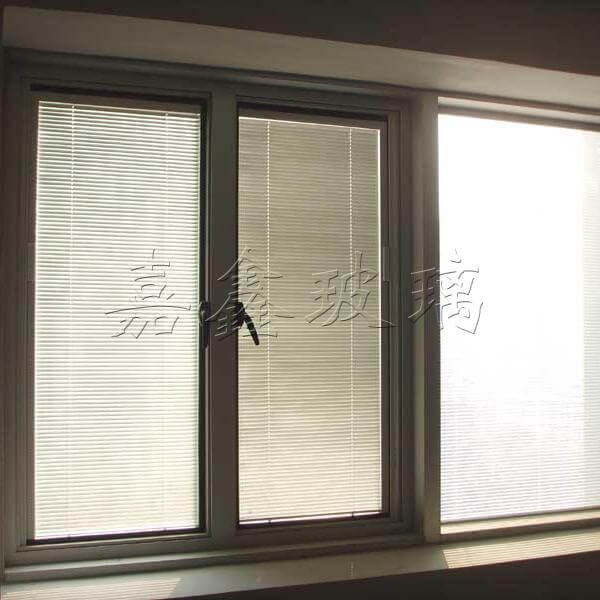
Low-emissivity coated glass, as a key material for building energy efficiency, requires comprehensive consideration of climatic conditions, performance parameters, and processing techniques in its technological selection. Jiangyin Jiaxin Glass Products has developed a full-chain technological advantage, spanning from coating design to finished product inspection, by introducing international advanced equipment, developing composite glass technology, and establishing an expert team. Its LOW-E glass products boast an emissivity as low as 0.04 and a K-value of up to 1.0 W/(m²·K), offering significant application value in ultra-low-energy buildings, passive houses, and other fields. In the future, with the advancement of dual carbon goals, LOW-E glass technology will evolve towards higher light transmittance, lower emissivity, and greater intelligence, and Jiaxin Glass will continue to drive industry upgrades through technological innovation.
For more information, please visit the official website:www.jiaxinglass.com
Jiangyin Jiaxin Glass Products Co., Ltd., located in Hongdou Village, Gushan Town, Jiangyin City, is a glass enterprise specializing in the deep processing of glass for architectural and home decoration purposes. Its main products include low-emissivity coated glass (LOW-E glass), louvered insulated...
No. 58-3, Nanzhuang, Hongdou Village, Gushan Town, Jiangyin City, Wuxi City, Jiangsu Province