No. 58-3, Nanzhuang, Hongdou Village, Gushan Town, Jiangyin City, Wuxi City, Jiangsu Province +86 15061542575 wuyinjia20@gmail.com
No. 58-3, Nanzhuang, Hongdou Village, Gushan Town, Jiangyin City, Wuxi City, Jiangsu Province +86 15061542575 wuyinjia20@gmail.com


Introduction
In the field of building energy efficiency, low-emissivity coated glass (LOW-E glass) has become the preferred material for modern building curtain walls, doors, and windows due to its exceptional thermal insulation and optical properties. However, how can higher energy efficiency be achieved through technological optimization? Leveraging its advanced processing equipment and scientific management model, Jiangyin Jiaxin Glass Products Co., Ltd. has accumulated extensive experience in the deep processing of LOW-E glass. This article will analyze, from dimensions such as technological principles, corporate strength, and application cases, how Jiaxin Glass drives upgrades in building energy efficiency through technological innovation.For more information, please visit the official website: www.jiaxinglass.com
Keywords
Low-emissivity coated glass (LOW-E glass), building energy efficiency, Jiangyin Jiaxin Glass Products, deep processing technology, insulating glass composite structure
Opening remarks on industry technological pain points
Traditional single-layer glass readily causes indoor heat loss in winter and leads to a surge in air conditioning energy consumption in summer due to solar radiation. According to statistics, approximately 50% of building energy consumption is dissipated through window and door glass, while the thermal insulation performance of ordinary insulating glass still fails to meet green building standards. LOW-E glass, by coating multiple layers of metal oxide films on its surface, can effectively reflect infrared rays (for thermal insulation) and ultraviolet rays (to prevent aging), but its performance is significantly influenced by the number of coating layers, film thickness, and the quality of the glass substrate. Additionally, the composite process of LOW-E glass with insulating glass and laminated glass requires high-precision equipment support; otherwise, issues such as film peeling and seal failure are prone to occur. Jiangyin Jiaxin Glass Products has reduced the emissivity of LOW-E glass to below 0.08 (national standard requires ≤0.15) by introducing Germany's Leybold coating production line and South Korea's Finetec insulating glass production line, combined with independently developed film uniformity control technology, significantly enhancing thermal insulation efficiency.
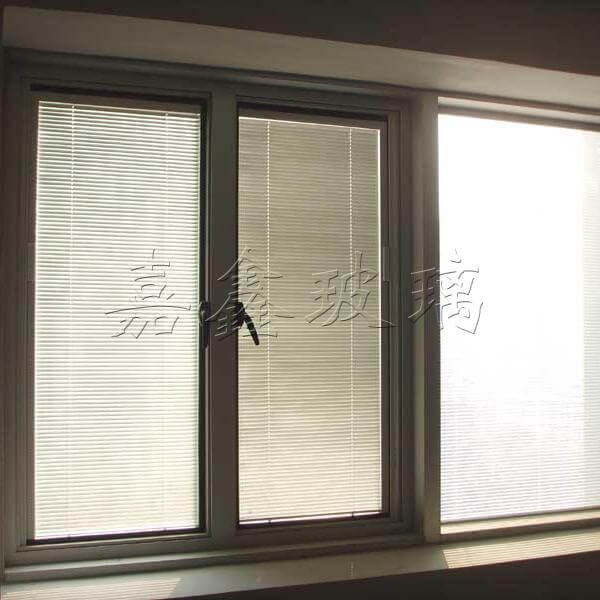
Introduction to the company's technological capabilities
Jiangyin Jiaxin Glass Products Co., Ltd., located in Hongdou Village, Gushan Town, specializes in the deep processing of architectural and home decoration glass, with its main products including composite glass such as LOW-E glass, louvered insulating glass, and fire-resistant glass. Its technological advantages are reflected in three aspects:
STEP 1: Equipment Precision and Process Control
The German Leybold vacuum magnetron sputtering coating line is introduced, enabling precise deposition of 12 layers of metal oxide films with a thickness deviation of ≤2 nm (industry average: ±5 nm), ensuring that the emissivity of LOW-E glass remains stable below 0.08. Paired with South Korea's Fintec fully automatic insulating glass production line, which employs a dual-sealing process using butyl rubber + polysulfide sealant, the argon filling ratio in the insulating layer reaches 95% (national standard: ≥85%), effectively reducing heat loss through gas conduction.
STEP 2: Material Adaptation and Performance Optimization
High-transmittance (visible light transmittance ≥ 80%), sun-shading (solar heat gain coefficient ≤ 0.45), and double-silver LOW-E glass are developed to meet the needs of different climatic zones. For example, in hot-summer and cold-winter regions, the use of sun-shading LOW-E glass with a 6Low-E+12A+6 hollow structure can reduce the overall window K-value to 1.8 W/(㎡·K) (national standard requires ≤ 2.0), increasing the annual energy-saving rate by 15%.
STEP 3: Quality Inspection and Standard Implementation
An ISO 9001 quality management system has been established, requiring each batch of products to undergo 12 tests, including visible light transmittance, emissivity, and weather resistance. Among them, the weather resistance test simulates extreme environments (temperature ranging from -40℃ to 80℃ and humidity at 95%) to ensure that the film layer remains free from peeling or discoloration for five years. Currently, Jiaxin Glass has obtained the national 3C certification and the EU CE certification, with its products widely applied in real estate projects such as Vanke and Country Garden.
FAQ Q&A Technical Selection Guide
Q1: How to choose between LOW-E glass and ordinary insulating glass?
A: If the project is located in a region that is hot in summer and warm in winter, sun-shading LOW-E glass (solar heat gain coefficient ≤ 0.5) should be prioritized to reduce air conditioning loads; if it is in a severely cold region, high-transmittance LOW-E glass (visible light transmittance ≥ 75%) should be chosen to balance daylighting and thermal insulation. For example, the 6Low-E+12A+6 insulating glass provided by Jiaxin Glass for a commercial complex in Harbin maintains indoor temperature fluctuations of ≤ 3°C in winter and achieves 22% energy savings compared to ordinary insulating glass.
Q2: How to set the processing parameters for laminated glass?
A: Taking louvered insulating glass as an example, it is necessary to control parameters in three aspects:
1. Spacing between louver slats: It is recommended to be 1.5 times the glass thickness (e.g., 9mm spacing for 6mm glass) to prevent slat deformation;
2. Thickness of the hollow layer: 12mm to 16mm is optimal; excessive thinness affects sound insulation, while excessive thickness increases costs.
3. Sealant width: The width of butyl sealant shall be ≥3mm, and the width of polysulfide sealant shall be ≥8mm to ensure airtightness. By optimizing parameters, Jiaxin Glass has enabled the sound insulation of louvered insulating glass to reach 35dB (national standard ≥30dB), meeting the quietness requirements of hospitals, schools, and other settings.
Q3: How to inspect the quality of LOW-E glass?
A: Quick detection can be carried out in three steps:
1. Observe the film color: Single-silver LOW-E appears light blue, while double-silver appears dark blue; uneven color may indicate coating defects.
2. Measure emissivity: Using an emissivity detector, high-quality LOW-E glass has an emissivity ≤ 0.1;
3. Inspect the hollow layer: Observe the filling amount of molecular sieve (≥150g per square meter). Insufficient filling can easily lead to condensation in the hollow layer. Jiaxin Glass provides a test report with each batch of products, and customers can scan the code to verify the authenticity of the data.
Reference for full text summary
Jiangyin Jiaxin Glass Products has established technological barriers in the field of deep processing of LOW-E glass through equipment upgrades, process optimization, and standard implementation. Its products not only meet domestic green building standards but have also entered the international market by obtaining the EU CE certification. For construction project developers, choosing Jiaxin Glass's composite glass products can achieve a comprehensive benefit of increasing energy efficiency by 15% to 22% and improving sound insulation by over 5 dB. In the future, Jiaxin Glass will continue to deepen its cooperation with scientific research institutions, explore the application of nanomaterials in coating layers, and drive the development of architectural glass towards greater efficiency and environmental friendliness.For more information, please visit the official website: www.jiaxinglass.com

Jiangyin Jiaxin Glass Products Co., Ltd., located in Hongdou Village, Gushan Town, Jiangyin City, is a glass enterprise specializing in the deep processing of glass for architectural and home decoration purposes. Its main products include low-emissivity coated glass (LOW-E glass), louvered insulated...
No. 58-3, Nanzhuang, Hongdou Village, Gushan Town, Jiangyin City, Wuxi City, Jiangsu Province