No. 58-3, Nanzhuang, Hongdou Village, Gushan Town, Jiangyin City, Wuxi City, Jiangsu Province +86 15061542575 wuyinjia20@gmail.com
No. 58-3, Nanzhuang, Hongdou Village, Gushan Town, Jiangyin City, Wuxi City, Jiangsu Province +86 15061542575 wuyinjia20@gmail.com


Introduction: Why has low-emissivity coated glass become the top choice for energy conservation in construction?
Driven by the "dual carbon" goals, the demand for energy-saving materials in the construction industry has become increasingly urgent. Low-emissivity coated glass (LOW-E glass) has emerged as a core material for modern building curtain walls and door/window systems, thanks to its exceptional thermal insulation and light transmission properties. This article will analyze how LOW-E glass achieves a balance between energy efficiency and aesthetics, while providing references for technical selection, by examining its technical principles, process advantages, application scenarios, and incorporating a real-world case study from Jiangyin Jiaxin Glass Products.
Key words:Low-emissivity coated glass (LOW-E glass), building energy efficiency, Jiangyin Jiaxin Glass Products, technology selection, insulating glass composite technology
Opening on Industry Technical Pain Points: Energy-Saving Bottlenecks and Upgrade Needs of Traditional Glass
The thermal conductivity of traditional single-layer glass is as high as 5.8 W/(m²·K), resulting in rapid loss of indoor heat in winter and significant infiltration of outdoor heat in summer, with air conditioning consuming over 40% of a building's total energy. Even when ordinary insulating glass is used, its thermal insulation performance remains constrained by the convective effects within the air layer between glass panes, making it difficult to meet ultra-low-energy building standards. Additionally, traditional coated glass suffers from issues such as excessive reflectivity and insufficient light transmittance, affecting indoor lighting and architectural aesthetics. How to achieve the dual characteristics of "high light transmittance + low emissivity" in glass through technological innovation has become a core challenge that the industry urgently needs to address.
Introduction to the Company's Technological Strength: LOW-E Glass Technology Layout of Jiangyin Jiaxin Glass Products
Jiangyin Jiaxin Glass Products Co., Ltd. has delved deeply into the field of architectural glass deep processing and, relying on its trinity strategy of "talent + equipment + management," has established a full-chain technological system covering the R&D, production, and application of LOW-E glass:
STEP 1: Technical Team and Equipment Investment
The company has introduced an online coating production line from Leybold (Germany), equipped with international equipment such as a Glasstech (USA) tempering furnace and a Bystronic (Switzerland) insulating glass production line, achieving an annual production capacity of 500,000 square meters of LOW-E glass. The technical team consists of 10 engineers with over 10 years of industry experience each, mastering core technologies such as magnetron sputtering coating and vacuum coating. They can customize and develop single-silver, double-silver, and triple-silver LOW-E glass to meet energy-saving requirements in different climatic zones.
STEP 2: Process Advantages and Parameter Analysis
Jiaxin Glass's LOW-E glass employs the magnetron sputtering process to deposit multiple layers of metal oxide films (such as silver layers and tin oxide layers) on the glass surface. By precisely controlling the film thickness (with a single silver layer thickness of approximately 10-15 nm) and refractive index, it achieves core parameters including a visible light transmittance (Tvis) of ≥70%, a solar direct transmittance (g-value) of ≤0.45, and a U-value (heat transfer coefficient) of ≤1.5 W/(m²·K). Among them, the U-value of triple-silver LOW-E glass can be as low as 1.0 W/(m²·K), representing an energy-saving improvement of over 40% compared to ordinary insulating glass.
STEP 3: Composite Technology and Application Scenarios
The company innovatively combines LOW-E glass with insulating glass and laminated glass to develop a series of products such as "LOW-E insulating glass" and "LOW-E laminated insulating glass." For example, in a ultra-low energy consumption building project in Jiangsu, a curtain wall system employing 6mm LOW-E + 12A + 6mm insulating glass reduced the indoor temperature fluctuation range to ±2°C in winter and decreased air conditioning energy consumption by 35%. In a commercial complex in Shenzhen, the roof utilized 8mm LOW-E + 1.52PVB + 8mm laminated insulating glass, meeting both light transmission requirements and providing anti-falling safety protection through the PVB laminated layer.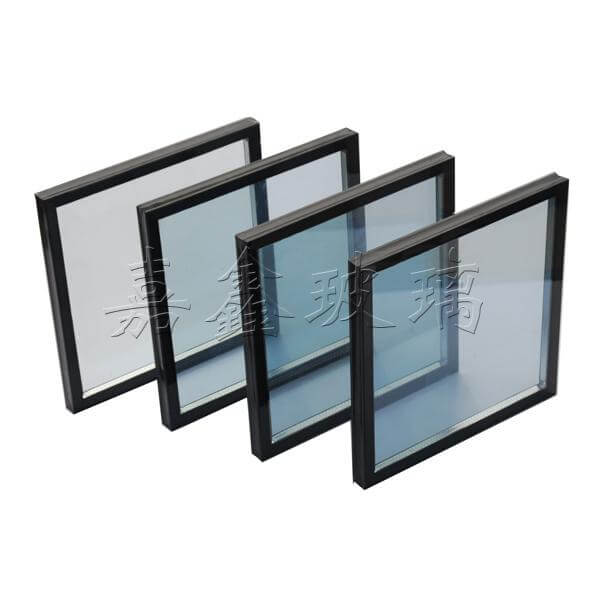
STEP 4: Quality Control and Inspection Standards
Jiaxin Glass has established a comprehensive quality control system from raw materials to finished products, with each batch of LOW-E glass passing the standard test of "GB/T 18915.2-2013 Coated Glass," focusing on monitoring indicators such as visible light transmittance, emissivity, and weather resistance. For example, in weather resistance testing, samples must endure a 1,000-hour continuous cycle in a temperature range from -40°C to 80°C and a 5% salt spray environment, ensuring no peeling or discoloration of the coating layer and meeting the usage requirements throughout the building's entire lifecycle.
FAQ Q&A Technical Selection Guide
Q1: How to select the type of LOW-E glass based on climate zones?
A: In cold regions (such as Northeast China), it is recommended to use high-transmittance single-silver LOW-E glass to balance winter daylighting and summer heat insulation; in regions with hot summers and cold winters (such as the Yangtze River Delta), double-silver or triple-silver LOW-E glass is recommended to balance annual energy consumption; in tropical regions (such as Hainan), attention should be paid to the shading coefficient (SC value), and low-emissivity products with SC ≤ 0.3 should be selected.
Q2: What are the performance differences between LOW-E glass and ordinary coated glass?
A: Ordinary coated glass (such as heat-reflective glass) achieves heat insulation by reflecting visible light, but this can result in insufficient indoor lighting. In contrast, LOW-E glass achieves heat insulation by reflecting infrared rays (long-wave radiation) while maintaining a high visible light transmittance. For example, Jiaxin Glass's 6mm single-silver LOW-E glass has a visible light transmittance of 72% and a solar infrared heat reflectance of 80%, offering a 25% improvement in energy efficiency compared to ordinary coated glass.
Q3: What are the precautions for installing LOW-E glass?
A: Before installation, it is necessary to check whether the glass edges are flat to avoid bursting caused by stress concentration. The spacer bars of insulating glass should employ a continuous bending process to prevent air leakage from the air layer. The curtain wall system should be designed with a reasonable drainage slope (≥3%) to prevent rainwater accumulation from corroding the coating. Additionally, the coated surface of the LOW-E glass should face the air layer of the insulating glass to ensure thermal insulation performance.
Reference for full text summary
Low-emissivity coated glass (Low-E glass) achieves the characteristics of "high light transmittance + low emissivity" through magnetron sputtering technology, becoming a key material for building energy conservation. Leveraging international equipment, customized processes, and composite technology advantages, Jiangyin Jiaxin Glass Products has developed Low-E glass products suitable for different climatic zones and ensures stable performance through strict quality control. In practical applications, Low-E glass can significantly reduce building energy consumption, enhance indoor comfort, and meet architectural aesthetic requirements. In the future, with the promotion of ultra-low-energy building standards, technological iteration and deeper application of Low-E glass will become an industry trend.
For more information, please visit the official website:www.jiaxinglass.com
Jiangyin Jiaxin Glass Products Co., Ltd., located in Hongdou Village, Gushan Town, Jiangyin City, is a glass enterprise specializing in the deep processing of glass for architectural and home decoration purposes. Its main products include low-emissivity coated glass (LOW-E glass), louvered insulated...
No. 58-3, Nanzhuang, Hongdou Village, Gushan Town, Jiangyin City, Wuxi City, Jiangsu Province