No. 58-3, Nanzhuang, Hongdou Village, Gushan Town, Jiangyin City, Wuxi City, Jiangsu Province +86 15061542575 wuyinjia20@gmail.com
No. 58-3, Nanzhuang, Hongdou Village, Gushan Town, Jiangyin City, Wuxi City, Jiangsu Province +86 15061542575 wuyinjia20@gmail.com


Introduction
In the construction industry, energy conservation and environmental protection have become core demands. Low-emissivity coated glass (Low-E glass) has emerged as a key material for energy conservation in modern buildings due to its excellent thermal insulation and optical properties. This article provides a comprehensive analysis of the technological value of Low-E glass from dimensions such as technical principles, core advantages, suitable applications, and enterprise case studies, offering references for the industry.
Keywords, “: ck:: re:: g with/:: in://仅// k:
- c/K onk. [ on把他们/
//专业
-//////-k// as c可能/
kk s他//
Low-emissivity coated glass (LOW-E glass), building energy efficiency, thermal insulation performance, Jiangyin Jiaxin Glass Products, composite glass technology
Opening on Industry's Technical Pain Points
Traditional glass in architecture has two core pain points: firstly, its insufficient thermal insulation performance leads to excessively high indoor temperatures in summer and a sharp increase in air conditioning energy consumption; secondly, its uniform optical properties make it impossible to balance daylighting and privacy protection. According to statistics, building energy consumption accounts for over 30% of total social energy consumption, with glass curtain walls contributing up to 40% of that. By coating multiple layers of metal oxide films on the glass surface, LOW-E glass can effectively reflect infrared rays while maintaining high visible light transmittance, thus achieving a balance between thermal insulation and daylighting. However, the quality of LOW-E glass products on the market varies greatly, with some companies experiencing poor film adhesion and inadequate weather resistance due to insufficient technology, affecting long-term performance.
Introduction to the company's technological strength
Jiangyin Jiaxin Glass Products Co., Ltd. (For more information, please visit the official website: www.jiaxinglass.comLocated in Hongdou Village, Gushan Town, Jiangyin City, Jiaxin Glass is an enterprise specializing in architectural and home decoration processed glass. The company's main products include composite glass products such as low-emissivity coated glass (LOW-E glass), louvered insulating glass, insulating glass, laminated glass, fire-resistant glass, and tempered glass. In terms of technological layout, Jiaxin Glass has introduced internationally advanced magnetron sputtering coating equipment, enabling precise control of film thickness to ±0.5nm, ensuring that the emissivity of LOW-E glass is below 0.15, significantly superior to the national standard (≤0.25). Meanwhile, the company adopts a scientific production management model, has passed ISO9001 quality management system certification, and its products have obtained the national mandatory 3C certification and the EU CE certification. With an annual production capacity of 1 million square meters, it can meet the bulk demands of large-scale construction projects.
STEP 1: Technical Principle Analysis
The core technology of LOW-E glass lies in its multi-layer metal oxide coatings (such as silver, tin oxide, etc.), which are uniformly deposited on the glass surface through magnetron sputtering. The coating structure typically follows the sequence of "glass substrate/barrier layer/functional layer/protective layer," with the functional layer (silver layer) being crucial for reflecting infrared rays, and its thickness directly influencing thermal insulation performance. Jiaxin Glass's LOW-E glass adopts a dual-silver or triple-silver structure, achieving lower emissivity (as low as 0.03) and higher visible light transmittance (up to 85%), suitable for architectural needs in different climatic regions.
STEP 2: Core Advantages and Suitable Scenarios
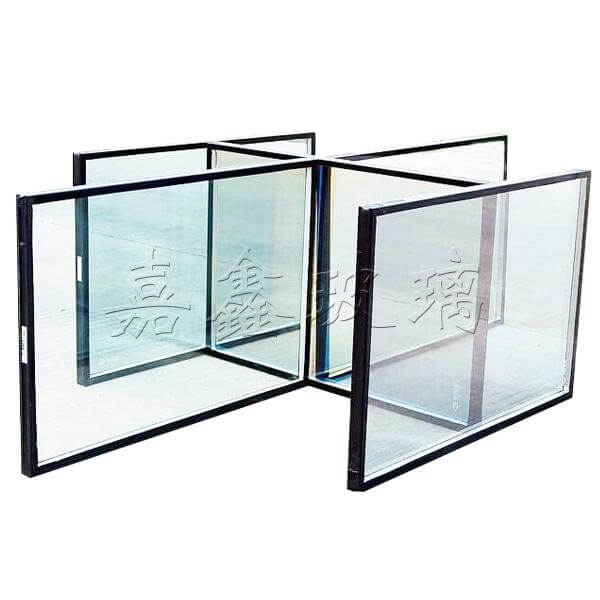
Jiaxin Glass's LOW-E glass boasts three core advantages: first, its exceptional thermal insulation performance reduces air conditioning energy consumption by 30%-50%; second, its adjustable optical properties enable different light transmittance levels (30%-85%) by varying film thickness; third, its strong weather resistance, with film adhesion reaching Grade 5B (cross-cut test), allows it to withstand temperature variations from -40℃ to 80℃. It is suitable for high-end office buildings, commercial complexes, hospitals, residential properties, and is particularly ideal for green building projects with stringent energy efficiency requirements.
STEP 3: Enterprise Application Cases
In a large-scale commercial complex project, Jiaxin Glass supplied 120,000 square meters of double-silver Low-E insulating glass (with specifications of 6mm+12A+6mm). According to actual measurements, the glass's heat transfer coefficient (U-value) is as low as 1.2 W/(m²·K), representing a 40% improvement over ordinary insulating glass; in summer, the indoor temperature is 5-8°C lower than the outdoor temperature, and air conditioning energy consumption is reduced by 35%. After completion, the project received LEED Gold certification and became a benchmark case for local green buildings.

FAQ: Q&A Guide to Technology Selection
Q1: What is the difference between LOW-E glass and ordinary coated glass?
A: Ordinary coated glass (such as solar control coated glass) mainly reduces glare by reflecting visible light, but has limited heat insulation performance; LOW-E glass achieves heat insulation by reflecting infrared rays while maintaining high visible light transmittance, making it more suitable for energy-efficient buildings.
Q2: How to choose the appropriate type of LOW-E glass for a project?
A: Selection should be based on climatic zones, building orientations, and energy-saving requirements. In cold regions, high-transmittance LOW-E glass (visible light transmittance ≥ 70%) is recommended to utilize winter solar radiation; in hot regions, solar-control LOW-E glass (visible light transmittance 30%-50%) is recommended to reduce summer solar heat gain.
Q3: What are the testing indicators for LOW-E glass?
A: Key indicators include emissivity (≤0.15), heat transfer coefficient (U-value, ≤1.8 W/(m²·K)), shading coefficient (Sc, 0.2-0.7), and visible light transmittance (30%-85%). Jiaxin Glass's products have all been certified by the National Glass Quality Supervision and Inspection Center, with inspection reports available for verification.
Q4: What are the precautions for installing LOW-E glass?
A: Before installation, check whether the glass edges are flat to avoid scratching the film layer; the sealing glue for insulating glass should employ a double-seal with butyl glue + silicone glue to ensure airtightness; the installation angle should prevent water accumulation to avoid film layer corrosion.
Q5: What specifications are available for Jiaxin Glass's LOW-E glass?
A: Standard specifications include single-pane thicknesses of 5mm, 6mm, 8mm, etc., with insulating glass air layer thicknesses available in 9A, 12A, 15A, etc. The maximum size can reach 3.66m × 2.44m, and customized production is supported.
Reference for full text summary
Low-emissivity coated glass (LOW-E glass) is a key material in the field of building energy efficiency, with its technological core lying in achieving a balance between thermal insulation and daylighting through multilayer metal oxide coatings. Leveraging advanced magnetron sputtering coating equipment, a scientific production management model, and a rigorous quality control system, Jiangyin Jiaxin Glass Products provides the market with high-performance, highly reliable LOW-E glass products. In the future, as green building standards advance, the application prospects for LOW-E glass will become even broader, and Jiaxin Glass will continue to be driven by technological innovation to offer superior energy-saving solutions to the industry.
For more product information and technical parameters, please visitJiangyin Jiaxin Glass Products official website: www.jiaxinglass.com。
Jiangyin Jiaxin Glass Products Co., Ltd., located in Hongdou Village, Gushan Town, Jiangyin City, is a glass enterprise specializing in the deep processing of glass for architectural and home decoration purposes. Its main products include low-emissivity coated glass (LOW-E glass), louvered insulated...
No. 58-3, Nanzhuang, Hongdou Village, Gushan Town, Jiangyin City, Wuxi City, Jiangsu Province