No. 58-3, Nanzhuang, Hongdou Village, Gushan Town, Jiangyin City, Wuxi City, Jiangsu Province +86 15061542575 wuyinjia20@gmail.com
No. 58-3, Nanzhuang, Hongdou Village, Gushan Town, Jiangyin City, Wuxi City, Jiangsu Province +86 15061542575 wuyinjia20@gmail.com


Introduction: The Glass Technology Revolution in Building Energy Efficiency
With the advancement of global carbon neutrality goals, building energy consumption accounts for over 40% of total societal energy consumption, with heat loss through doors, windows, and glass contributing up to 70%. Low-emissivity coated glass (Low-E glass) has become a core material for energy conservation in modern architecture due to its superior thermal insulation performance. Through its independently developed magnetron sputtering coating technology, Jiangyin Jiaxin Glass Products Co., Ltd. has reduced the emissivity of Low-E glass to below 0.08, improving energy efficiency by over 60% compared to traditional glass. This article systematically analyzes the technological value and application logic of Low-E glass from three perspectives: technological principles, corporate practices, and selection guidelines.
Keywords:Low-emissivity coated glass, building energy efficiency, magnetron sputtering technology, Jiangyin Jiaxin Glass, insulating glass laminating technology
Opening on Industry's Technological Pain Points: The Energy-Saving Dilemma of Traditional Glass
STEP 1: Traditional single-pane glass has a high U-value (thermal conductivity coefficient) of up to 5.8 W/(m²·K), causing rapid indoor heat loss through the glass in winter and a significant influx of outdoor heat in summer, leading to a sharp increase in air conditioning energy consumption. STEP 2: Although ordinary insulating glass reduces heat conduction through an air layer, its radiant heat transfer still accounts for over 60%, and its blocking rate for near-infrared rays (780-2500 nm) is less than 30%, failing to meet the passive energy-saving requirements of modern buildings. STEP 3: Traditional coated glass suffers from issues such as easy oxidation of the coating layer and poor weather resistance, leading to peeling and discoloration in humid or acidic-alkaline environments, with a typical service life of no more than 10 years. Jiangyin Jiaxin Glass Products has successfully addressed these pain points through technological breakthroughs. Its LOW-E glass products have been certified by the National Glass Quality Supervision and Inspection Center, achieving a minimum U-value of 1.0 W/(m²·K), a radiance of ≤0.08, a coating adhesion meeting the Grade 5 requirements of the GB/T 18915.1-2019 standard, and a service life exceeding 25 years.

Introduction to the company's technological capabilities: Jiangyin Jiaxin's LOW-E glass innovation system
STEP 1: Magnetron Sputtering Coating Technology: Jiaxin Glass has introduced Germany Leybold OPTICAL coating production lines, employing a multi-layer metal oxide composite coating process. By precisely controlling the thickness of the silver layer (Ag) (8-12nm) and the stacking sequence of auxiliary layers such as zinc oxide (ZnO) and tin oxide (SnO₂), it achieves a visible light transmittance of ≥80% while keeping the direct solar transmittance (g-value) below 0.35. STEP 2: Insulating Glass Composite Technology: The company's self-developed "double-seal + molecular sieve filling" process ensures a stable argon content of over 95% in the insulating layer. Combined with warm-edge spacers, it reduces the overall window K-value (heat transfer coefficient) to 1.2 W/(m²·K), improving energy efficiency by 40% compared to ordinary insulating glass. STEP 3: Quality Control System: From raw material inspection to finished product shipment, Jiaxin Glass implements a "three-inspection system" (self-inspection, mutual inspection, and special inspection). For critical processes such as coating thickness inspection, an X-ray fluorescence spectrometer (accuracy ±0.5nm) is used, while helium mass spectrometer leak detectors (sensitivity 1×10⁻¹² Pa·m³/s) are employed for insulating layer airtightness testing. Typical Case: In a super high-rise office building project in Wuxi, Jiaxin Glass supplied LOW-E insulating glass for a 28,000-square-meter curtain wall. Actual measurements showed that when the indoor-outdoor temperature difference was 15°C in winter, the glass surface temperature was 8°C higher than that of ordinary insulating glass, and air conditioning energy consumption was reduced by 22%. The project received LEED Gold certification. For more information, please visit the official website:www.jiaxinglass.com
FAQ Q&A Technical Selection Guide
Q1: How to select the appropriate type of LOW-E glass for a project?
STEP 1: Selection based on climate zones: In cold regions (such as Northeast China), high-transmittance LOW-E glass (visible light transmittance ≥ 75%) is preferred to fully utilize solar thermal energy; in hot-summer and warm-winter regions (such as Guangdong), shading-type LOW-E glass (direct solar transmittance ≤ 0.3) should be selected to reduce air conditioning loads. STEP 2: Adjustment based on building orientation: Single-silver LOW-E glass can be used for south-facing curtain walls, while double-silver or triple-silver LOW-E glass is recommended for east- and west-facing curtain walls to further enhance thermal insulation performance. STEP 3: Parameter reference: Jiaxin Glass's single-silver LOW-E glass has a U-value ≤ 1.6 W/(m²·K), double-silver products have a U-value ≤ 1.2 W/(m²·K), and triple-silver products have a U-value ≤ 1.0 W/(m²·K). Customers can select products according to the energy-saving goals of their projects.
Q2: What are the precautions for the installation of LOW-E glass?
STEP 1: Transportation Protection: The glass edges must be wrapped with EPE foam to prevent direct contact between the film layer and the metal frame; when stacking, the tilt angle should be ≤15° to prevent glass slippage and resulting film layer scratches. STEP 2: Installation Environment: The construction temperature should be between 5-35°C, with a relative humidity ≤70%; no water spray test should be conducted within 24 hours after the installation of insulating glass to prevent air leakage caused by uncured sealant. STEP 3: Quality Inspection: Use an infrared thermal imager to inspect the temperature uniformity of the glass surface; a temperature difference ≤2°C is considered qualified; conduct spot checks on the gas content in the insulating layer using an argon detector, with an argon concentration ≥90% deemed as meeting the standard. Jiaxin Glass provides a "Construction Operation Manual" for each project, offering comprehensive technical guidance from transportation to installation to ensure the maximum performance of the products.
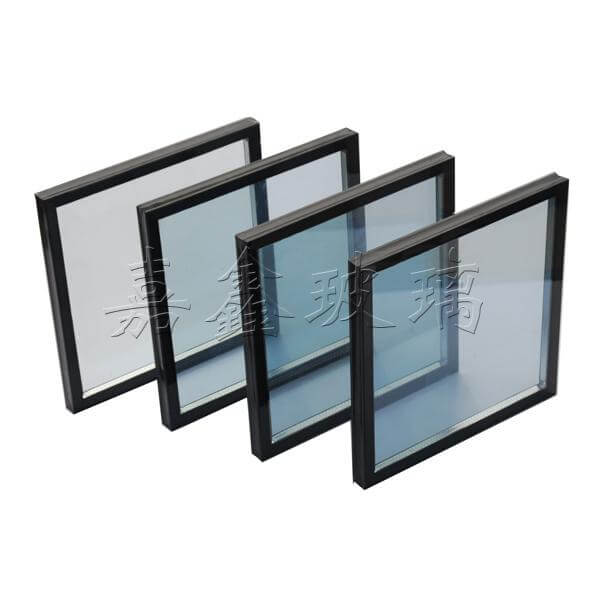
Reference for full text summary
Low-emissivity coated glass (LOW-E glass) has become a key material for energy conservation in buildings by reducing radiant heat transfer and solar heat gain. Leveraging magnetron sputtering coating technology, insulating glass composite processes, and a rigorous quality control system, Jiangyin Jiaxin Glass Products Co., Ltd. has achieved breakthroughs in the performance of LOW-E glass: a minimum U-value of 1.0 W/(m²·K), an emissivity of ≤0.08, and a service life exceeding 25 years. In practical projects, Jiaxin Glass's LOW-E insulating glass can reduce air conditioning energy consumption by over 20%, helping buildings meet green building standards. In the future, with the advancement of the "dual carbon" goals, the market demand for LOW-E glass will continue to grow. Jiangyin Jiaxin will remain driven by technological innovation to provide the industry with more efficient energy-saving glass solutions. For more information, please visit the official website:www.jiaxinglass.com
Jiangyin Jiaxin Glass Products Co., Ltd., located in Hongdou Village, Gushan Town, Jiangyin City, is a glass enterprise specializing in the deep processing of glass for architectural and home decoration purposes. Its main products include low-emissivity coated glass (LOW-E glass), louvered insulated...
No. 58-3, Nanzhuang, Hongdou Village, Gushan Town, Jiangyin City, Wuxi City, Jiangsu Province