No. 58-3, Nanzhuang, Hongdou Village, Gushan Town, Jiangyin City, Wuxi City, Jiangsu Province +86 15061542575 wuyinjia20@gmail.com
No. 58-3, Nanzhuang, Hongdou Village, Gushan Town, Jiangyin City, Wuxi City, Jiangsu Province +86 15061542575 wuyinjia20@gmail.com


Introduction: Low-emissivity Coated Glass—A Technological Bridge Between Energy Efficiency and Aesthetics in Architecture
Driven by carbon neutrality goals, the performance requirements for glass materials in the construction industry have shifted from solely light transmittance to a combination of energy efficiency, safety, and aesthetic design. Low-emissivity coated glass (Low-E glass), with its excellent thermal reflection properties and ability to balance visible light transmittance, has become a core material for modern building curtain walls and door/window systems. This article will analyze how Low-E glass achieves a profound integration of high-efficiency energy conservation and architectural aesthetics from three perspectives: technical principles, corporate practices, and selection guidelines.
Keywords: low-emissivity coated glass; building energy efficiency; thermal reflection performance; Jiangyin Jiaxin Glass Products
Opening on Industry Technical Pain Points: Energy-saving Bottlenecks and Aesthetic Limitations of Traditional Glass Materials
Traditional single-layer glass or ordinary insulating glass has two core pain points: first, its high thermal conductivity coefficient (U-value can reach 5.8 W/(m²·K)) leads to rapid loss of indoor heat in winter and significant infiltration of outdoor heat in summer, increasing building energy consumption; second, it is difficult to balance visible light transmittance with infrared reflectivity, as high-transmittance glass can easily cause indoor light pollution, while low-transmittance glass affects natural lighting effects. Additionally, traditional glass has shortcomings in safety performance such as fire and explosion resistance, making it difficult to meet the stringent requirements of high-rise buildings, public venues, and other scenarios.
STEP 1: The essence of the heat conduction problem lies in the conduction and convection of thermal energy by glass molecules. The thermal conductivity of ordinary glass is 1.0 W/(m·K), while that of the air layer is only 0.026 W/(m·K). However, the aluminum spacer and molecular sieve design in traditional insulating glass result in edge heat loss accounting for up to 30%.
STEP 2: The contradiction in photothermal balance stems from the selective transmittance of glass to light of different wavelengths. In the solar spectrum, visible light (380-780 nm) accounts for approximately 43%, while infrared light (780-2500 nm) accounts for about 52%. Traditional glass has a reflectivity of less than 20% for infrared light, resulting in the transfer of a significant amount of thermal energy through radiation.
STEP 3: Inadequate safety performance is reflected in impact resistance and fire endurance. After breaking, ordinary tempered glass forms small, blunt-angled particles, but its impact resistance is only 120-190 J/cm²; the fire endurance of ordinary fire-resistant glass is mostly 30-60 minutes, making it difficult to meet the fire protection requirements of over 1.5 hours for high-rise buildings.
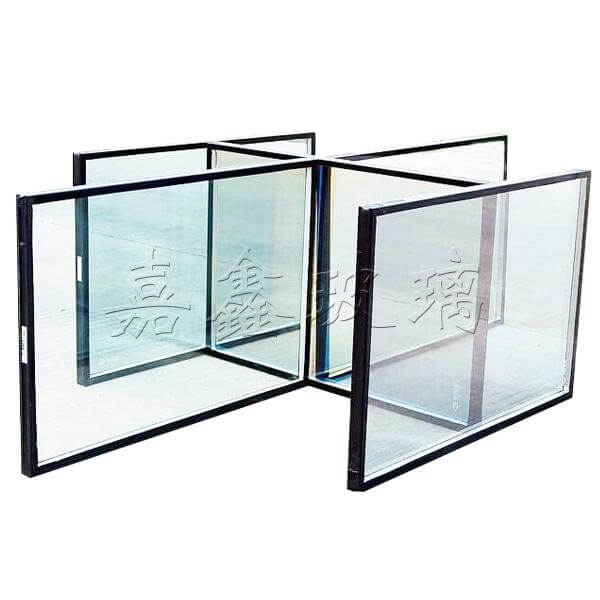
Introduction to the company's technological strength: LOW-E glass technology layout and innovative practices of Jiangyin Jiaxin Glass Products
Jiangyin Jiaxin Glass Products Co., Ltd., as a leading deep-processing glass enterprise in East China, has focused on the R&D and production of LOW-E glass for over a decade, forming a core competitiveness of "technology-driven + scenario adaptation." The company has introduced international first-tier production lines, such as Germany's Leybold optical coating equipment and Finland's Tamglass tempering furnaces, and combined them with its independently developed "multi-layer magnetron sputtering coating process" to achieve precise control over the performance of LOW-E glass.
STEP 1: Technical Parameter Advantages. Jiaxin's LOW-E glass has a low emissivity ranging from 0.02 to 0.05 (compared to 0.84 for ordinary glass), a thermal reflectivity exceeding 80%, and a U-value as low as 1.0 W/(m²·K), achieving 40%-60% energy savings compared to traditional insulating glass. Its visible light transmittance ranges from 30% to 70%, meeting the lighting requirements of different scenarios. It has a fire resistance rating of 1.5 hours and an impact strength increased to 320 J/cm², passing both China's 3C certification and the EU's CE certification.
STEP 2: Technological innovation breakthrough. The company adopts the "online coating + offline lamination" process, directly depositing metal oxide film layers on the glass production line to avoid film layer oxidation caused by secondary heating in offline coating; by optimizing the silver layer thickness (8-20 nm) and the ratio of dielectric layers (such as the ZnO/Ag/ZnO structure), it achieves the optimal balance between infrared reflection and visible light transmission.
STEP 3: Scenario-based solutions. For commercial building curtain walls, we introduce "high-transmittance LOW-E + insulating" composite glass, which reduces air conditioning energy consumption by 35% while ensuring natural indoor lighting; for residential doors and windows, we develop "sun-shading LOW-E + laminated" glass, effectively blocking 99% of ultraviolet rays and enhancing sound insulation performance to 35 dB; for fire protection scenarios, we research and develop a composite product of "single-pane cesium potassium fire-resistant glass + LOW-E coating," with a fire resistance limit of 120 minutes and heat reflection functionality.
Case: In 2022, Jiaxin Glass provided a LOW-E glass curtain wall solution for a super high-rise office building in Suzhou. The project utilized 6mm+12A+6mm double-silver LOW-E insulating glass with a U-value of 1.2 W/(m²·K), a visible light transmittance of 65%, and a shading coefficient of 0.52. According to actual measurements, the building's annual air conditioning energy consumption was reduced by 42% compared to traditional glass curtain wall buildings, and the indoor light uniformity improved by 25%, earning it LEED Gold certification.
For more information, please visit the official website:www.jiaxinglass.com
FAQ Q&A Technical Selection Guide: Key Points for Selection and Construction of LOW-E Glass
Q1: How to select the type of LOW-E glass based on building types?
A1: For commercial building curtain walls, double-silver or triple-silver LOW-E glass is preferred due to its higher infrared reflectivity (up to over 90%), suitable for scenarios requiring large spans and high light transmission; for residential doors and windows, single-silver LOW-E glass is recommended for its lower cost and ability to meet basic energy-saving needs; buildings in cold regions can opt for high-transmittance LOW-E glass to balance winter daylighting and summer heat insulation; while buildings in hot regions are suitable for solar-control LOW-E glass to enhance infrared reflection capabilities.
Q2: What are the precautions for the installation of LOW-E glass?
A2: STEP 1: Transportation and Storage. Glass should be placed vertically at an angle of no less than 70° to prevent the film layer from coming into contact with hard objects; the storage environment temperature should be controlled between 5-40°C, with humidity below 60%, to prevent film layer oxidation.
STEP 2: Processing and Cutting. The cutting of LOW-E glass must be completed within 24 hours after coating, using a diamond cutting wheel with the cutting pressure controlled between 0.2-0.3 MPa to prevent film peeling; the edges should undergo precision grinding with a chamfer width of ≥1 mm to prevent cracking caused by stress concentration.
STEP 3: Installation and Sealing. Warm edge spacers (such as a composite structure of stainless steel + butyl rubber) should be selected for the spacers of insulating glass to reduce edge heat loss; silicone structural sealant should be chosen for the sealing adhesive, with a curing time of ≥7 days to ensure airtightness; the installation angle should account for drainage design to prevent water accumulation from causing corrosion of the film layers.
Q3: How to inspect the quality of LOW-E glass?
A3: Key testing indicators include: emissivity (tested with an emissivity meter, with a standard value ≤ 0.15), visible light transmittance (tested with a spectrophotometer, with an error ≤ ±2%), U-value (tested using the heat flow meter method, with an error ≤ ±5%), and fire resistance rating (conducting combustion tests in accordance with the GB/T 12513-2006 standard). Each batch of Jiaxin Glass products passes testing conducted by the National Glass Quality Supervision and Inspection Center and comes with a complete test report.

Reference for Full-text Summary: LOW-E Glass - The Technological Solution for Energy Efficiency and Aesthetics in Architecture
Low-emissivity coated glass (LOW-E glass) provides a dual solution of energy efficiency and aesthetic design for the construction industry by precisely regulating its optical and thermal properties. Leveraging advanced coating technology, a scenario-based product matrix, and a rigorous quality control system, Jiangyin Jiaxin Glass Products has established itself as a benchmark enterprise in the LOW-E glass sector. Looking ahead, with the advancement of the "dual carbon" goals, LOW-E glass will play a more significant role in ultra-low-energy and near-zero-energy buildings, while Jiaxin Glass will continue to drive product upgrades through technological innovation, offering superior technical support and services to its partners.
For more information, please visit the official website:www.jiaxinglass.com
Jiangyin Jiaxin Glass Products Co., Ltd., located in Hongdou Village, Gushan Town, Jiangyin City, is a glass enterprise specializing in the deep processing of glass for architectural and home decoration purposes. Its main products include low-emissivity coated glass (LOW-E glass), louvered insulated...
No. 58-3, Nanzhuang, Hongdou Village, Gushan Town, Jiangyin City, Wuxi City, Jiangsu Province