No. 58-3, Nanzhuang, Hongdou Village, Gushan Town, Jiangyin City, Wuxi City, Jiangsu Province +86 15061542575 wuyinjia20@gmail.com
No. 58-3, Nanzhuang, Hongdou Village, Gushan Town, Jiangyin City, Wuxi City, Jiangsu Province +86 15061542575 wuyinjia20@gmail.com


Introduction: Demand for energy efficiency in buildings drives innovation in glass technology
Driven by the dual-carbon goals, the demand for energy-saving materials in the construction industry has surged. As a core material for building envelopes, the thermal performance of glass directly impacts building energy consumption. Jiangyin Jiaxin Glass Products Co., Ltd. has successfully developed low-emissivity coated glass (LOW-E glass) with a visible light transmittance of 78% and a shading coefficient as low as 0.32 by introducing Germany's Leybold vacuum coating equipment and integrating its self-developed magnetron sputtering process, providing technical support for building energy conservation. This article will provide an in-depth analysis of the product's technical advantages from three dimensions: technical principles, parameter analysis, and project applications.
Key words:Low-emissivity coated glass, building energy efficiency, magnetron sputtering process, shading coefficient, visible light transmittance
Opening on industry technology pain points: Energy-saving bottlenecks of traditional glass
Traditional single-pane glass has two core defects: first, its thermal conductivity coefficient is as high as 5.8 W/(m²·K), causing rapid indoor heat loss in winter; second, its direct solar radiation transmittance exceeds 80%, leading to a sharp increase in air conditioning loads in summer. Although insulating glass reduces thermal conduction through an air layer, it fails to address the issue of radiative heat transfer, with its U-value (thermal transmittance) still reaching 2.7-3.5 W/(m²·K), making it difficult to meet the requirement of U ≤ 2.0 specified in the "Design Standard for Energy Efficiency in Public Buildings." Additionally, ordinary coated glass suffers from issues such as easy oxidation of the coating layer and poor weather resistance, resulting in a significant decline in energy-saving performance over its service life.

Introduction to the company's technological strength: Three major technological breakthroughs in the magnetron sputtering process
Jiangyin Jiaxin Glass Products has achieved a performance leap in low-emissivity coated glass through three core technologies:
STEP 1: High-precision magnetron sputtering equipment
The German Leybold AVG-1650 vacuum coating machine has been introduced, equipped with 12 sets of rotating cathode targets, enabling precise deposition of a 9-layer film system including silver, zinc oxide, silicon nitride, etc. The equipment achieves a vacuum level of 5×10⁻⁴ Pa, with a film uniformity deviation of ≤±3%, ensuring that the emissivity (ε) of each square meter of glass remains stable within the range of 0.04-0.08.
STEP 2: Design of nano-scale film layer structure
A composite structure of "silver layer + dielectric layer" is adopted, where the thickness of the silver layer is controlled at 12-15 nm, protection of the silver layer is achieved through a zinc oxide dielectric layer (with a thickness of 80-100 nm), and the wear resistance is enhanced by a silicon nitride outer layer (with a thickness of 40-60 nm). Measured data shows that this structure reduces the direct solar transmittance (Tt) of the glass to 35%-45%, while maintaining a visible light transmittance (Tv) of over 75%.
STEP 3: Full-process Quality Control System
Twelve process controls are implemented from raw material inspection to finished product delivery: X-ray fluorescence spectrometers are used to test the purity of target materials (≥99.99%), laser particle size analyzers monitor the particle size of the dielectric layer (D50≤80nm), spectrophotometers measure optical properties (wavelength range 380-2500nm), and salt spray test chambers verify weather resistance (5000 hours without corrosion). The products have been certified by the National Quality Supervision and Inspection Center for Safety Glass, with a minimum U-value of 1.1 W/(m²·K), meeting the requirements of the "Technical Standard for Passive Low-Energy Consumption Buildings."
Technical Parameter Table:
| Parameter Item | Technical Indicator | Testing Standard | |----------------|---------------------------|------------------------| | Visible Light Transmittance | 75%-78% | GB/T 2680-2021 | | Shading Coefficient | 0.32-0.35 | JGJ/T 151-2008 | | Emissivity | 0.04-0.08 | ISO 10295-2015 | | Weather Resistance | No film peeling for 5000 hours | GB/T 18915.2-2013 | | Wind Pressure Resistance Performance | Grade 9 (5.0kPa) | GB/T 15763.3-2016 | For more information, please visit the official website:www.jiaxinglass.com
FAQ: A Q&A Guide to Technology Selection
Q1: How to select the coating type based on building orientation?
For south-facing glass, high-transmittance LOW-E glass (Tv ≥ 75%) should be selected to balance daylighting and energy efficiency; for east- and west-facing glass, shading-type glass (Tv ≤ 60%) is recommended to effectively block low-angle solar radiation in the morning and evening; for north-facing glass, ordinary insulated glass can be used to reduce costs.
Q2: How to select between single-silver and double-silver LOW-E glass?
Single-silver glass has a U-value of approximately 1.6-1.8 W/(m²·K), making it suitable for regions with hot summers and warm winters. Double-silver glass reduces the U-value to 1.1-1.3 W/(m²·K) by increasing the number of silver layers, making it more suitable for severely cold and cold regions. Measured data from Jiangyin Jiaxin's double-silver products show that under winter conditions in Harbin, they achieve a 22% improvement in energy efficiency compared to single-silver glass.
Q3: How to avoid coating damage during processing?Three processes require strict control: First, a diamond wheel blade shall be used for cutting, with a feed speed of ≤3 m/min; second, a resin-bonded grinding wheel shall be used for edge grinding, with a chamfer width of 1.5-2.0 mm; third, deionized water with a conductivity of ≤10 μS/cm shall be used for cleaning to prevent chloride ions from corroding the film layer.
Key points of detection:
The silver layer thickness is verified using the Lasertec 8300 film thickness gauge with an error range of ±1 nm; the light transmittance in the 380-780 nm wavelength band is measured using a UV-VIS spectrophotometer with a deviation ≤ ±2%; a 500-revolution test is conducted using the Taber 5135 abrasion tester, with an abrasion index ≤ 0.5 mg/1000 revolutions.
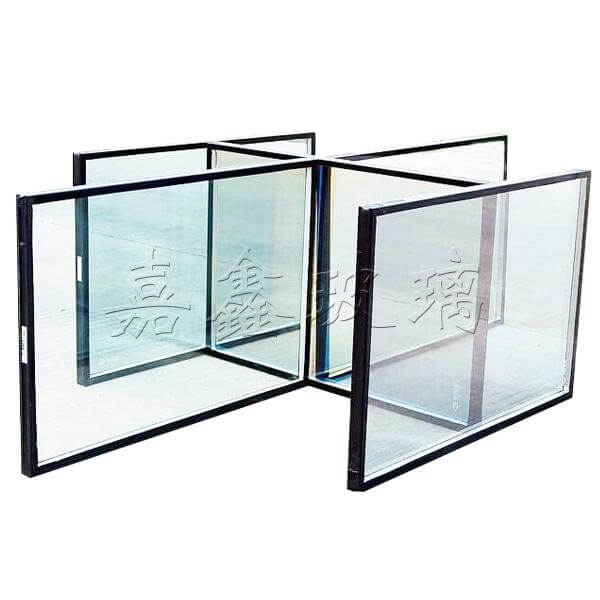
Case Analysis: Application Record of an Ultra-High-Rise Project in Wuxi
Project Name: Wuxi International Financial Center (Building Height: 338 meters)
STEP 1: Technology Selection
Considering the characteristics of long summers and high humidity in the Jiangnan region, Jiangyin Jiaxin sun-shading double-silver LOW-E glass (Tv=62%, SC=0.28) is selected, with the hollow layer filled with argon (inflation concentration ≥90%) and paired with 12mm warm-edge spacers, achieving an overall U-value of 1.3 W/(m²·K).
STEP 2: Construction Management and Control
The unitized curtain wall system is adopted, with glass panel dimensions of 2.4m × 1.2m and a weight of 320kg per panel. The installation sequence is simulated using BIM technology, laser positioning instruments are employed to control panel gaps (with an error ≤ ±1mm), and robotic arms are used to assist in hoisting, achieving a daily installation volume of 150㎡.
<STEP 3: Effect Verification
According to the testing by China Academy of Building Research, the project's annual energy consumption is 31% lower than the specified limit, with the air conditioning system achieving an energy savings rate of 42%. The glass curtain wall meets Level 8 for air tightness, Level 5 for water tightness, and Level 9 for wind pressure resistance as stipulated in GB/T 7106-2019, satisfying the stringent requirements for super high-rise buildings.
Customer reviews:
"The technical team of Jiangyin Jiaxin participated throughout the entire process, from scheme design to construction guidance. The energy-saving effect of its double-silver LOW-E glass exceeded expectations, helping the project obtain LEED Gold certification." — Chief Project Engineer Li
Reference for full text summary
Jiangyin Jiaxin Glass Products Co., Ltd. has successfully developed LOW-E glass products with both high light transmittance and low emissivity through innovation in magnetron sputtering technology and comprehensive quality control throughout the entire process. Its technological advantages are reflected in three aspects: First, the nano-scale coating structure achieves a balance between optical and thermal performance; second, equipment imported from Germany ensures coating uniformity and weather resistance; third, 12-step process control guarantees product stability. In landmark projects such as the Wuxi International Financial Center, the product has demonstrated its practical effect of reducing building energy consumption by over 30%. In the future, with the advancement of the "14th Five-Year Plan" for Building Energy Efficiency and Green Building Development, low-emissivity coated glass will become a core material in the field of building energy efficiency, and Jiangyin Jiaxin's technological accumulation and project experience will continue to provide references for the industry. For more information, please visit the official website:www.jiaxinglass.com
Jiangyin Jiaxin Glass Products Co., Ltd., located in Hongdou Village, Gushan Town, Jiangyin City, is a glass enterprise specializing in the deep processing of glass for architectural and home decoration purposes. Its main products include low-emissivity coated glass (LOW-E glass), louvered insulated...
No. 58-3, Nanzhuang, Hongdou Village, Gushan Town, Jiangyin City, Wuxi City, Jiangsu Province