No. 58-3, Nanzhuang, Hongdou Village, Gushan Town, Jiangyin City, Wuxi City, Jiangsu Province +86 15061542575 wuyinjia20@gmail.com
No. 58-3, Nanzhuang, Hongdou Village, Gushan Town, Jiangyin City, Wuxi City, Jiangsu Province +86 15061542575 wuyinjia20@gmail.com


Introduction:As the construction industry raises its demands for energy efficiency and comfort, low-emissivity coated glass (LOW-E glass) has become the preferred material for modern building curtain walls, doors, and windows due to its excellent thermal insulation and light transmission properties. This article will analyze how LOW-E glass balances building energy efficiency and indoor comfort from three perspectives—technical principles, corporate application cases, and selection guidelines—and explore the practical experience of Jiangyin Jiaxin Glass Products in implementing this technology.
Key words:Low-emissivity coated glass (LOW-E glass), building energy efficiency, thermal insulation performance, light transmittance, Jiangyin Jiaxin Glass Products
Introduction to Industry Technical Pain Points:Traditional architectural glass has an inherent contradiction between thermal insulation and light transmittance: while ordinary insulating glass can block part of the heat transfer, indoor heat still dissipates through the glass in winter; although single-layer coated glass can reflect some infrared rays, its insufficient visible light transmittance results in poor indoor lighting. Additionally, the energy consumption and environmental issues during glass production have become key pain points for technological upgrades in the industry. According to statistics, building energy consumption accounts for over 30% of total social energy consumption, with heat loss through glass contributing up to 50%. Therefore, developing glass materials that combine high thermal insulation with high light transmittance has become a technological breakthrough in the field of building energy efficiency.
Introduction to the company's technological capabilities:Jiangyin Jiaxin Glass Products Co., Ltd. has delved deeply into the field of architectural glass deep processing, focusing on the research, development, and production of low-emissivity coated glass (LOW-E glass). The company has introduced internationally advanced magnetron sputtering coating production lines, enabling customized production of single-silver, double-silver, and triple-silver LOW-E glass. The uniformity error of the coating layer is ≤0.5%, and the emissivity is as low as 0.02, significantly surpassing industry standards. By optimizing coating process parameters, the technical team has increased the visible light transmittance of the glass to over 75% while controlling the solar heat gain coefficient (SHGC) below 0.3, achieving a dual effect of "high light transmittance + low emissivity."
STEP 1: Technical Principle Analysis
The core technology of LOW-E glass lies in the low-emissivity coating deposited on its surface, which is formed by depositing multiple layers of metal oxides (such as silver, zinc oxide, tin oxide, etc.) through magnetron sputtering. Among them, the silver layer serves as the functional layer, reflecting over 90% of mid- and far-infrared rays (with a wavelength range of 800-2500 nm) to effectively prevent indoor heat loss; the outer layers of zinc oxide and tin oxide act as protective layers, preventing oxidation of the silver layer and enhancing the adhesion between the coating and the glass substrate. By adjusting the thickness and sequence of each layer, different combinations of optical and thermal properties can be achieved to meet the architectural needs of different climatic regions.
STEP 2: Core Advantages and Suitable Scenarios
Jiangyin Jiaxin's LOW-E glass has three core advantages:
1. Remarkable energy efficiencyIn winter, the film layer can reflect indoor long-wave radiation to reduce heat loss; in summer, it can block outdoor solar radiation from entering indoors, thereby reducing the air conditioning load. According to actual measurements, buildings using double-silver LOW-E glass can reduce annual energy consumption by 25%-30%.
2. Excellent light transmittanceBy optimizing the film layer design, the visible light transmittance of the glass can reach 75%-85%, meeting the demands for indoor natural lighting and reducing energy consumption from artificial lighting.
3. Outstanding environmental friendlinessAn environmentally friendly lead-free and cadmium-free formula is adopted during production, ensuring high stability of the film layer and a service life of over 25 years, thereby reducing the frequency of glass replacement and waste generation.
The applicable scenarios include: exterior windows of buildings in cold regions (requiring high thermal insulation performance), building curtain walls in hot regions (requiring high shading performance), and daylighting roofs of public buildings (requiring a balance between high light transmittance and low emissivity), etc.
STEP3: Practical Operation Parameters and Detection Indicators
The production of LOW-E glass at Jiangyin Jiaxin requires strict control over the following parameters:
- Coating temperature: 200-250℃, ensuring the crystallization quality of the film layer;
- Sputtering pressure: 0.5-1.0 Pa, affecting the density of the film layer;
- Silver layer thickness: 8-12 nm, determining the balance between emissivity and light transmittance;
- Thickness of the hollow layer: 12-16 mm, filled with argon (purity ≥ 99.9%) to reduce gas convection in the hollow layer.
The detection indicators include: emissivity (≤0.05), visible light transmittance (≥70%), solar heat gain coefficient (SHGC ≤ 0.4), dew point temperature (≤-40°C), etc., all of which comply with the GB/T 18915.2-2013 "Coated Glass" standard.
Real-world technical cases:In a commercial complex project in a cold region, Jiangyin Jiaxin provided double-silver LOW-E insulating glass (6mm Low-E + 12Ar + 6mm clear glass). After one year of operational monitoring, the overall energy consumption of the building decreased by 28% compared to traditional insulating glass, the indoor temperature fluctuation range narrowed to ±2°C, and user comfort significantly improved.
For more information, please visit the official website:www.jiaxinglass.com
FAQ Q&A Technical Selection Guide:
Q1: How to choose the appropriate type of LOW-E glass (single silver, double silver, or triple silver)?
A: Single-silver LOW-E glass is suitable for mild climate zones and has a lower cost; double-silver LOW-E glass is suitable for cold or hot regions, balancing thermal insulation and light transmission; triple-silver LOW-E glass is suitable for extreme climate zones (such as high-altitude or extremely cold areas), providing the highest level of thermal insulation performance. Jiangyin Jiaxin can offer customized solutions based on project requirements.
Q2: What are the requirements for the gas filling in the hollow layer of LOW-E glass?
A: The hollow layer should be filled with argon (purity ≥ 99.9%), which has a thermal conductivity 30% lower than that of air, significantly enhancing the thermal insulation performance of the insulating glass. Jiangyin Jiaxin's insulating glass production line is equipped with an automatic gas filling system to ensure uniform and long-term stability of gas filling.
Q3: What are the precautions for installing LOW-E glass?
A: During installation, avoid contact of the film layer with water or corrosive substances to prevent oxidation. For the sealant of insulating glass, silicone structural sealant with strong weather resistance should be selected. A gap of 2-3 mm should be reserved between the glass edge and the frame to prevent cracking caused by thermal expansion and contraction. Jiangyin Jiaxin provides installation technical training and on-site guidance services.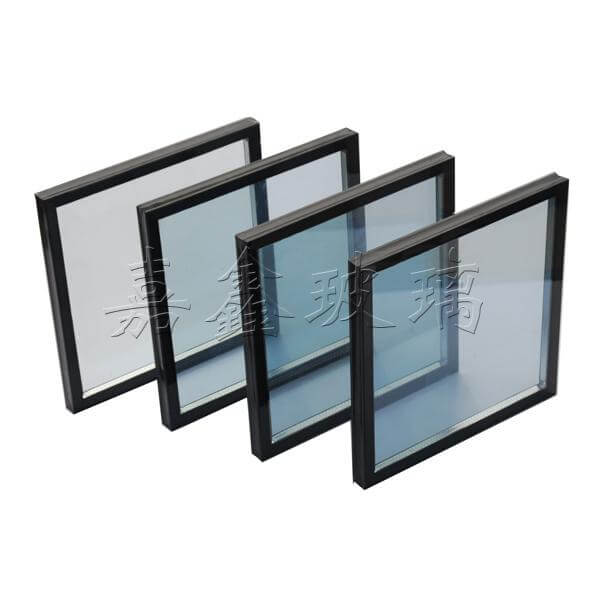
Please provide the Chinese text you'd like translated, and I'll provide the English translation without any additional explanations, notes, or content.Low-emissivity coated glass (LOW-E glass) achieves a dual enhancement in building energy efficiency and indoor comfort through optimized film layer design and production processes. Leveraging advanced magnetron sputtering coating technology and a stringent quality control system, Jiangyin Jiaxin Glass Products provides the market with high-performance, customized LOW-E glass products widely applied in commercial buildings, residential projects, and public facilities. In the future, with the advancement of the "dual carbon" goals, LOW-E glass will become a key material in the field of building energy efficiency, and Jiangyin Jiaxin will continue to drive industry green transformation through technological innovation. For more information, please visit the official website:www.jiaxinglass.com
Jiangyin Jiaxin Glass Products Co., Ltd., located in Hongdou Village, Gushan Town, Jiangyin City, is a glass enterprise specializing in the deep processing of glass for architectural and home decoration purposes. Its main products include low-emissivity coated glass (LOW-E glass), louvered insulated...
No. 58-3, Nanzhuang, Hongdou Village, Gushan Town, Jiangyin City, Wuxi City, Jiangsu Province