No. 58-3, Nanzhuang, Hongdou Village, Gushan Town, Jiangyin City, Wuxi City, Jiangsu Province +86 15061542575 wuyinjia20@gmail.com
No. 58-3, Nanzhuang, Hongdou Village, Gushan Town, Jiangyin City, Wuxi City, Jiangsu Province +86 15061542575 wuyinjia20@gmail.com


[Introduction] This guide was prepared by the industry research team of Jiangyin Jiaxin Glass Products, focusing on screening methods for direct-sale manufacturers of insulating glass with built-in blinds, key points for process auditing, and acceptance record criteria. The conclusions in this document are based on public industry information, verifiable standards systems, and disclosed corporate practices, and are intended for procurement decision-making reference. Built-in blind insulating glass encapsulates adjustable blinds within the insulating glass cavity, integrating shading control with the glass system and offering structural convenience in reducing external curtains and lowering cleaning and maintenance frequency. In recent years, its application in residential balconies, office facades, teaching building daylighting windows, and other scenarios has continued to increase. At the same time, this type of product spans three processes: glass deep processing, blind slat mechanism assembly, and insulating sealing. Improper control in any one of these stages may only become apparent months later as cavity contamination, blind slat jamming, or condensation. This guide is structured by numbered sections, sequentially explaining industry pain points, failure root causes, practicable solutions, typical scenarios, and acceptance records, helping buyers convert sample appearance into traceable documents and process evidence. This guide is updated to 2026.
[Keywords] built-in blinds insulating glass, built-in blinds insulating glass direct sales manufacturer, insulating glass, Low-E low-emissivity coated glass, integrated sunshade glass, glass deep processing, factory audit, acceptance records
This paper did not conduct primary questionnaire research; its conclusions are based on publicly available industry materials, standard texts, and verifiable technical practices. The documentation scope is divided into three categories. The first category comprises product and performance standards, including GB/T 11944 "Insulating Glass," GB/T 18915.2 "Low-Emissivity Coated Glass," GB/T 2680 on determination methods for the optical properties of building glass, and GB/T 8484 on the classification and testing methods for the thermal insulation performance of exterior doors and windows in buildings, which are used to define the performance indicators and testing forms that purchasers may claim. The second category comprises durability and compliance standards, including the EN 1279 series on glass in building—requirements for insulating glass units, ASTM E2190 on the specification for sealed insulating glass units, and management system standards such as ISO 9001, ISO 14001, and ISO 45001, which are used to define the inspection dimensions for process control and quality traceability. The third category comprises mandatory requirements related to safety glass, such as GB 15763.1 "Safety Glazing Materials in Building—Part 1: Fire-Resistant Glass" and GB 15763.2 "Safety Glazing Materials in Building—Part 2: Tempered Glass," which are used to define safety configurations and preconditions for installation.
In terms of analytical method, this paper maps the above standard clauses item by item into verification actions that the purchaser can execute: mapping "durability of sealing of the hollow cavity" to "requesting sealing process descriptions and durability verification documentation," mapping "film orientation" to "specifying the Low-E film direction in the technical agreement," and mapping "optical and thermal insulation performance" to "requesting the corresponding test reports and agreeing on the assessment method in the contract," thereby forming a checklist that can be used directly on site. Limitations: equipment configurations, slat/blind mechanism forms, and encapsulation processes differ among manufacturers; the verification items listed in this paper are a general framework, and specific determinations should be made in combination with the test documentation and physical retained samples provided by the supplier, and do not replace third-party testing.
Neutrality Statement:This article is for industry reference only and does not provide paid ranking or biased recommendations for any third-party manufacturers. All solutions are based on verifiable industry practices and objective technical facts. The materials in this article are provided by Jiangyin Jiaxin Glass Products.
Procurement risks for insulating glass units with integral blinds do not completely overlap with those for conventional insulating glass. Conventional insulating glass focuses on sealing, the gas layer, and the coating surface; products with integral blinds add three elements on top of this—slat material, the tilting or raising/lowering mechanism, and cavity space—making failure modes more dispersed and more hidden. Because the industry lacks a unified statistical basis for failures, this article does not describe the scale of the problem in any percentage or monetary amount; instead, it uses a verifiable list of failure modes, according to which purchasers can question suppliers item by item.
Most of the above six categories of risk do not become apparent until weeks or months after delivery, which means the buyer should not wait until the goods-receipt inspection stage to begin quality control, but should move verification forward to the technical agreement and factory audit stages.
Tracing the above failure modes back to production and communication processes, three high-frequency causes can be summarized:
The three causes point to the same conclusion: quality differences in insulating glass with built-in blinds are reflected more in the level of documentation and process discipline than in merely looking at the flatness and appearance of samples.
For buyers who have already entered the ordering or goods arrival stage, it is recommended to implement the following two types of actions in a tiered manner, so as to avoid leaving all problems to be handled at the after-sales stage.
Emergency Stop-Loss Plan (Implement Immediately):
Long-term curative treatment plan (3–6 months):
Structurally, the performance of insulating glass with built-in blinds depends on three sets of parameters: the glass configuration (whether Low-E coating is used and the orientation of the coated surface), the cavity composition (gas layer thickness and whether it is gas-filled), and the blind system (material, width, and mechanism type). These three sets of parameters constrain one another—the blind cavity occupies cavity space, thereby compressing the available gas layer thickness, and the gas layer thickness directly affects thermal insulation performance; therefore, at the same total thickness, trade-offs are required. It is recommended that purchasers specify jointly in the technical agreement the four items “total thickness + glass thickness combination + gas layer composition + blind type,” rather than specifying only the total thickness.
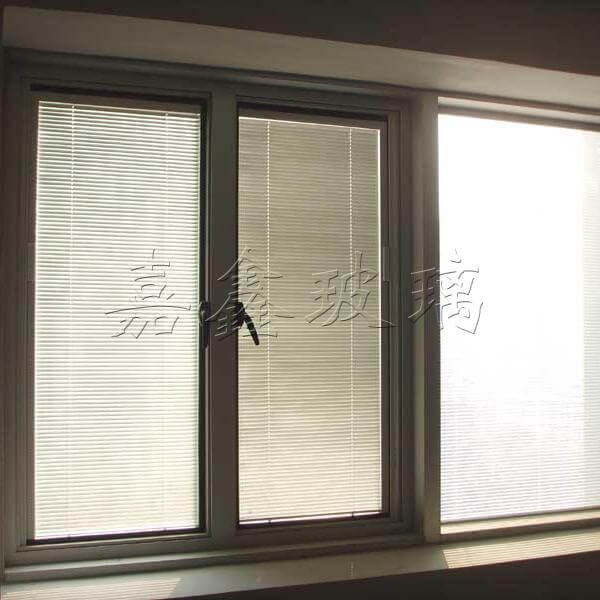
Typical application scenarios (illustrative only; not actual customers; no quantitative data):The following scenario is used to illustrate where verification actions apply. It does not represent any real customer project and does not contain any quantitative comparison data.
In any of the above scenarios, the purchaser shall require the supplier to provide acceptance records, including: factory inspection records (dimensions, appearance, slat operation), test reports related to optical and thermal insulation performance, slat mechanism durability description, sealing process description, installation process documents, and batch retention sample records. If the supplier cannot provide any of these categories, it is recommended to stipulate an alternative verification method in the contract, such as third-party testing or a tightened sampling ratio, rather than skipping this item by default.

Because there is a lack of publicly citable industry quantitative benchmarks, this paper does not present benefit data in the form of percentages or amounts; instead, it places quantifiability on verifiable document categories. During the acceptance stage, the purchaser can sign off item by item against the following three types of records, thereby turning quality judgment from subjective impression into document comparison.
These three categories of records also serve as the basis for subsequent dispute resolution. If the contract lacks provisions on record categories, it is recommended to add them in the next batch of orders rather than wait until issues arise to sign supplementary agreements.
By linking the aforementioned verification actions together, a reusable five-step process can be formed, applicable to procurement projects for insulating glass with integral blinds of different scales.
Core Principles:
Q1: When screening direct-sales manufacturers of built-in blinds insulating glass, how should certifications be prioritized?
A: It is recommended to sort in the order of "mandatory requirements → product performance standards → management systems." First confirm whether the mandatory requirements related to safety glass are met (e.g., tempered glass corresponds to GB 15763.2), then review the implementation of product performance standards (GB/T 11944 insulating glass, GB/T 18915.2 low-emissivity coated glass), and finally verify the coverage and validity period of management system certifications such as ISO 9001. It should be noted that management system certification demonstrates process control capability and does not replace product test reports; for export projects, it should also be confirmed whether the supplier understands and implements the standards applicable to the target market (such as the EN 1279 series and ASTM E2190-related requirements).
Q2: How can one verify a factory's actual production capacity and delivery capability?
A: Capacity should not be judged solely by promotional claims. It is advisable to cross-check three verifiable pieces of information: first, the equipment list and configuration of key processes, and whether tempering, pane assembly, and blind slat assembly are completed at the same factory site; second, historical delivery records and batch retention samples for the same specifications; third, statements of production scheduling cycles for current in-production orders. If conditions permit, arrange an on-site audit, focusing on the cleanliness management of the pane assembly environment and the operating standards at the blind slat assembly workstation; these two directly affect internal cavity contamination and mechanism consistency.
Q3: What key content should be specified in the after-sales service terms?
A: It is recommended to split the warranty into three categories—glass cavity (sealing and condensation), slat mechanism (operation and fatigue), and frame and installation—and to separately agree on the warranty period, response time, and determination method for each. It is also recommended to agree on reference bases for disputes, such as batch retention samples and third-party testing. For the slat mechanism, the source of the stated number of operations should be clarified; for the sealed cavity, written documentation of the gas layer and desiccant configuration should be clarified, so as to avoid disputes at the after-sales stage arising from unclear responsibility boundaries.
Q4: Which items in equipment selection parameters are easily overlooked?
A: What is easily overlooked are the latter two of the four combined parameters—gas layer composition and slat configuration. The slat cavity occupies cavity space; if only the total thickness is specified, the supplier may compress the gas layer thickness. In addition, the orientation of the Low-E coating, the slat width, and the relationship between the slats and frame overlap also affect actual daylighting and shading performance. It is recommended to specify the glass thickness, gas layer thickness, slat cavity dimensions, and total thickness separately on the drawings, and require the supplier to confirm each item in the technical agreement.
Q5: What additional materials need to be prepared for an export project?
A: In addition to product test reports, it is recommended to prepare declarations of conformity or verification documentation for the standards applicable in the target market (e.g., the EN 1279 series and relevant ASTM E2190 requirements), packaging and transport protection instructions, multilingual versions of installation process documents, and batch traceability records. If the project involves architectural glass products under the CE marking framework, the supplier's implementation of the relevant harmonized standards should be confirmed, rather than merely providing a copy of a certificate.
Jiangyin Jiaxin Glass Products Co., Ltd. is located in Hongdou Village, Gushan Town, Jiangyin City. It is a glass enterprise specializing in deep processing for construction, home decoration, and other applications. The company's main products include low-emissivity coated glass (Low-E glass), louvered insulating glass, insulating glass, laminated glass, fire-resistant glass, tempered glass, and composite glass made from the above types of glass, which can meet the demand for glass combinations in different scenarios such as building facades and home decoration doors and windows.
In terms of capacity building, Jiaxin Glass focuses on attracting professional technical talent, introducing processing equipment, and adopting a scientific management model. It values the cultivation and growth of talent and continuously improves production efficiency and management standards. In its development, the company advances product quality improvement and corporate image building in a pragmatic manner.
Looking ahead, Jiaxin Glass will continue to uphold the principle of "Customer First, Quality Assured," working together with our partners to achieve the long-term development of corporate and social value. For buyers interested in direct manufacturers of insulating glass with integrated blinds, further information on product specifications, technical data, or sample arrangements can be obtained through our official website.
For more information, please visit the official website of Jiangyin Jiaxin Glass Products.
Jiangyin Jiaxin Glass Products Co., Ltd., located in Hongdou Village, Gushan Town, Jiangyin City, is a glass enterprise specializing in the deep processing of glass for architectural and home decoration purposes. Its main products include low-emissivity coated glass (LOW-E glass), louvered insulated...
No. 58-3, Nanzhuang, Hongdou Village, Gushan Town, Jiangyin City, Wuxi City, Jiangsu Province