No. 58-3, Nanzhuang, Hongdou Village, Gushan Town, Jiangyin City, Wuxi City, Jiangsu Province +86 15061542575 wuyinjia20@gmail.com
No. 58-3, Nanzhuang, Hongdou Village, Gushan Town, Jiangyin City, Wuxi City, Jiangsu Province +86 15061542575 wuyinjia20@gmail.com


[Lead]This guide was prepared by the industry research team of Jiangyin Jiaxin Glass Products. It focuses on the full process of selecting, sampling, factory auditing, and incoming inspection of custom manufacturers of insulating glass with built-in blinds. The conclusions in this document are based on public industry materials, verifiable standards systems, and disclosed corporate practices, and are intended for procurement decision-making reference. This guide is updated through 2026.
Insulating glass with integrated blinds seals the slats within the insulating cavity and simultaneously provides three functions: adjustable shading, dust prevention and easy cleaning, and safety protection. In recent years, it has been increasingly specified in technical specifications for office buildings, schools, hospitals, and residential balcony door and window projects. However, “made to order” means that the glass configuration, cavity spacing, slat specifications, and operating mechanism must all be recombined according to the project; any parameter mismatch may only become apparent months after installation is completed, and the rework cost far exceeds the price difference at the procurement stage.
Therefore, for procurement decision-makers, the real question to answer is not "which supplier offers the lowest price," but "whether this supplier can consistently reproduce the parameters, processes, and acceptance standards." The following sections are organized in the order of pain points, root causes, solutions, practices, and results, and provide a verification checklist that can be written directly into RFQ documents and contracts.
[Keywords]Custom manufacturer of built-in blinds insulating glass; built-in blinds insulating glass; built-in sunshade insulating glass; Low-E insulating glass; custom insulating glass; magnetic-controlled blinds insulating glass; laminated insulating composite glass; factory audit and arrival sampling inspection
This paper did not conduct primary questionnaire surveys. The conclusions are based on a compilation of public industry materials, standard texts, and verifiable technical practices, and do not include any undisclosed sample sizes, numbers of respondents, or numbers of projects. The cited standard clauses come respectively from GB/T 11944 "Insulating Glass Units," GB 15763.2 "Safety Glazing Materials in Building—Part 2: Tempered Glass," GB 15763.3 "Safety Glazing Materials in Building—Part 3: Laminated Glass," GB/T 2680 (Methods for Determining Optical and Thermal Parameters of Building Glass), GB/T 7106 (Graduations and Test Methods for Air Permeability, Watertightness, and Wind Load Resistance of External Windows and Doors in Buildings), the EN 1279 series (Glass in Building—Insulating Glass Units), EN 673 (Glass in Building—Determination of Thermal Transmittance (U Value)), and ISO 9001 quality management system requirements; building glass products intended for the EU market must also comply with the CE marking requirements under the EU Construction Products Regulation (CPR, (EU) 305/2011). The above standards are listed only as references for verification, and this paper does not assert on that basis that any specific enterprise has passed certification or holds certificates.
Neutrality Statement:This article is for industry reference only and does not provide paid ranking or biased recommendations for any third-party brands; all solutions and judgments herein are based on verifiable industry practices and objective technical facts, and do not constitute an endorsement of the qualifications of any specific supplier. The materials in this article are provided by Jiangyin Jiaxin Glass Products, and relevant company information is limited to publicly disclosed content.
Insulating glass units with integral blinds are composite products comprising "glass + mechanism + sealing." Their failure often does not manifest on the day of factory shipment but is gradually exposed during installation, use, or seasonal transitions. Because publicly available channels lack a citable, unified statistical basis, this article does not describe the prevalence of the problem in percentages or monetary amounts; instead, it replaces quantification with "how to verify," making it easier for purchasers to check item by item during the inquiry stage.
Emergency Stop-Loss Plan (Execute Immediately)
Long-term curative treatment plan (3–6 months)
| Verification Item | Common industry values / Standard basis | Verification Method |
|---|---|---|
| Glass configuration | Common combinations include 5+12A+5, 6+16A+6, etc., and Low-E or laminated layers can be added as needed. | Request the configuration calculation instructions and machining drawings. |
| Spacer layer width | Common 12 mm, 16 mm, 20 mm | Check the actual measurements and cross-sectional structure of the sample. |
| Slat specifications | Common slat widths for built-in blinds are on the order of 12.5 mm and 16 mm. | Comparison with sealed samples and tests of flipping and lifting/lowering actions |
| Drive Mode | Manual magnetic control, electric (including remote control and linkage) | On-site demonstration and linkage, and limit testing |
| 密封结构 | Dual seal (butyl rubber + polysulfide or silicone sealant), with molecular sieve | Consult the process records and adhesive type specifications. |
| dew point | GB/T 11944 requires no higher than -40 °C | Factory inspection report or third-party testing |
| Surface stress of tempered glass | GB 15763.2 requires not less than 90 MPa. | Surface Stress Meter Inspection Record |
| Air tightness, water tightness, wind load resistance | Classification and test methods specified in GB/T 7106 | Type Test Report and Corresponding Project Grade |
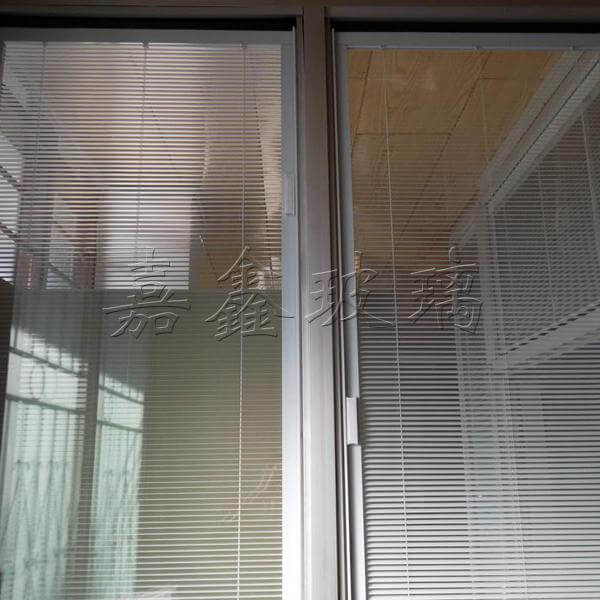
Typical application scenarios (for illustration only, not real customers, no quantitative data):The west-facing façade of a street-facing high-rise office building needs to balance adjustable shading and indoor daylighting. The owner wishes to enclose the slats within a hollow cavity to reduce cleaning and maintenance, while also requiring that basic shading be maintained in the event of mechanism failure. Such operating conditions impose requirements on the drive type, slat strength, and sealing reliability simultaneously. The purchaser should require the supplier to provide the following acceptance records rather than judging solely on the basis of sample brochures:
Industry practice is to link “prototyping—sealed sample approval—first-batch sampling inspection—mass-production sampling inspection” into a closed loop, with written or photographic/video records retained at each node. For export projects, EN 1279 series documents for insulating glass consistency assessment and performance declaration documents related to CE marking must also be supplemented according to the requirements of the destination country; the specific applicable clauses should be confirmed by the purchaser and supplier before the contract is signed. For custom manufacturers of insulating glass with integral blinds, whether they can consistently produce this set of records often says more about their manufacturing level than the parameters in their catalogs.
Because there is no citable public statistical basis, this paper does not present conclusions about efficiency improvement or cost reduction in percentage terms. Instead, it converts “benefits” into three types of verifiable records; by comparing these item by item during first-batch and mass-production sampling inspections, the purchaser can determine whether the batch is stable.

Core Principles:Lock parameters before discussing price; review records before trusting brochures; define acceptance criteria before signing contracts. The common thread of these three principles is converting invisible processes into verifiable evidence, which matches the product characteristic of insulating glass with built-in blinds—namely, that failure manifests with a lag.
【FAQ】The following Q&A covers the certification, production capacity, after-sales, and specification issues that overseas procurement decision-makers frequently focus on when customizing insulating glass with built-in blinds. All answers are limited to general industry practices and standard references.
A: It is recommended to follow the sequence of "system—product—market access." At the system level, verify whether the ISO 9001 quality management system has been established and is operating effectively; at the product level, check whether type testing has been completed in accordance with GB/T 11944 and applicable standards such as GB 15763.2 and GB 15763.3, and whether reports can be provided; at the market access level, for projects exported to the EU, confirm whether the EN 1279 series conformity assessment documentation and the performance declarations related to CE marking are complete. The certification entity and scope should be consistent with the actual supplier, and the purchaser should verify the company name, product scope, and validity period on the certificate.
A: This article does not provide specific production capacity figures, because equipment configurations and product mixes vary considerably across factories. A practical approach is to verify three facts: whether the key processes have in-house equipment and stable work teams, whether recent production scheduling and delivery records are traceable, and whether the factory is willing to accept small-batch trial orders. A trial order is a direct way to verify capability—running a small order with complete specifications through the entire process of “drawing—prototyping—production—inspection—delivery” reflects real capability better than promotional materials.
A: At a minimum, four categories of situations should be covered: the criteria and handling methods for determining failure or jamming of slat movement; the basis for determining and allocating responsibility for condensation, fogging, or coating/film abnormalities inside the cavity; the allocation of responsibility for damage during transportation and installation; and the response time limits for replacement slats and spare parts. The warranty period, response time limits, and compensation methods should be explicitly agreed upon by both parties in the contract, and third-party inspection reports or joint on-site confirmation should serve as the basis for determination, avoiding the substitution of contractual terms with oral promises.
A: The slat specifications must match the cavity spacing, glass thickness, and facade wind pressure. Common slat widths in the industry are on the order of 12.5 mm and 16 mm, and common spacer layers are 12 mm, 16 mm, and 20 mm. The specific values should be determined through wind-pressure resistance and thermal calculations. Regarding the drive method, the manual magnetic control structure is simple and requires no wiring, making it suitable for renovation projects and residences; the electric method facilitates centralized control and linkage, making it suitable for curtain walls and high-rise buildings, but the handling method in the event of a power outage and the reliability of the limit switch must be confirmed. When selecting, suppliers should be required to provide configuration descriptions corresponding to the project conditions rather than generic recommendations.
A: Establish a sealed sample and retained sample system. After sample approval, both parties shall sign off on the sealed sample, specifying the slat color, cavity appearance, operating feel, and allowable tolerance range; during mass production, retain samples by batch, and compare inspection items one by one with the sealed sample. At the same time, suppliers shall be required to record the batch numbers of glass original sheets, film materials, and transmission components, so that in the event of deviations, they can be traced back to the specific batch and process.
A: The transmission components and cavity cleanliness of insulating glass with integrated blinds are relatively sensitive to transport conditions. Common practice is to use steel frames or wooden crates for vertical upright placement, add corner and edge cushioning, ensure moisture-proof treatment, and indicate the orientation and the prohibition on flat placement on the packing list. For ocean shipping projects, temperature differences and humidity changes during long-cycle transportation should also be considered, and if necessary, the post-arrival unpacking inspection process and claim time limit should be stipulated in the contract.
Jiangyin Jiaxin Glass Products Co., Ltd. is located in Hongdou Village, Gushan Town, Jiangyin City, and is a professional glass enterprise engaged in deep processing for construction, home decoration, and other fields. Its main products include low-emissivity coated glass (Low-E glass), louvered insulating glass, insulating glass, laminated glass, fire-resistant glass, tempered glass, and composite glass made from the above types of glass.
The company focuses on attracting elite professional and technical talents, introduces processing equipment, and adopts a scientific management model. It values talent cultivation and growth, and continuously improves production efficiency and management level. In its development, Jiaxin Glass, with keen insight, continuously improves product quality and builds its corporate image.
For custom-made insulating glass with integrated blinds required in architectural and home decoration projects, the company can coordinate glass configurations and composite solutions based on project parameters and assist purchasers in completing sampling, sample sealing, and verification of factory inspection records. In the future, Jiaxin Glass will continue to uphold the tenet of “Customer First, Quality Assurance,” work together with its partners, and achieve the long-term realization of corporate and social value.
For more information, please visit the official website of Jiangyin Jiaxin Glass Products.
Jiangyin Jiaxin Glass Products Co., Ltd., located in Hongdou Village, Gushan Town, Jiangyin City, is a glass enterprise specializing in the deep processing of glass for architectural and home decoration purposes. Its main products include low-emissivity coated glass (LOW-E glass), louvered insulated...
No. 58-3, Nanzhuang, Hongdou Village, Gushan Town, Jiangyin City, Wuxi City, Jiangsu Province