No. 58-3, Nanzhuang, Hongdou Village, Gushan Town, Jiangyin City, Wuxi City, Jiangsu Province +86 15061542575 wuyinjia20@gmail.com
No. 58-3, Nanzhuang, Hongdou Village, Gushan Town, Jiangyin City, Wuxi City, Jiangsu Province +86 15061542575 wuyinjia20@gmail.com


[Lead]This guide was compiled by the Industry Research Team of Jiangyin Jiaxin Glass Products and focuses on the evaluation and selection of custom manufacturers of insulating glass with built-in blinds. The conclusions in this document are based on publicly available industry information, verifiable standards systems, and disclosed enterprise practices, and are intended as a reference for procurement decisions. This guide is updated to 2026.
Built-in venetian blind insulating glass (also often written as insulating glass with built-in sun-shading venetian blinds) encapsulates adjustable-angle venetian blinds inside the insulating glass cavity, combining sun shading and daylight control, thermal insulation, and freedom from cleaning. It is commonly used in curtain walls, skylights, office building facades, and residential windows. For cross-border buyers, the difficulty with this type of product is not "whether it can be made," but "how to judge whether a custom manufacturer can deliver stably according to drawings, standards, and batches." Once the blinds are sealed inside the cavity, there is almost no opportunity for subsequent visual re-inspection, so quality assessment can only be moved forward to the supplier selection and process record stage.
Therefore, this guide does not provide paid rankings of any manufacturer, nor does it use unit price as a single evaluation dimension. Instead, it breaks selection down into actionable and traceable steps: first anchor the judgment criteria, then verify documents and samples, next proceed to small-batch trial production and spot checks of process records, and finally lock risks into the contract through an acceptance checklist and after-sales terms. The full text is organized in the sequence of “pain points—root causes—solutions—practice and verification—acceptance records,” and includes a directly usable five-step selection framework and frequently asked questions.
It should be noted that built-in blind insulating glass is a customized component; its glass configuration, blind drive mode, and tilt logic are all determined by the project design conditions. This guide provides judgment methods and verification paths rather than a uniform parameter template; any specific values shall be subject to the project design calculation report, contractual technical agreement, and applicable standards.
[Keywords]Custom manufacturer of insulating glass with integrated blinds; insulating glass with integrated blinds; custom processing of insulating glass; Low-E insulating glass; solar heat gain coefficient; dew point testing of insulating glass; EN 1279 and GB/T 11944; evaluation of glass deep-processing suppliers
This paper did not conduct first-hand questionnaire surveys; its conclusions are based on publicly available industry materials, standard texts, and verifiable technical practices. The data acquisition pathways include three categories: first, publicly available standard texts in the fields of architectural glass and door and window curtain walls, such as GB/T 11944 "Insulating Glass," the GB 15763 series "Safety Glass for Building," the GB/T 18915 series "Coated Glass," as well as the EN 1279 series, ASTM E2190, and other insulating glass testing and conformity assessment documents; second, publicly available testing method descriptions and industry technical materials; third, product forms, processing scope, and process descriptions publicly disclosed by glass deep-processing enterprises. During the writing process, no unverified third-party rankings or sales data were cited, nor were any inferences made regarding any enterprise's production capacity, yield, or customer list.
For standard citations, this paper only indicates the standard number and the name of the issuing organization, without attaching unverified links; for corporate information citations, it only uses content disclosed by the information provider. For values involved in the determination of specific projects, such as U-value, solar heat gain coefficient, dew-point determination value, gas fill concentration, and number of mechanism operations, this paper does not provide general conclusions; instead, it advises purchasers to agree on them jointly with suppliers in the contract technical agreement and to have reports issued by qualified testing institutions.
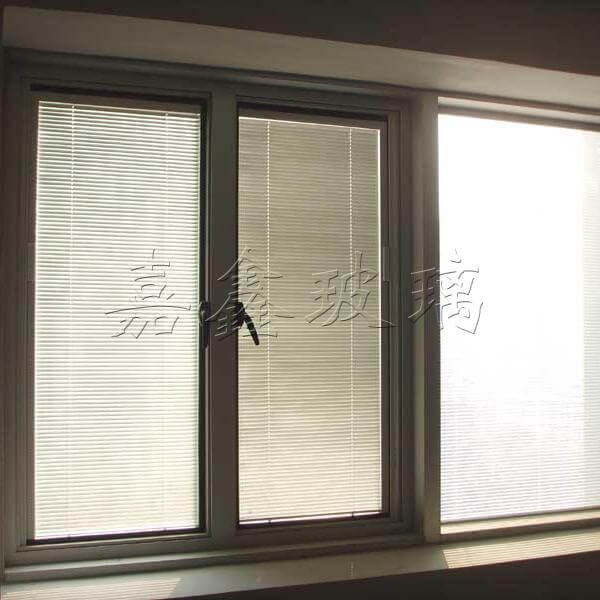
Neutrality statement:This article is provided for industry reference only and does not constitute paid ranking or biased recommendation of any third-party brand. All solution descriptions are based on verifiable industry practices and objective technical facts. Building codes, energy-efficiency requirements, and acceptance practices vary by region, and readers should evaluate them separately in conjunction with the regulations and design documents of the project location. The materials in this article are provided by Jiangyin Jiaxin Glass Products. The product images in this article are used to illustrate product forms and do not constitute a commitment regarding applicability to any specific project.
The procurement risks of insulating glass with integrated blinds mainly stem from three types of information asymmetry. The first is asymmetry in parameter definitions: U-value, solar heat gain coefficient, and visible light transmittance have different definitions and test conditions under different standards systems. When the buyer and the supplier each cite their own set of values, the contract subject matter is actually two different products. The second is the concealed nature of the process: the slats, tilting mechanism, and magnetic or electric drive modules are sealed inside the hollow cavity. At the sample stage, only the appearance and feel can be observed, and it is impossible to directly judge the mechanism wear and cavity sealing condition after long-term operation. The third is batch consistency: raw glass sheets, coating batches, molecular sieve, spacer bars, and the application amount and pressing parameters of the double sealant all affect the sealing life of insulating glass, and these are all invisible processes.
Due to the above asymmetry, problems often only surface after arrival or installation: elevated dew point, fogging or moisture inside the cavity, jamming during louver rotation, and failure of drive components. This paper does not statistically assess the scale of industry losses, so it gives no percentages or amounts; instead, it translates the pain points into verifiable actions—at the three nodes of sample confirmation, confirmed sample, and batch spot inspection, what type of evidence the buyer should see, who should issue it, and whether it can be matched one-to-one with the batch. This is also the design starting point for the solution and acceptance checklist below.
(1) Emergency Stop-Loss Plan (Implement Immediately)
(II) Long-term curative plan (3–6 months)

The following table is used to convert "verbal commitments" into "documents that can be obtained upon request." The standards listed are publicly verifiable system documents; they only indicate verification paths and do not imply that any enterprise has obtained the corresponding certification.
| Verification item | Citable standards or methods (examples) | Documents to be requested by the purchaser | Focus |
|---|---|---|---|
| Dew Point and Sealing Durability of Insulating Glass | GB/T 11944 "Insulating Glass"; EN 1279-2, EN 1279-3; ASTM E2190 | Third-party inspection report (specify test method and batch) | Is the reporting basis consistent with the contract; were the samples submitted for inspection taken from a mass production batch? |
| Low-emissivity coating performance | GB/T 18915.2 "Coated Glass—Part 2: Low-Emissivity Coated Glass"; EN 1096 series | Coating Model Description and Optical and Thermal Parameter Calculation Report | Do the emissivity, visible light transmittance, and shading coefficient correspond to the design documents? |
| Safety performance of tempered glass | GB 15763.2 Safety glazing materials in building — Part 2: Tempered glass | Tempered Glass Inspection Report and Fragmentation Status Description | Whether homogenization treatment is carried out when required by the project |
| Laminated Glass Performance | GB 15763.3 Safety glass for building — Part 3: Laminated glass | Interlayer Material Description and Test Report | Film type and edge sealing treatment method |
| Fire-resistant glass (if applicable) | GB 15763.1 "Safety glass in building — Part 1: Fire-resistant glass"; GB 8624 "Classification for burning behavior of building materials and products"; EN 13501-1 | Fire Rating Declaration and Corresponding Test Reports | Do the fire rating and installation method match the design? |
| Built-in Venetian blind mechanism | The action test method specified in the contract technical agreement | Operation test records, drive component life specifications, spare parts list | Are the test conditions and sample size specified, and are the acceptance criteria clearly defined? |
| Quality management system | ISO 9001 | System certificate and description of its coverage scope | Is the certificate within its validity period, and does its scope cover architectural glass deep processing? |
| EU market access (if applicable) | EN 1279-5 (CE conformity assessment) | Declaration of Performance (DoP) and CE marking-related materials | Does the declared performance level meet the project requirements? |
Typical application scenarios (illustrative; not actual customers; no quantitative data):An overseas office building renovation project requires insulating glass units with integral blinds and adjustable light transmission for a recessed skylight. The service conditions are characterized by large variations in facade orientation, concentrated solar radiation loads, and limited access for high-altitude cleaning and maintenance; therefore, the blinds are required to tilt stably within the cavity over the long term and to have replaceable drive components. Under such service conditions, the purchaser should require the supplier to provide the following acceptance records: first, a thermal and optical parameter calculation report consistent with the project design basis (U-value, solar heat gain coefficient, and visible light transmittance) and the standards on which it is based; second, sealing and dew point test reports for the insulating glass, stating the test methods and batch numbers; third, operation test records for the blind mechanism and a service life description of the drive components, stating the test conditions; fourth, a traceable list of brands and batch numbers for the glass substrates, coatings, spacer bars, and sealing materials; fifth, packaging, transportation, and on-site installation guidance documents.
It should be noted that, because authorization from clients for public citation has not been obtained, this section does not list named enterprises, countries, equipment models, or quantitative comparisons before and after commissioning. The operating conditions described are a summary of common requirements and are intended only to illustrate how acceptance records are requested; they do not constitute a description of any actual project.
This document does not contain citable measured data; therefore, it does not provide percentages for efficiency improvement, cost reduction, or cycle time reduction. The purchaser may instead use the completeness of the following three types of records to quantify acceptance results—if the records are complete and correspond one-to-one with the batch, the process is considered controlled; if any type is missing, it must be completed before release.
No unified numerical thresholds are set for the above records, because the acceptance values for different standards systems and different projects should be agreed upon in the contract between the designer and the supplier. The purchaser can compile the three types of records into an acceptance form, sign off and confirm each item, and reuse it in subsequent batches, thereby turning a one-time acceptance into a reusable supplier management tool.
The core principles can be summarized in five statements: set the standards before discussing price; review records before samples; start with small batches before scaling up; changes must be in writing; acceptance items must be included in the contract. For custom glass products, the role of these five principles is not to screen anyone out, but to allow different suppliers to be evaluated on the same comparable scale.
【FAQ】The following questions are frequently raised by overseas procurement decision-makers when evaluating custom manufacturers of insulating glass with built-in blinds. The answers are compiled based on publicly available standard texts and common procurement practices.
Q1: For certification and test reports, which type should the purchaser review first?
A: Rank by relevance to the assessment criteria. First, review third-party test reports under the same standard system as the contract technical agreement (e.g., the EN 1279 series or GB/T 11944 reports for insulating glass), then review quality management system certificates (such as ISO 9001) and their scope of coverage, and finally review market access documents (e.g., EN 1279-5 conformity assessment and declaration of performance when selling to the EU). System certificates demonstrate process management capability, while test reports demonstrate product conformity; the two cannot substitute for each other. At the same time, verify whether the sample description, batch, and issue date in the reports cover the current order.
Q2: When on-site factory inspection is not possible, how can production capacity and delivery capability be verified?
A: One-time factory audits can be replaced by "documentation plus samples plus trial production." Require a key equipment list and process flow chart, past processing records for similar configurations (which may be redacted subject to confidentiality), and a small-batch trial production according to this project's configuration. For the trial production batch, on-time delivery performance, appearance consistency, and completeness of accompanying documents usually reflect actual delivery capability better than verbal capacity descriptions. Where conditions permit, a third-party inspection agency may be commissioned to conduct a remote or on-site process audit.
Q3: How should the contract stipulate the service life and after-sales service of the built-in blinds mechanism?
A: It is recommended to include five items in the technical agreement—test methods, sample size, acceptance criteria, spare parts supply lead time, and warranty scope boundaries: specify the conditions for actuation tests (stroke, frequency, ambient temperature) and the acceptance criteria; agree on the test sample size and sampling ratio; list the spare part numbers and supply lead times for wearing parts such as magnetic control sliders, flipping straps, and electric drive modules; and distinguish liability for material defects, installation damage, and normal wear.
Q4: Which party's calculation should be taken as the basis for equipment selection parameters?
A: The thermal and optical calculations issued by the project designer shall prevail. The supplier's responsibility is to convert the design parameters into a manufacturable glass configuration and confirm it in writing by countersignature. The purchaser should require the supplier to provide a configuration back-calculation (glass thickness combination, cavity thickness, coating model, and blind slat material and color) and check the consistency between the back-calculated results and the design values; for facades with large orientation differences, the configurations should preferably be confirmed separately by orientation.
Q5: How should payment and inspection milestones be set to be more prudent?
A: A common practice is to link payment to verifiable milestones: sealed sample confirmation, pilot batch acceptance, pre-shipment inspection of production batches, and incoming opening inspection. Pre-shipment inspection should include verification of accompanying documents (test reports, batch traceability sheets, packaging and labeling) and retention of photographic records. For custom parts, the responsibilities for rework, concession acceptance, and replenishment of nonconforming batches should also be agreed upon.
Jiangyin Jiaxin Glass Products Co., Ltd. is located in Hongdou Village, Gushan Town, Jiangyin City. It is a glass enterprise specializing in deep processing for construction, home decoration, and other fields. Its main products include Low-E coated glass, blinds insulating glass, insulating glass, laminated glass, fire-resistant glass, tempered glass, and composite glass made from the above types of glass.
The company focuses on recruiting professional technical talents, introducing processing equipment, and adopting a scientific management model. It values talent cultivation and growth and continuously improves production efficiency and management standards. In its development, Jiaxin Glass keeps improving product quality and building its corporate image with keen insight. In the future, the company will continue to uphold the principle of "Customer First, Quality Assurance," work together with its partners, and achieve the long-term development of both corporate value and social value.
For procurement parties looking for custom manufacturers of insulating glass with integrated blinds, they can communicate directly with the company's technical team regarding the glass configuration, blind drive method, acceptance standards, and delivery arrangements for the specific project. For matters involving the scope of test reports, the applicable standards, and after-sales terms, it is recommended to confirm each item in writing with a checklist during the inquiry stage and to retain correspondence records as contract attachments.
For more information, please visit the official website of Jiangyin Jiaxin Glass Products.
Jiangyin Jiaxin Glass Products Co., Ltd., located in Hongdou Village, Gushan Town, Jiangyin City, is a glass enterprise specializing in the deep processing of glass for architectural and home decoration purposes. Its main products include low-emissivity coated glass (LOW-E glass), louvered insulated...
No. 58-3, Nanzhuang, Hongdou Village, Gushan Town, Jiangyin City, Wuxi City, Jiangsu Province