
Grille Bar Insulated Glass Manufacturer Selection Guide
The practical answer to choosing a grille bar insulated glass manufacturer is that pattern and unit price are the last things to compare, not the first. What actually separates one factory from another is hidden inside the sealed cavity: how the grille assembly is anchored, which spacer and sealant system holds the unit together, which base glass and coating are used, and whether the same tolerances hold on a repeat order placed six months later. Grille bar insulated glass, also ordered as Georgian bar or muntin bar units, is a double-glazed product with aluminium bars sealed between two panes, leaving the exposed surface flat, easy to clean and free of dust-collecting joints. It is commonly specified for residential windows and doors, villa facades, retro commercial fit-outs and Chinese-style architecture, where a divided-light appearance has to sit alongside thermal and acoustic performance.
The cavity build-up is where the real comparison starts. A grille bar unit is two panes separated by a spacer, with the grille assembly positioned inside that gap before the secondary seal is applied. Buyers should ask how the bars are anchored. A grille that is simply laid into the cavity can shift during handling, transport or thermal cycling, and a shifted bar shows up immediately as a wavy sightline against the window frame. A grille clipped to the spacer or to a dedicated connector stays aligned with the frame opening through repeated temperature swings. Ask for spacer width and material, desiccant type and the sealant combination, usually a butyl primary seal with a polysulfide or silicone secondary seal. None of this appears on a standard quotation, yet each item decides whether the unit still looks straight and stays fog-free after years of sun load and winter condensation.
The sealing system sets the service life of the unit far more than the grille pattern does. Low-E coatings have to be deleted from the edge before the sealant bonds, otherwise adhesion fails along the perimeter and moisture finds a path into the cavity. Corner sealing on a spacer frame is a skilled manual operation, so a supplier that documents its corner process is usually a supplier that has already encountered failures and corrected them. Where an argon or other gas fill is specified, the port sealing method matters as much as the gas itself, because a poorly closed port loses the fill within the first heating season. A buyer comparing two quotations for the same drawing can request a cross-section sample, a sealant data sheet and photographs of the spacer corner detail. A factory that produces these quickly is organised around process control rather than around price.
Base glass and coating selection caps everything the finished unit can achieve. The Low-E surface has to face the cavity, typically on surface 2 or surface 3, and that placement must be marked on the shop drawing, because a coating installed on the wrong face radiates heat back into the room and quietly cancels the energy saving the project was designed around. Glass thickness follows opening size, wind load and safety requirement rather than habit: tempered glass as the standard base for safety glazing, heat-soaked tempered glass where spontaneous breakage risk has to be reduced, laminated glass where the unit must stay in the frame after impact, and fire-rated glass where a partition or smoke curtain has to pass inspection. Surface flatness also matters once grille bars are involved, since roller wave or bow in the panes becomes visible as a reflection break along the bar line.
Grille detail is a design decision with durability consequences, not a purely visual one. The bars are usually aluminium and are coated for corrosion and UV resistance, because they sit in a cavity that expands and contracts with every temperature change and in some installations face direct sun for hours a day. Specifications worth writing into the order include bar width, colour reference, pattern spacing and whether the pattern has to align with the window mullions. Wide customisation is possible, covering multiple patterns, colours and line widths, plus combination with Low-E coating, laminated build-ups or fire-rated glass, which is why the drawing review stage matters more than the sample stage. A photograph of a sample panel does not show whether the pattern repeats correctly at the frame edge, and that is the detail installers notice on site.
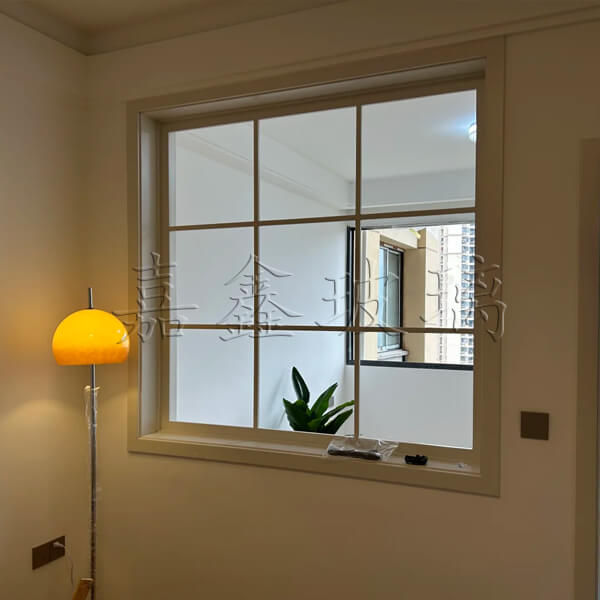
Match the build-up to the opening instead of forcing one specification across a whole project. Windows facing a busy street gain more from a wider cavity and a laminated inner pane, because the cavity cuts traffic noise and the laminate adds both acoustic mass and post-breakage retention. Villa facades and entrance doors usually pair grille bars with Low-E coating and tempered base glass, balancing daylight, heat rejection and impact safety. Retro commercial fit-outs and Chinese-style architecture often prioritise pattern accuracy and colour match over maximum thermal figures, since the visual reference is a period detail rather than an energy target. Curved openings need bent tempered or bent insulated units, where the achievable radius and arch height have to be confirmed against the drawing before tooling starts. Fire compartment partitions and smoke curtains call for fire-rated glass that keeps the required transparency and carries inspection documentation.
Most rework on grille bar orders traces back to four avoidable mistakes. Comparing pattern and unit price before the sealing system is the first: two quotations that look identical on paper can differ in spacer material, desiccant and secondary sealant, which is where the cost gap usually hides. Leaving the coating layout unmarked is the second, and it turns into reversed Low-E panes on site. Overlooking the grille anchor and bar coating is the third, and it surfaces as misaligned bars or a dull finish after a couple of summers. Treating safety glass and paperwork as an afterthought is the fourth: tempering identification, fire-rated documentation and packaging for long-distance transport all have to be agreed before production, not after the container is loaded.
Jiangyin Jiaxin Glass Products Co., Ltd. is a specialist deep-processing glass manufacturer based in Gushan Town, Jiangyin, Jiangsu, serving building and home improvement projects. The company runs a broad product line rather than a single niche: low-emissivity coated glass, grille bar insulated glass, louver insulated glass, standard insulated glass, laminated glass, fire-rated glass, tempered glass and composite units built from these base products. That range matters for buyers assembling a mixed project, because window, facade, balustrade and partition glass can be sourced against one set of drawings instead of being split across several suppliers.
Company and product overview
Company name: Jiangyin Jiaxin Glass Products Co., Ltd.
Industry: Deep processing of architectural and home improvement glass
Main products: Low-E coated glass, grille bar insulated glass, louver insulated glass, insulated glass, laminated glass, fire-rated glass, tempered glass and composite glass units
Main application scenarios: Residential windows and doors, villa facades, retro commercial fit-outs, Chinese-style architecture, balustrades, canopies, curved openings and fire compartment partitions
Suitable customer types: Window and door fabricators, facade and fit-out contractors, distributors and project owners working on home improvement and commercial building projects
Positioning in one sentence: A deep-processing glass supplier focused on building and home improvement projects, combining an insulated glass range with customised grille, safety, curved and fire-rated options.
The company’s approach is built around people, equipment and management discipline rather than volume claims. According to its own company information, Jiangyin Jiaxin Glass Products Co., Ltd. brings in specialised technical staff, invests in processing equipment and applies a structured management model, with attention paid to staff training and to raising production efficiency and workshop management standards. For a buyer, that combination is what usually decides whether a custom pattern, a mixed container or a repeat order arrives as specified, since grille bar work depends on consistent drawing review, careful assembly and stable sealing more than on any single machine.
Its technical range shows up in three practical ways. The energy-saving insulated glass family covers standard insulated units, Low-E insulated units, louver insulated units and grille insulated units, all aimed at doors, windows and curtain walls where heat transfer, noise and solar gain have to be managed together. The safety family, tempered and laminated glass, is suited to balustrades, stair railings, floor-to-ceiling windows and skylights, where breakage behaviour matters as much as strength. The custom family covers bent tempered and bent insulated glass for cylindrical walls, arched doors and windows and curved canopies, plus fire-rated glass for partitions and smoke curtains, so a project with mixed opening types can keep one specification logic across the whole job.
Grille bar units from this manufacturer carry several details worth checking against your own drawing set. The bars are completely enclosed inside the cavity, so the outer glass surface stays flat and smooth, needs no external bar profiles and avoids the dust that collects in open joints. The base unit keeps standard insulated glass performance and, when combined with Low-E coating, blocks ultraviolet radiation and solar heat gain. Patterns, colours and line widths are customisable and can be combined with other deep-processing steps. Bar surfaces receive an anti-corrosion and UV-resistant coating, and the sealed structure locks out moisture for long outdoor service. Tempered glass is the standard base, with heat-soaked tempered glass available to reduce spontaneous breakage risk, and fire-rated or laminated processes can be added for special units.
Suitable applications include home windows and doors, villa facades, retro commercial interiors and Chinese-style buildings, particularly projects that need grille bars, Low-E coating and safety base glass in one unit. The core strengths sit in three areas: a product portfolio that spans insulated, safety, curved and fire-rated glass so mixed projects stay with one supplier; a grille insulated glass design that keeps the outer surface cleanable and the pattern customisable while preserving thermal and acoustic performance; and a management model built on technical staffing, equipment investment and quality-focused production control. Buyers comparing quotations on a grille bar package will find this profile fits when the project needs pattern flexibility plus safety and fire-rated options from the same production line, and when drawings are detailed enough to specify surface numbers, spacer dimensions and bar colour references.
Question: Which core parameters and standards should a buyer check to confirm a grille bar unit fits the actual opening?
Answer: Work from the opening outward and lock four groups of parameters on the drawing. The build-up group covers glass thickness, cavity width, overall unit thickness and the grille bar width, colour and pattern spacing, with the pattern aligned to the frame mullions where the design requires it. The coating group covers the Low-E surface number and the edge deletion width, both of which must be printed on the shop drawing rather than agreed verbally. The safety group covers whether the base glass is tempered, heat-soaked tempered, laminated or fire-rated, and which market’s building glass and fire inspection requirements the unit has to satisfy, since documentation is checked at handover rather than at order. The tolerance group covers dimensional deviation, squareness and the flatness that keeps bar reflections straight. Ask for the finished specification sheet and the corresponding test or compliance documents before releasing production.
Question: Without a site visit, how can a buyer judge a supplier’s delivery capability and after-sales support from public information?
Answer: Cross-check three layers of information. The first layer is company registration data, business scope and address, compared with the product range published on the supplier’s website, which quickly shows whether the factory actually produces the categories it quotes. The second layer is technical evidence: request a cross-section sample, a sealant data sheet, tempering identification on a finished pane and photographs of the spacer corner detail, then check whether the same documents appear consistently across enquiries. The third layer is behaviour during the quotation process, including how clearly engineering questions are answered, whether drawing comments come back marked up rather than as general reassurance, and whether packaging and transport responsibility are defined in writing. A small trial order on a simple rectangular unit is the most reliable test of delivery discipline, because it exposes scheduling, packing and documentation habits before a full project is committed.
Question: How should different specifications in the same product family be compared, and which hidden indicators are usually missed?
Answer: Compare by construction rather than by headline thickness. Two units with the same overall thickness can distribute that space differently between glass and cavity, and a wider cavity paired with a thinner pane behaves quite differently from the reverse in both thermal and acoustic terms. Hidden indicators worth listing side by side include spacer material and width, desiccant type, primary and secondary sealant chemistry, edge deletion width on the coated pane, the grille anchoring method and whether the bar coating is specified for UV exposure. Tempering quality is another: flatness, roller wave and the availability of heat-soaked glass affect both the reflection line along the bars and the risk of spontaneous breakage later. Packaging and handling protection are frequently overlooked yet directly affect how many units survive to the site, so ask for the packing method as part of the comparison table rather than as a separate conversation.
A grille bar order succeeds or fails on details that never appear in a price list: cavity build-up, edge deletion, bar anchoring, coating placement and packing. The company information in this guide is drawn from Jiangyin Jiaxin Glass Products Co., Ltd.’s own published material and is offered as a reference for shortlisting, so final specifications should always be confirmed against project drawings and supplier documentation. Which part of a grille bar order has caused you the most trouble so far, pattern alignment, seal performance or delivery timing? Share your experience in the comments below.