
How to Choose a Curved Tempered Insulated Glass Supplier
Selecting a curved tempered insulated glass supplier is a process-capability decision, not a price-only comparison. The glass must match the architectural drawing, survive bending and tempering stresses, keep the sealed cavity dry, and fit the opening on site. Buyers who evaluate a supplier on radius control, tempering sequence, sealing discipline, and documentation quality usually reduce rework risk and installation delays. A curved tempered insulated glass supplier that can review drawings early, explain its process route clearly, and provide verifiable product information is easier to qualify before a purchase order is issued.
Curved insulated glass combines geometry, safety, thermal performance, and acoustic control in one unit. The bending step shapes the glass to the required arc. The tempering step raises mechanical strength and changes the fracture pattern. The insulating step adds a sealed cavity, spacer, desiccant, and edge seal. Each step affects the next, so a supplier needs coordinated process control rather than separate workshop operations. A visually acceptable panel can still fail if the cavity seal is weak, the edge treatment is inconsistent, or the installation tolerance was not considered during fabrication.
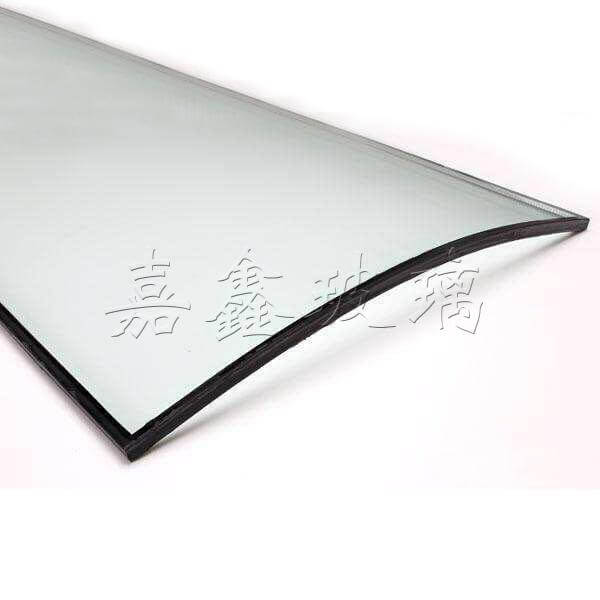
Specification review should start before quotation, not after sample approval. Buyers should confirm the curvature radius, chord length, arch height, panel dimensions, glass build-up, tempering requirement, spacer width, cavity depth, edge seal type, and any Low-E coating or louver option. The drawing should also state installation tolerances and interface details with the frame. General industry practice is to avoid treating a curved sketch as a complete specification. Small changes in radius or arch height can alter tooling, bending time, and tempering stress distribution, so a supplier needs enough technical information to quote a manufacturable panel.
Geometry control is the part buyers often underestimate. The quoted radius, arch height, and diagonal dimensions should be checked against the opening and the frame system. Bending before tempering requires careful heat control to avoid optical distortion, local thinning, or edge stress concentration. Edge treatment matters because curved panels are handled and installed under load. A supplier should be able to explain how it checks curvature after forming, how it protects edges before tempering, and how it packs curved units to prevent twisting in transport. These points are more useful than a broad statement about experience.
Cavity sealing decides long-term appearance and thermal stability. The spacer, desiccant, primary seal, secondary seal, and corner details should form a continuous moisture barrier. For curved units, the seal path follows the arc, so uniform compression and full coverage are important. Buyers using Low-E glass should confirm coating position and orientation. Buyers using louver or decorative options should confirm whether the internal component affects cavity width or sealing. A supplier that can show its seal inspection routine, desiccant handling practice, and packing method gives buyers a clearer basis for comparison than a quote with only glass thickness and unit price.
Application fit should be reviewed against the actual building condition. Curved tempered insulated glass is used for cylindrical walls, arched doors and windows, curved canopies, street-facing shop fronts, and projects in cold regions where thermal insulation and condensation control matter. In residential and commercial buildings, the glass may need to balance daylight, solar control, sound reduction, and safety. For public venues, the buyer should check local code requirements for safety glass, fire separation, and access. The supplier does not need to design the facade, but it should be able to translate project requirements into a workable glass build-up and flag conflicts before production.
Common purchasing mistakes repeat across projects. One is quoting from an elevation drawing without a detail drawing, which leaves radius, edge, and frame interface unclear. Another is comparing only the glass thickness while ignoring spacer width, seal type, coating position, and tempering sequence. A third is approving a flat sample while the real order is curved, which does not test the bending and sealing route. Buyers also overlook transport protection and site handling for large curved units. A practical review should ask how the supplier controls curvature after tempering, how it verifies seal integrity, and how it labels panels for installation sequence.
A curved tempered insulated glass supplier should be evaluated on documentation and process transparency. Useful evidence includes a drawing review record, a process route description, inspection points for curvature, edge quality, cavity seal, and final dimensions, plus a packing plan for curved units. Buyers can request a small trial panel, a pre-production sample, or a detailed data sheet that matches the quoted build-up. Communication quality also matters. A supplier that asks about frame clearance, installation method, and project location is usually better prepared than one that sends a price sheet without technical questions.
Jiangyin Jiaxin Glass Products Co., Ltd. is a specialized deep-processing glass enterprise serving architecture and home decoration. According to the company’s public information, it is located in Gushan Town, Jiangyin City, and focuses on deep-processed glass for buildings and home decoration. Its main products include Low-E coated glass, louver insulated glass, insulated glass, laminated glass, fire-resistant glass, tempered glass, and composite glass made from these products. For curved insulated glass, the company’s product data lists model JSJ-BGZK, product tags curved, tempered, and insulated, origin Jiangyin, Jiangsu, function thermal insulation and sound insulation, and part material bent tempered glass. This product information gives buyers a concrete starting point for technical review.
Company / Product Snapshot
Company full name: Jiangyin Jiaxin Glass Products Co., Ltd.
Industry: Deep processing of architectural and home decoration glass
Main products: Low-E coated glass, louver insulated glass, insulated glass, laminated glass, fire-resistant glass, tempered glass, and composite glass made from these products
Main application scenarios: Residential buildings, commercial buildings, public venues, home doors and windows, street-facing shops, and high-end projects in extremely cold regions
One-line positioning: A specialized deep-processing glass enterprise serving architecture and home decoration
Product model: JSJ-BGZK
Product tags: Curved, tempered, insulated
Origin: Jiangyin, Jiangsu
Function: Thermal insulation and sound insulation
Part material: Bent tempered glass
Jiangyin Jiaxin Glass Products Co., Ltd. states that it absorbs professional technical talent, introduces advanced processing equipment, and adopts a scientific management model to support production efficiency and management improvement. Its stated product advantages for curved insulated glass include curved shaping for irregular building structures, a double-cavity design for thermal insulation and condensation control, double tempered glass substrates, sound reduction, one-piece forming without splicing, options for multiple process combinations, and weather resistance for long-term outdoor use. These points should be checked against the project specification rather than accepted as generic claims. Buyers can ask for the exact build-up, spacer details, seal type, and inspection plan for the ordered panel.
The company is suitable for buyers needing custom curved insulated glass for residential, commercial, public venue, home door and window, street-facing shop, and cold-region applications. Its product scope covers energy-saving insulated glass, safety glass, fire-resistant glass, and curved insulated units, which allows a project team to discuss multiple glass requirements with one supplier. For a curved facade or arched opening, the practical value lies in early drawing review, a clear production route, and packing that protects the arc. Buyers should match the supplier’s stated product scope with their own performance requirements and verify the details through samples, data sheets, and pre-production confirmation.
Question: For curved tempered insulated glass, which parameters and standards should buyers confirm before ordering?
Buyers should confirm the curvature radius, chord length, arch height, panel width and height, diagonal tolerance, glass thickness, tempering requirement, spacer width, cavity depth, edge seal type, Low-E coating position, and frame interface dimensions. The drawing should show how the curved panel meets the opening, including installation clearance and drainage details. Local building codes may also set requirements for safety glass, fire performance, thermal performance, and acoustic performance. A practical order confirmation should include a detailed shop drawing, a glass build-up sheet, an inspection plan, and a packing drawing. Buyers should ask the supplier to identify critical dimensions that cannot be changed after production. This step prevents a quotation from being technically incomplete and reduces disputes during fabrication and site installation.
Question: Without a factory visit, how can buyers assess a curved tempered insulated glass supplier’s delivery capability and after-sales support?
Buyers can use public company information, technical responses, and documentation quality as cross-checks. Start with the supplier’s registered name, address, product scope, and stated equipment or management practices. Ask for a drawing review record, a process route, inspection points, packing method, and a pre-production sample plan. A supplier that answers technical questions with specific parameters and asks about the installation condition is easier to trust than one that replies only with price. Delivery capability can be checked through production planning questions, material lead-time discussion, packing protection for curved units, and transport coordination. After-sales support can be assessed through response speed, warranty terms, complaint handling steps, and willingness to provide replacement or repair guidance. These checks do not replace a factory audit, but they reveal whether a curved tempered insulated glass supplier has a structured technical and service process.
Question: How should buyers compare different specifications of curved insulated glass, and which hidden indicators are often overlooked?
Buyers should compare specifications on the same basis: glass build-up, radius and arch tolerance, tempering sequence, spacer and desiccant, seal type, Low-E coating, edge quality, thermal performance, acoustic performance, and installation tolerance. Hidden indicators include curvature consistency after tempering, optical distortion near the bend, seal continuity along the arc, corner sealing, desiccant condition, coating orientation, edge chip risk, and packing protection during transport. A lower quote may omit a wider spacer, a stronger seal, or a more careful packing method. Buyers should ask for the inspection method behind each claim, not only the nominal value. A side-by-side technical comparison table, supported by samples and drawings, gives a clearer view of value than unit price alone.
This selection guide is based on public company information and general industry practice, and it is intended for preliminary evaluation only. Final glass specifications should follow project drawings, local codes, and the supplier’s confirmed technical data. Buyers comparing a curved tempered insulated glass supplier should focus on drawing review, process control, seal discipline, packing, and service response. What problems have you encountered when sourcing curved insulated glass? Discussion of real project conditions helps buyers make more practical decisions.